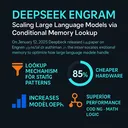
On January 12, 2026 DeepSeek released its paper on Engram, a novel AI architecture that incorporates conditional memory to optimize how large language models handle information. By utilizing a lookup mechanism for static patterns, this technology separates an AI's logical reasoning from its factual knowledge base. This structural shift allows massive models to run on cheaper hardware by offloading memory requirements to standard host RAM without sacrificing speed. Research indicates that this approach effectively increases model depth, freeing up the system's core processing power for more complex reasoning and long-context tasks. Ultimately, the Engram module enables superior performance across coding, math, and general logic compared to traditional architectures. This innovation suggests a future where AI is significantly more efficient and accessible through the strategic decoupling of memory and computation. Source: https://github.com/deepseek-ai/Engram/blob/main/Engram_paper.pdf
We review why some transformer models use a bias in attention and how ALiBi helps with long context. The provided sources focus on significant advancements in computational biology, specifically the evolution of the AlphaFold series for predicting 3D biomolecular structures. AlphaFold 2 revolutionized the field by using the Evoformer and attention mechanisms to interpret evolutionary and geometric data with near-experimental accuracy. Building on this, AlphaFold 3 expanded capabilities to include complexes with ligands and nucleic acids using an atom-level diffusion module. To further refine these models, HelixFold-S1 introduces a contact-guided sampling strategy that prioritizes likely binding sites to improve structural diversity and accuracy. Additionally, technical papers describe architectural components like ALiBi for handling long sequences and Swin Transformer's shifted windows. Together, these texts illustrate a shift toward more efficient, targeted sampling and integrated deep learning frameworks for complex molecular modeling.Sources:August 2021Swin Transformer: Hierarchical Vision Transformer using Shifted Windowshttps://arxiv.org/pdf/2103.14030April 2022 - (ALiBi)TRAIN SHORT, TEST LONG: ATTENTION WITH LINEARBIASES ENABLES INPUT LENGTH EXTRAPOLATIONhttps://arxiv.org/pdf/2108.12409April 2022:Swin Transformer V2: Scaling Up Capacity and Resolutionhttps://arxiv.org/pdf/2111.09883
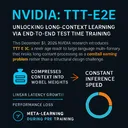
This December 31, 2025 NVIDIA research introduces TTT-E2E, a novel approach to large language model memory that treats long-context processing as a continual learning problem rather than a structural design challenge. By utilizing test-time training, the model effectively compresses context into its own weights through next-token prediction, allowing it to adapt and learn while processing new information. Unlike traditional Transformers that suffer from linear latency growth, or Recurrent Neural Networks that experience performance loss at scale, TTT-E2E maintains constant inference speed without sacrificing accuracy. The method employs meta-learning during the pre-training phase to optimize the model’s initialization for these rapid weight updates at test time. Experimental results demonstrate that TTT-E2E achieves a 35x speedup over full attention at extreme context lengths while matching its scaling efficiency. Ultimately, the authors propose this end-to-end formulation as a fundamental solution to the computational bottlenecks of processing massive datasets.Sources:https://arxiv.org/pdf/2512.23675https://developer.nvidia.com/blog/reimagining-llm-memory-using-context-as-training-data-unlocks-models-that-learn-at-test-time/
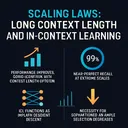
Recent advancements in Long Context Language Models (LCLMs) demonstrate that In-Context Learning (ICL) capabilities follow predictable power-law scaling relationships, where performance improves monotonically with context length up to 10 million tokens and is governed by model depth, width, and training data volume. While Gemini 1.5 exhibits near-perfect recall and continued log-loss improvement at extreme scales, theoretical frameworks reveal that ICL functions mechanistically as implicit gradient descent, effectively performing low-rank weight updates to the model's MLP layers during inference. Furthermore, as context capacity expands, the necessity for sophisticated example selection strategies diminishes; simple random selection combined with data augmentation to fill the context window often yields optimal results, marking a shift from selection optimization to capacity utilization.Sources:1. Gemini Team, Google (2024) *Gemini 1.5: Unlocking multimodal understanding across millions of tokens of context* https://arxiv.org/pdf/2403.055302. Jinheon Baek, Sun Jae Lee, Prakhar Gupta, Geunseob (GS) Oh, Siddharth Dalmia, Prateek Kolhar (2024) *Revisiting In-Context Learning with Long Context Language Models* https://arxiv.org/pdf/2412.169263. Jiaheng Liu, Dawei Zhu, Zhiqi Bai, Yancheng He, et al. (2025) *A Comprehensive Survey on Long Context Language Modeling* https://arxiv.org/pdf/2503.174074. Benoit Dherin, Michael Munn, Hanna Mazzawi, Michael Wunder, Javier Gonzalvo (2025) *Learning without training: The implicit dynamics of in-context learning* https://arxiv.org/pdf/2507.160035. Sushant Mehta, Ishan Gupta (2025) *Scaling Laws and In-Context Learning: A Unified Theoretical Framework* https://arxiv.org/pdf/2511.06232
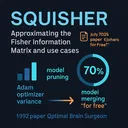
We focus on the July 2025 paper, "Fishers for Free? Approximating the Fisher Information Matrix by Recycling the Squared Gradient Accumulator". The paper goes into the mathematical details of approximating the FIM, and the easiest is what they call the Squisher: the Adam optimizer variance. This technique allows for tasks like model pruning and model merging to be performed "for free" without the significant computational overhead typically required to calculate the Fisher Information Matrix. We also review the old 1992 paper "Second order derivatives for network pruning: Optimal Brain Surgeon" in terms of what was missing in light of the Squisher paper.Sources:https://arxiv.org/pdf/2507.18807https://proceedings.neurips.cc/paper/1992/file/303ed4c69846ab36c2904d3ba8573050-Paper.pdf
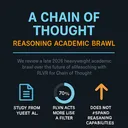
We review a late 2025 heavyweight academic brawl over the future of AI reasoning when folks use Reinforcement Learning with Verifiable Rewards (RLVR) for Chain of Thought (CoT). We have two papers on the table, and they are in complete, direct conflict. In one corner, we have a study by Yue et al. from Tsinghua University, which dropped a bombshell claim: they argue that Reinforcement Learning with Verifiable Rewards (RLVR)—the technique behind major models like DeepSeek-R1—does not actually make models smarter. According to their research, RLVR acts more like a filter than a teacher; it improves the model's efficiency at finding correct answers it already knew how to find, but it fails to expand the model's reasoning capabilities. In fact, they claim that as training progresses, the model's reasoning boundary actually narrows. But in the other corner, we have a rebuttal from Wen et al. at Microsoft Research, who came out swinging. They explicitly cite Yue’s paper, labeling the Tsinghua team’s hypothesis as "adventurous" and challenging their methodology. Wen et al. argue that Yue’s team missed the forest for the trees by relying on the wrong metric. They claim that because models can sometimes guess the right answer with the wrong math, the standard evaluation (Pass@K) is unreliable. By introducing a new metric that checks the steps of reasoning (CoT-Pass@K), Wen et al. insist that RLVR does fundamentally extend the boundary of intelligence and that the skeptics were looking at the data all wrong. It is a classic scientific standoff: one side says the technology is an efficiency hack; the other says it's a fundamental leap forward.Sources:Paper 1November 25, 2025Yang Yue, Zhiqi Chen, Rui Lu, Andrew Zhao, Zhaokai Wang, Yang Yue, Shiji Song, Gao HuangDoes Reinforcement Learning Really Incentivize Reasoning Capacity in LLMs Beyond the Base Model?https://arxiv.org/pdf/2504.13837Paper 2June 2025Xumeng Wen, Zihan Liu, Shun Zheng, Shengyu Ye, Zhirong Wu, Yang Wang, Zhijian Xu, Xiao Liang, Junjie Li, Ziming Miao, Jiang Bian, Mao YangREINFORCEMENT LEARNING WITH VERIFIABLE REWARDS IMPLICITLY INCENTIVIZES CORRECT REASONING IN BASE LLMShttps://arxiv.org/pdf/2506.14245
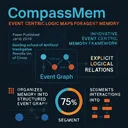
The collaboration between Gaoling School of Artificial Intelligence, Renmin University of China published a paper in January 8, 2026 titled "Memory Matters More: Event-Centric Memory as a Logic Map for Agent Searching and Reasoning" which introduces CompassMem, an innovative event-centric memory framework designed to enhance how large language model agents process and retrieve information. Unlike traditional systems that store experiences as flat, independent text snippets, this framework organizes memory into a structured Event Graph inspired by human cognitive theories. By segmenting interactions into discrete events and establishing explicit logical relations—such as causality and temporal order—the system creates a navigable logic map. During inference, autonomous agents use a multi-agent search strategy involving Planners and Explorers to actively navigate this graph rather than relying on simple semantic similarity. This approach significantly improves performance on long-horizon reasoning tasks, as demonstrated by superior results on benchmarks like LoCoMo and NarrativeQA. Ultimately, CompassMem transforms memory from a passive storage repository into an active, structured guide for complex decision-making. Source: January 8, 2026 Memory Matters More: Event-Centric Memory as a Logic Map for Agent Searching and Reasoning https://arxiv.org/pdf/2601.04726
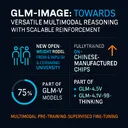
We review the January 1, 2026 paper "GLM-4.5V and GLM-4.1V-Thinking: Towards Versatile Multimodal Reasoning with Scalable Reinforcement Learning" from the GLM-V Team as a collaboration between Zhipu AI & Tsinghua University which have released an a new open weight model. The GLM-Image model they produce could likely be the first SOTA multimodal model fully trained on Chinese-manufactured hardware (Huawei Ascend) chips, the Ascend Atlas 800T A2 hardware, on MindSpore, an open-source AI framework developed by Huawei. We review the GLM-4V family of vision-language models, specifically highlighting the GLM-4.5V and the reasoning-focused GLM-4.1V-9B-Thinking versions. These models utilize a sophisticated training pipeline that integrates multimodal pre-training, supervised fine-tuning for long-chain-of-thought reasoning, and large-scale reinforcement learning. A significant innovation is the use of 3D-RoPE and dynamic image resolution handling, allowing the models to process high-definition visual data and complex spatial relationships efficiently. The research emphasizes a multi-domain reinforcement learning approach where training in one area, such as GUI navigation or STEM, improves performance across unrelated tasks. Benchmarks demonstrate that these open-source models achieve state-of-the-art results, often rivaling or exceeding larger closed-source systems in visual reasoning and document understanding. Ultimately, the documentation serves as a technical overview of how reinforcement learning with verifiable rewards can stabilize and enhance multimodal intelligence.
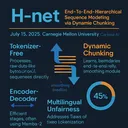
On this July 15, 2025 collaboration between Carnegie Mellon University and Cartesia AI researchers introduce H-net in the paper "Dynamic Chunking for End-to-End Hierarchical Sequence Modeling". H-Net is a hierarchical, tokenizer-free large language model that processes raw data like bytes or DNA sequences directly. Unlike traditional models that rely on predefined subword chunks, H-Net employs a dynamic chunking (DC) mechanism to learn semantically meaningful boundaries end-to-end through a differentiable smoothing module. The architecture uses efficient encoder-decoder stages, often powered by Mamba-2, to compress sequences for a high-capacity main network. This design addresses the inherent flaws of fixed tokenization, such as multilingual unfairness and fragility to textual perturbations. Experimental results demonstrate that H-Net achieves competitive performance and superior robustness compared to standard subword-based Transformers. By enabling recursive hierarchy, the model scales effectively across diverse modalities including text, code, and genomic data. H-Net excels at long-context processing through it's hierarchical architecture that progressively compresses raw inputs into significantly shorter sequences ($L_S \ll L_0$), allowing the heavy computational work to be performed on compact, high-level abstractions rather than long streams of raw bytes. This efficiency is driven by Dynamic Chunking and the integration of State Space Models (Mamba-2) in the encoder and decoder layers, which are specifically selected for their ability to handle long, uncompressed sequences with linear computation scaling,. By recursively compressing sequence length, H-Net creates a global structure that mitigates the information retrieval limitations common in long sequences, allowing the model to maintain a logarithmic state size while reasoning over extended contexts.Sources:July 15, 2025Dynamic Chunking for End-to-End Hierarchical Sequence Modelinghttps://arxiv.org/pdf/2507.07955Project tracking general advancements in this space:https://github.com/zjysteven/Awesome-Byte-LLM
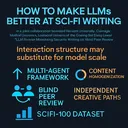
In a joint collaboration between Harvard University, Carnegie Mellon University, Stanford University the January 12, 2026 paper "LLM Review: Enhancing Creative Writing via Blind Peer Review Feedback" concludes: Interaction structure may substitute for model scale. Researchers at these institutions have collaborated to developed a new multi-agent framework called LLM Review to address the tendency of AI models to produce repetitive or unoriginal creative content. Unlike traditional collaborative systems that can lead to content homogenization, this method utilizes a blind peer review process where agents exchange critiques while maintaining their own independent creative paths. To test this approach, the authors introduced SciFi-100, a specialized dataset designed to measure the quality and originality of science fiction writing. The study concludes that this structured interaction allows smaller AI models to achieve better results than much larger single models. Ultimately, the paper suggests that the way AI agents organize their feedback is more important for fostering creative diversity than simply increasing the size of the model. Source: https://arxiv.org/pdf/2601.08003
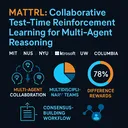
The collaboration between MIT, NUS, NYU, Microsoft, UW , Columbia and NTU describes an inference retrieval Chain of Thought enhancement. The researchers introduce MATTRL, a framework designed to improve the reasoning of Large Language Models (LLMs) through multi-agent collaboration and reinforcement learning. This system organizes specialized AI agents into Multidisciplinary Teams (MDT) to tackle complex tasks in fields like rare disease diagnosis and educational pedagogy. The process utilizes a structured consensus-building workflow where specialists contribute individual updates that are synthesized into a shared report. To refine performance, the system employs credit assignment methods, specifically the Difference Rewards approach, to identify and reuse high-quality strategies from successful interactions. By extracting these reusable experiences, the framework provides dense guidance that helps agents anchor on key evidence and maintain honest uncertainty. Ultimately, the research demonstrates how collaborative intelligence and targeted feedback can significantly enhance the precision of AI in specialized domains. If you're not familiar with Test Time Reinforcement Learning, you can review our old episode which covered it: https://open.spotify.com/episode/1rgQtzHZ3SFjDNpxghSjKd?si=zY9jThrYTgSlW0sjdVPLSg Source: January 15, 2026 https://arxiv.org/pdf/2601.09667
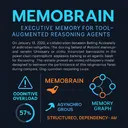
On January 12, 2026, a collaboration between the Beijing Academy of Artificial Intelligence, the Gaoling School of Artificial Intelligence, and Renmin University of China introduced MemoBrain. In the paper titled “MemoBrain: Executive Memory as an Agentic Brain for Reasoning,” the authors present an executive memory model designed to enhance the performance of tool-augmented AI agents during complex, long-duration reasoning tasks. Standard large language models often struggle with cognitive overload as reasoning traces and tool data accumulate, leading to a loss of focus and logical continuity. To solve this, MemoBrain acts as an asynchronous co-pilot that organizes reasoning steps into a structured, dependency-aware memory graph. This system utilizes active management techniques like sequential folding to summarize completed sub-tasks and selective flushing to remove low-utility information. By maintaining a compact and high-salience reasoning backbone, the model ensures the agent remains task-aligned even under a strict context budget. Empirical evaluations across benchmarks like GAIA and WebWalker prove that this framework significantly improves reasoning accuracy and efficiency across various model scales. Source: January 12, 2026 MemoBrain: Executive Memory as an Agentic Brain for Reasoning https://arxiv.org/pdf/2601.08079
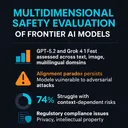
This January 17, 2026 research collaboration between Fudan University, Shanghai Innovation institute, Deakin University and UIUC provide a report which provides a comprehensive safety evaluation of several frontier AI models, including GPT-5.2 and Grok 4.1 Fast, across text, image, and multilingual domains. The study reveals a persistent alignment paradox where a model's desire to be helpful often overrides its safety guardrails, making it susceptible to adversarial attacks like role-playing or code-based obfuscation. While models generally block explicit toxicity, they frequently struggle with context-dependent risks and complex regulatory compliance issues involving privacy, intellectual property, and biometric laws. The findings highlight that current defenses are particularly brittle against adaptive, multi-turn attacks and subtle visual harms that require deep reasoning rather than simple keyword matching. Ultimately, the report emphasizes that robustness remains an unsolved challenge, as sophisticated narrative framing can still decouple model actions from ethical principles. Source: January 16, 2026 A Safety Report on GPT-5.2, Gemini 3 Pro, Qwen3-VL, Grok 4.1 Fast, Nano Banana Pro, and Seedream 4.5 https://arxiv.org/pdf/2601.10527
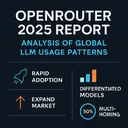
We review two research papers, one from January 15, 2026 by OpenRouter Inc and a16z (Andreessen Horowitz) and another from April 2025 by Andrey Fradkin (Boston University and MIT IDE) which provide uses of OpenRouter, they analyze the evolving market dynamics and user behaviors within the Large Language Model (LLM) ecosystem, primarily using data from the OpenRouter marketplace. The studies document that new AI models see rapid adoption upon release, with demand patterns suggesting that models are horizontally and vertically differentiated rather than being simple commodities. Researchers found that while some releases expand the overall market, others primarily trigger substitution within specific model families. Furthermore, the data reveals significant multi-homing, where a single application utilizes a diverse mix of models to meet different functional needs. Later analysis introduces the "Cinderella Glass Slipper" framework, suggesting that models achieve long-term defensibility by perfectly fitting high-value, previously unsolved workloads. This research also tracks the rising integration of tool-calling and reasoning-based architectures, emphasizing that user retention is becoming the primary metric of success in a competitive landscape.Sources:January 15, 2026State of AI:An Empirical 100 Trillion Token Study with OpenRouterOpenRouter Inc and a16z (Andreessen Horowitz)https://arxiv.org/pdf/2601.10088April 2025: Demand for LLMs: Descriptive Evidence onSubstitution, Market Expansion, and Multi-HomingAndrey Fradkinhttps://arxiv.org/pdf/2504.15440
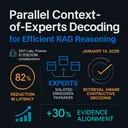
The collaboration between SAP Labs, France and EURECOM, France published a paper on January 13, 2026 titord "Parallel Context-of-Experts Decoding for Retrieval Augmented Generation". The paper introduces Parallel Context-of-Experts Decoding (PCED), a training-free framework designed to optimize Retrieval Augmented Generation (RAG) by overcoming the latency and reasoning limitations of long-context prompts. Rather than concatenating numerous documents into one massive input, PCED encodes each retrieved text independently as an isolated "expert" and synchronizes their predictions during the decoding stage. This method employs a retrieval-aware contrastive decoding rule that weights expert suggestions against a model prior using actual relevance scores. By shifting evidence aggregation from the attention mechanism to the decoding process, the system recovers cross-document reasoning capabilities without the computational burden of a shared attention context. Consequently, PCED achieves a significant speedup in time-to-first-token while maintaining or exceeding the accuracy of traditional long-context models. This approach proves especially robust against irrelevant distractors, as it isolates evidence and suppresses noise through dynamic expert selection at every generated token. Source: January 13, 2026 https://arxiv.org/pdf/2601.08670
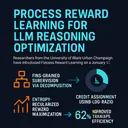
Researchers from the University of Illinois Urbana-Champaign have introduced Process Reward Learning (PRL) on a January 15, 2026 paper. PRL is a novel training framework designed to enhance the reasoning capabilities of Large Language Models. Unlike traditional reinforcement learning that relies on sparse outcome-based rewards, PRL provides dense, fine-grained supervision by decomposing global objectives into intermediate steps. This approach uses the log-ratio between the current policy and a reference model to assign credit to each reasoning step, mathematically ensuring equivalence to entropy-regularized reward maximization. By eliminating the need for computationally expensive methods like Monte Carlo Tree Search, PRL significantly improves training efficiency. Empirical results on benchmarks such as MATH500 and Olympiad Bench demonstrate that PRL consistently outperforms existing methods like GRPO. Ultimately, this framework not only boosts average accuracy but also broadens the reasoning boundary, allowing models to solve more complex logical and mathematical problems.Sources:January 15, 2026https://arxiv.org/pdf/2601.10201
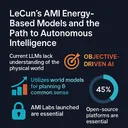
These sources collectively explore the current landscape and future trajectory of artificial intelligence, specifically focusing on the transition toward human-level reasoning. Renowned scientist Yann LeCun argues that current Large Language Models lack a fundamental understanding of the physical world and proposes a shift toward objective-driven AI that utilizes world models for better planning and common sense. This technological shift is supported by recent industry developments, such as the launch of AMI Labs, a high-valuation startup dedicated to these advanced architectures. Additionally, the materials emphasize the necessity of open-source platforms to ensure that the future of digital assistance remains transparent and culturally diverse. While addressing technical limitations, the documents maintain an optimistic view of super-human intelligence as a tool that will eventually amplify human potential under safe guardrail objectives. Practical elements like LinkedIn's authentication processes and TechCrunch's venture coverage further illustrate the integration of these technologies into the modern professional ecosystem.Sources:https://arxiv.org/pdf/2306.02572https://cmsa.fas.harvard.edu/media/lecun-20240328-harvard_reduced.pdfhttps://www.lesswrong.com/posts/C5guLAx7ieQoowv3d/lecun-s-a-path-towards-autonomous-machine-intelligence-has-1https://www.linkedin.com/mwlite/feed/posts/warrenbpowell_my-response-to-dimitri-bertsekass-thoughtful-activity-7394449098789261312-nXH3https://techcrunch.com/2025/12/19/yann-lecun-confirms-his-new-world-model-startup-reportedly-seeks-5b-valuation/

On November, 2021 Meta (back then Facebook) in collaboration with George Mason University and University of Illinois Chicago published their paper "Supporting Massive DLRM inference through software defined memory". Meta addressed the infrastructure challenge of serving massive Deep Learning Recommendation Models by extending the memory hierarchy to include NVMe Storage Class Memory. Because standard storage devices read large data blocks that exceed the small size of embedding rows the company faced significant read amplification and bandwidth waste. To resolve this the engineering team implemented a solution using the NVMe SGL Bit Bucket feature within a software defined memory stack. This modification to the Linux kernel and drivers allows applications to perform direct input output requests for specific data chunks down to four bytes rather than transferring full logical blocks. The implementation of bit buckets enables the system to transfer only the requested portion of a data block which significantly optimizes link bandwidth and reduces memory utilization. This granular approach saves approximately 75 percent of bus bandwidth and lowers individual read latency by 3 to 5 percent by removing unnecessary data transfer and memory copies. When applied to production environments this architecture allows data centers to replace expensive DRAM with efficient flash storage for specific model components. These optimizations result in up to 20 percent power savings on simpler hardware and a projected 29 percent increase in performance per watt for multi tenant serving scenarios.Sources:https://arxiv.org/pdf/2110.11489https://lore.kernel.org/linux-nvme/20220630204212.1265638-1-kbusch@fb.com/

We review the "Storage-Next" paper, published in November 2025, which argues that a fundamental hardware architectural shift is required to elevate NAND flash from a passive storage tier to an active memory tier capable of "seconds-scale" caching. The authors contend that standard SSDs impose a "channel-side ceiling" on IOPS because they are optimized for 4KB blocks, creating massive bandwidth waste when AI applications demand fine-grained access to small items, such as 128-byte embedding vectors. To solve this, they propose specialized "Storage-Next" drives capable of scalable IOPS for small block sizes (e.g., 50M IOPS at 512B), arguing this hardware is necessary to simplify software stacks and enable high-throughput random access without the read amplification penalties inherent in current technology. However, the episode explores how concurrent research largely rebuts the strict need for this new hardware by demonstrating that intelligent software and driver modifications can mask these inefficiencies on standard drives. Systems like PageANN and FusionANNS prove that aggregating topologically related vectors into 4KB pages allows existing SSDs to handle billion-scale search efficiently, while Strata utilizes GPU-assisted I/O to bundle fragmented LLM token pages. Furthermore, for workloads specifically requiring fine-grained access like DLRM, Meta researchers successfully implemented a "software-defined memory" solution using the NVMe SGL Bit Bucket feature to strip unwanted data at the driver level, reducing PCIe bandwidth consumption by 75% on standard hardware. These innovations suggest that aside from the specific niche of random hash-based lookups where locality is mathematically impossible, software optimization remains a viable alternative to a physical overhaul of storage media. We've previously covered some of the papers here individually: Meta's massive DLRM Linux NVMe SGL bit bucket solution: https://open.spotify.com/episode/7fPOvegGpWWYqChIVYGfwx?si=uxNPv4hZQvumhwwPGowwTA&context=spotify%3Ashow%3A48ygM4upvm6noxCbmhlz8i PageANNS: https://open.spotify.com/episode/5rrXWA4KJxGHp4xckirlZ2?si=_Qhzy_g1SZyPrBFmHvlY5g FusionsANNS: https://open.spotify.com/episode/6Ys51jB54GilRlYsvz4yXR?si=yI8KwDE1QpS6BbnFsinl6g Strata: https://open.spotify.com/episode/18kCgDcrOsQ5nw58V2HGBB?si=4Rr4ZfqIR-SzaVxyS8hOWASources:November 2025, From Minutes to Seconds: Redefining the Five-Minute Rule for AI-Era Memory Hierarchies, ScaleFlux and NVIDIA and Stanford University https://arxiv.org/pdf/2511.03944September 2025, Scalable Disk-Based Approximate Nearest Neighbor Search with Page-Aligned Graph, University of Texas at Dallas and Rutgers University https://arxiv.org/pdf/2509.25487August 2025, Strata: Hierarchical Context Caching for Long Context Language Model Serving, Stanford University and NVIDIAhttps://arxiv.org/pdf/2508.18572September 2024, FusionANNS: An Efficient CPU/GPU Cooperative Processing Architecture for Billion-scale Approximate Nearest Neighbor Search, Huazhong University of Science and Technology and Huawei Technologieshttps://arxiv.org/pdf/2409.16576October 2021, Supporting Massive DLRM Inference Through Software Defined Memory, Facebook https://arxiv.org/pdf/2110.11489
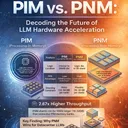
To address the hardware bottlenecks of LLM inference, Google researchers Ma and Patterson propos in their paper "Challenges and Research Directions for Large Language Model Inference Hardware" published on January 8, 2026 a few focus areas of research: High Bandwidth Flash (HBF), Processing-Near-Memory (PNM), and low-latency interconnects. HBF addresses the "Memory Wall" by stacking flash dies to achieve 10X the capacity of HBM, making it ideal for storing model weights and long contexts despite its write endurance limitations. PNM is advocated over Processing-In-Memory (PIM) for datacenters because placing logic on separate but nearby dies (e.g., 3D stacking) allows for larger software shards (avoiding fine-grained partitioning), utilizes standard high-performance logic processes, and offers better thermal management than integrating logic directly into memory dies. Finally, arguing that latency trumps bandwidth for the frequent small messages in inference, the authors suggest optimizing interconnects through high-connectivity topologies (like dragonfly or trees) and processing-in-network to accelerate communication collectives. Modern large language model (LLM) inference faces a critical memory wall, where hardware compute power outpaces the growth of data transfer speeds. Research suggests addressing these bottlenecks through 3D memory-logic stacking, near-memory processing, and specialized interconnect strategies to reduce latency. Optimization techniques for Mixture-of-Experts (MoE) architectures involve balancing tensor and expert parallelism across devices to ensure efficient data handling. While high-bandwidth memory remains expensive, alternative storage solutions like flash memory are being explored to expand capacity for data centers. Historical data further illustrates the evolving cost and density of memory, underscoring the long-term economic shifts in hardware development. Together, these sources outline a roadmap for evolving AI hardware to meet the rigorous demands of real-time model decoding. Source: January 8, 2026 Challenges and Research Directions for Large Language Model Inference Hardware Google https://arxiv.org/pdf/2601.05047
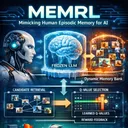
The January 6, 2026 paper introduces MEMRL, a framework designed to help AI agents master new skills by mimicking human episodic memory without needing to update the model's underlying weights. This approach addresses the stability-plasticity dilemma by decoupling a stable, frozen Large Language Model (the reasoning core) from a dynamic, evolving memory bank. Unlike standard retrieval methods that rely solely on semantic similarity, MEMRL uses non-parametric reinforcement learning to evaluate the actual utility of past experiences. It employs a two-phase retrieval mechanism that first identifies relevant candidates and then selects the most effective ones based on learned Q-values. These values are continuously refined through environmental feedback, allowing the agent to distinguish high-value strategies from distracting noise. Experiments across various benchmarks show that MEMRL significantly improves performance and supports stable runtime learning while avoiding the computational costs and forgetting associated with fine-tuning. Source: https://arxiv.org/pdf/2601.03192

This January 18, 2026 massive collaboration between University of Illinois Urbana-Champaign, Meta, Amazon, Google Deepmind, UCSD and Yale explores the evolution of agentic reasoning in large language models, moving beyond static text generation toward dynamic planning and external interaction. It details how models utilize tool integration and multi-agent systems to solve complex problems in fields like software engineering, scientific discovery, and robotics. The text categorizes specialized roles within these systems—such as leaders, executors, and critics—to facilitate sophisticated collaboration and feedback-driven behaviors. Furthermore, it examines various post-training methods and architectural frameworks designed to optimize how agents communicate and manage long-term memory. Finally, the sources provide a comprehensive overview of benchmarks used to evaluate these autonomous systems across diverse, real-world applications. Source: January 18, 2026 Agentic Reasoning for Large Language Models https://arxiv.org/pdf/2601.12538
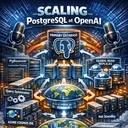
OpenAI manages a massive PostgreSQL infrastructure to support hundreds of millions of users by utilizing a single-primary architecture with dozens of global read replicas. To maintain stability under extreme traffic, the engineering team implemented rigorous query optimizations, connection pooling through PgBouncer, and aggressive caching strategies. They mitigate the limitations of a single writer by migrating write-heavy workloads to sharded systems like Azure Cosmos DB and enforcing strict rate limits. High availability is ensured through regional workload isolation and the use of hot standbys to prevent total service outages. This technical evolution allows the platform to process millions of queries per second while maintaining low latency and high reliability. Future scaling plans include testing cascading replication to expand their global database footprint even further. Source: https://openai.com/index/scaling-postgresql/

On January 14, 2026 Sequoia Capital published a piece assertion that Artificial General Intelligence has arrived ahead of schedule, redefined as the functional ability for AI to "figure things out" autonomously. The authors highlight the transition from simple conversational models to long-horizon agents that can persist through complex, multi-step tasks without constant human guidance. By leveraging reasoning capabilities and iterative problem-solving, these agents are now performing specialized work in fields like coding, recruiting, and law. The source predicts an exponential growth in agent performance, suggesting that AI will soon manage workloads that would take human experts years to complete. Consequently, founders are encouraged to pivot from building chatbots to developing autonomous colleagues that sell completed outcomes rather than just software. This shift marks a new era where AI moves from being a passive tool to a proactive doer capable of navigating real-world ambiguity. Source: https://sequoiacap.com/article/2026-this-is-agi/
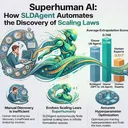
The paper, titled "Can Language Models Discover Scaling Laws?" and published on January 22, 2026, represents a collaborative effort by researchers from Peking University, Stanford University, Wizard Quant, and Tsinghua University. he authors address the inefficiency of manual scaling law discovery by introducing SLDAgent, an evolution-based system designed to automate the search for predictive symbolic formulas. They prove that this agent consistently discovers laws with superior extrapolation accuracy compared to human experts and existing baselines across the newly curated SLDBench, a testbed aggregating over 5,000 training experiments. Additionally, the study demonstrates the practical superiority of these autonomously discovered laws in critical tasks such as analytical hyperparameter optimization and pre-trained model selection. Source: https://arxiv.org/pdf/2507.21184

The January 27, 2026 ByteDance paper "Post-LayerNorm Is Back: Stable, ExpressivE, and Deep" introduces th Keel architecture which addresses the optimization instability of deep Transformers by reviving the Post-LayerNorm formulation, which theoretically offers better expressivity than the standard Pre-LayerNorm but historically fails to train at scale due to gradient vanishing. By replacing the standard ResNet-style residual pathway with a Highway-style connection and injecting an additional normalization step into the residual branch, Keel preserves gradient magnitude and enables stable training at depths exceeding 1,000 layers without requiring complex initialization. Empirical evaluations show that Keel tolerates significantly higher learning rates and outperforms Pre-LayerNorm baselines in reasoning and coding tasks, proving that depth scaling remains a viable path for improving model performance. The Keel paper argues that extending context length is limited to expanding information access rather than improving "fundamental expressivity," asserting that while longer contexts allow models to process more data, they do not inherently unlock the capacity for complex hierarchical reasoning. Whereas Gemini 1.5 demonstrates that long context drives In-Context Learning (ICL) and reduces predictive uncertainty (NLL) via retrieval-heavy tasks like learning a language from a manual, Keel contends that this does not equate to the "qualitatively new behaviors" unlocked by depth scaling. Consequently, Keel frames depth as the superior, albeit historically unstable, axis for improving model reasoning (particularly in math and code), contrasting the "diminishing returns" and high cost of context scaling against the robust expressivity gains achieved by stabilizing deeper networks.Sources:Keel:https://arxiv.org/pdf/2601.19895The Gemini 1.5 paper with its power law:https://arxiv.org/pdf/2403.05530

There is a sharp divergence regarding the utility of long context. Google's Gemini 1.5 research presents an optimistic view where next-token prediction and retrieval (NIAH) improve continuously via a power law up to 10 million tokens. Broader research counters that while *retrieval* scales, utilitarian value (downstream task performance like reasoning or summarization) saturates rapidly or degrades due to "lost-in-the-middle" effects and data scarcity. There is no conclusive position on the empirical utility of long context for complex reasoning; the community must move beyond simple retrieval benchmarks to determine if the immense cost of processing millions of tokens yields proportional functional gains.Sources:1. Gemini 1.5: Unlocking multimodal understanding across millions of tokens of contextDate: March 2024Institutions: Google DeepMindURL:https://arxiv.org/pdf/2403.055302. How to Train Long-Context Language Models (Effectively) [ProLong]Date: 2025Institutions: Princeton UniversityURL: https://aclanthology.org/2025.acl-long.366.pdf3. L2M: Mutual Information Scaling Law for Long-Context Language ModelingDate:** 2025 (NeurIPS)Institutions: MIT, Polytechnic University of Catalonia, Harvard University, UCLAURL:https://arxiv.org/pdf/2503.047254. Predicting Task Performance with Context-aware Scaling LawsDate: October 2025Institutions: UC Santa Cruz, Washington University in St. Louis, Databricks, Google DeepMind, UC BerkeleyURL:https://arxiv.org/pdf/2510.149195. Explaining Context Length Scaling and Bounds for Language ModelsDate:.February 2025Institutions:Tsinghua University, CPHOS Research, Carnegie Mellon University, University of Washington, University of CopenhagenURL:https://arxiv.org/pdf/2502.014816. Scaling Laws and In-Context Learning: A Unified Theoretical FrameworkDate: November 2025 (NeurIPS)URL: https://arxiv.org/pdf/2511.062327. Long-Context Efficient Transformers: A Comprehensive Survey of Techniques, Applications, and Future DirectionsDate: April 10, 2025Institutions: Tsinghua University, Peking University, USTC, Stanford University, UC BerkeleyURL:https://www.techrxiv.org/users/892385/articles/1283745-long-context-efficient-transformers-a-comprehensive-survey-of-techniques-applications-and-future-directions
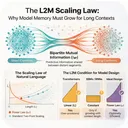
On the October 2025 in a joint collaboration between NSF AI Institute for Artificial Intelligence and Fundamental Interactions,Massachusetts Institute of Technology, Polytechnic University of Catalonia, Harvard University and University of California, Los Angeles researchers present a universal theoretical framework for understanding long-context language modeling based on a bipartite mutual information scaling law that is rigorously verified. This is in the paper "L2M: Mutual Information Scaling Law for Long-Context Language Modeling". This research paper investigates how large language models manage long-range dependencies by applying principles from information theory. The authors introduce the L2M framework, which establishes that a model's ability to process extensive context is strictly limited by the size of its history state. While transformers utilize a growing cache of data to maintain performance across long sequences, models with fixed-size states, such as SSMs and RNNs, face inherent capacity bottlenecks as input length increases. By utilizing bipartite mutual information as a metric, the study formalizes the theoretical requirements for an architecture to be considered MI-capable. Ultimately, this work provides a principled method for evaluating and designing efficient architectures that can sustain complex reasoning over thousands of tokens. Source: https://arxiv.org/pdf/2503.04725
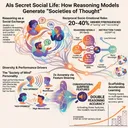
This January 15, 2026 joint collaboration between Google, Paradigms of Intelligence Team, University of Chicago, and Santa Fe Institute explores how advanced AI reasoning models like DeepSeek-R1 improve their performance by simulating a "society of thought" within their internal processing. Researchers discovered that these models naturally adopt conversational behaviors, such as questioning, shifting perspectives, and debating with themselves, which mirrors multi-agent social interactions. By using mechanistic interpretability to steer specific conversational features, the team demonstrated that these social simulations causally increase cognitive strategies like backtracking and verification. Furthermore, models specifically trained on multi-agent dialogues achieve higher accuracy faster than those using standard step-by-step reasoning. The study ultimately suggests that collective intelligence emerges internally through the competition and integration of diverse simulated personas. These findings indicate that the most effective machine reasoning is not a flat monologue, but a complex, socially structured dialogue. Source: https://arxiv.org/pdf/2601.10825