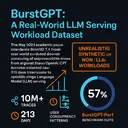
The May 2025 academic paper introduces BurstGPT, a novel, real-world workload dataset consisting of over ten million traces from regional Azure OpenAI GPT services collected over 213 days, which aims to optimize Large Language Model (LLM) serving systems. The authors argue that existing LLM serving optimizations are often evaluated using unrealistic synthetic or non-LLM workloads, leading to performance degradation in real-world deployments. BurstGPT provides empirical data on user concurrency patterns, conversation structures, model response lengths, and system failures to facilitate more accurate system evaluation and refinement of scheduling, caching, and resource provisioning strategies. The source presents BurstGPT-Perf, a benchmark suite using the dataset to demonstrate how realistic, bursty workloads reveal declines in efficiency, stability, and reliability in serving systems like vLLM. Ultimately, the work advocates for data-driven methodologies in optimizing LLM serving for better efficiency and quality of service. Source: https://arxiv.org/pdf/2401.17644
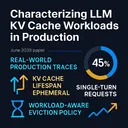
The June 2025 paper characterizes and optimizes the Key-Value Cache (KV$) workload patterns associated with serving large language models (LLMs) at a major cloud provider. Using real-world production traces from customer-facing (to-C) and business-facing (to-B) workloads, the authors analyze KV$ reuse behaviors, noting that reuses are significantly skewed, with single-turn requests being as important as multi-turn requests, especially in API-dominated workloads. Crucially, the analysis reveals that KV$ lifespan is ephemeral and that reuse probability follows predictable exponential distributions within specific request categories. Based on these findings, the researchers propose a workload-aware cache eviction policy that significantly improves the cache hit ratio and reduces the query time to first token compared to standard policies like LRU and LFU. Source: https://arxiv.org/pdf/2506.02634v1
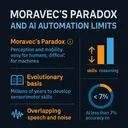
These two 2025 research papers collaboratively examine Moravec's Paradox, which posits that skills effortless for humans (like perception and mobility) are computationally difficult for machines, while complex reasoning tasks (like math or chess) are comparatively easy for AI. The Wikipedia entry introduces the paradox, explaining its evolutionary basis: skills acquired over millions of years are deeply encoded and hard to reverse-engineer, while abstract thought is evolutionarily recent and less efficient. A research paper further demonstrates this gap with an "auditory Turing test," where state-of-the-art AI models catastrophically fail (achieving less than 7% accuracy) on simple human listening tasks involving overlapping speech and noise, confirming the paradox in the auditory domain. Finally, an economics preprint incorporates the paradox into a model of economic growth, arguing that the high or infinite computational cost of automating physical, sensorimotor tasks means human labor in these bottleneck areas will persist, preventing the labor share of income from collapsing to zero as some AGI models predict.Sources:https://arxiv.org/pdf/2507.23091https://arxiv.org/pdf/2509.24466https://en.wikipedia.org/wiki/Moravec%27s_paradox
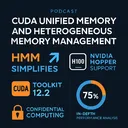
The provided sources offer a comprehensive look at memory management for GPU-accelerated computing, focusing heavily on Heterogeneous Memory Management (HMM) and NVIDIA Unified Virtual Memory (UVM). One source details the release of the CUDA Toolkit 12.2, highlighting new features like HMM support, NVIDIA Hopper (H100) GPU compatibility, and Confidential Computing for secure data environments. Another source focuses exclusively on HMM, explaining how this feature simplifies GPU programming by allowing direct access to system-allocated memory, thereby eliminating the need for explicit memory calls like `cudaMallocManaged`. The third source, a technical paper, performs an in-depth performance analysis of UVM, examining the overhead associated with transparent paging and migration, identifying key performance bottlenecks like Host OS interactions (e.g., page unmapping) and the efficiency of fault batching and prefetching mechanisms. Source: https://tallendev.github.io/assets/papers/sc21.pdf https://developer.nvidia.com/blog/nvidia-cuda-toolkit-12-2-unleashes-powerful-features-for-boosting-applications/ https://developer.nvidia.com/blog/simplifying-gpu-application-development-with-heterogeneous-memory-management/
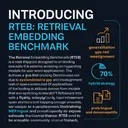
The text introduces the Retrieval Embedding Benchmark (RTEB), a new standard designed to accurately evaluate the retrieval accuracy of embedding models for real-world applications. The authors argue that existing benchmarks fail due to a generalization gap and misalignment with modern enterprise AI applications, often leading to inflated scores from models that are "teaching to the test." RTEB addresses this with a hybrid strategy using both transparent open datasets and impartial private datasets to measure true generalization. Emphasizing multilingual and domain-specific enterprise use cases like law and finance, RTEB aims to be a reliable, community-trusted standard, using NDCG@10 as its primary evaluation metric. Source: https://huggingface.co/blog/rteb
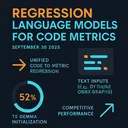
This September 30 2025 academic paper, introduces Regression Language Models (RLMs) as a unified method for code-to-metric regression, which is the task of predicting numerical outcomes from source code or computation graphs. This approach simplifies traditional methods by directly using text input—such as high-level programming languages like Haskell and Python or low-level ONNX graph representations—to predict metrics like accuracy, memory consumption, and execution latency. The RLM, initialized from a pretrained T5Gemma encoder, is shown to perform competitively against specialized models like Graph Neural Networks (GNNs) across various tasks, including predicting performance in Neural Architecture Search (NAS) and estimating memory usage in competitive programming. The findings highlight the RLM's versatility and ability to model multiple objectives concurrently, suggesting a shift toward generic, text-based regression in computational graph analysis. Source: https://arxiv.org/pdf/2509.26476
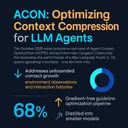
The October 2025 papar provide an overview of Agent Context Optimization (ACON), a novel framework designed to enhance the efficiency and performance of Large Language Model (LLM) agents operating in complex, long-horizon tasks. ACON addresses the challenge of unbounded context growth—which increases costs and reduces effectiveness—by optimally compressing both environment observations and interaction histories into concise summaries. The framework uses a gradient-free guideline optimization pipeline where a capable LLM analyzes compression failures from contrastive trajectories to refine the compression instructions in natural language. Furthermore, the optimized compressor can be distilled into smaller models to reduce computational overhead, with empirical results demonstrating significant reductions in peak tokens and memory usage while preserving or even improving task accuracy across multiple benchmarks. Source: https://arxiv.org/pdf/2510.00615
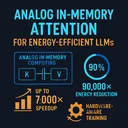
Thus November 2024 paper and new analysis in September 2025 provide a comprehensive overview of a novel Analog In-Memory Computing (AIMC) architecture designed to accelerate the attention mechanism in Large Language Models (LLMs). The core technology involves using capacitor-based gain cells (made from emerging OSFETs like IGZO) to store the Key (K) and Value (V) projections of the KV cache directly within the memory arrays, enabling parallel, analog dot-product computation that drastically reduces the latency and energy consumed by data movement in traditional GPUs. Simulations indicate performance improvements of up to 7,000× speedup and 90,000× energy reduction compared to NVIDIA A100 GPUs for the attention step alone, and the research introduces a hardware-aware training methodology to maintain accuracy despite analog non-idealities and the use of a simplified ReLU-based activation function instead of softmax. The text also notes that while major chipmakers are engaged in tangential AIMC research, this specific attention mechanism design is currently a prototype from academic institutions and faces a multi-year timeline for commercial readiness and scaling to trillion-parameter models.Sources:https://arxiv.org/pdf/2409.19315https://www.nextbigfuture.com/2025/09/analog-in-memory-computing-attention-mechanism-for-fast-and-energy-efficient-large-language-models.html

The October 2025 paper introduces CoDA (Collaborative Data-visualization Agents), a novel multi-agent system designed to automate complex data visualization from natural language queries, addressing the limitations of existing rule-based and single Large Language Model (LLM) approaches. The core innovation of CoDA is its collaborative paradigm, where specialized LLM agents—focused on tasks like query analysis, data processing, design mapping, and self-reflection—work together through an iterative refinement loop to enhance output quality and robustness. Experimental results demonstrate that CoDA significantly outperforms state-of-the-art baselines (MatplotAgent, VisPath, CoML4VIS) on benchmarks like MatplotBench and Qwen Code Interpreter, achieving superior execution pass rates and visualization success rates, particularly when dealing with complex queries, multi-file data, and specific stylistic constraints. Ablation studies further validate the necessity of CoDA’s architectural components, such as the Global TODO List and the Search Agent, confirming that structured planning and external knowledge retrieval are crucial for overcoming ambiguity and ensuring high-fidelity code generation. The paper concludes that this agentic approach transforms visualization generation into a more resilient and adaptive problem-solving process, making it effective for real-world data science tasks. Source: https://arxiv.org/pdf/2510.03194
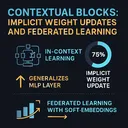
We compare and contrast the math behind two recent research papers which we have covered individually before on this podcast: July 2025: Learning without training: The implicit dynamics of in-context learning https://arxiv.org/pdf/2507.16003 September 2025: Federated Learning with Ad-hoc Adapter Insertions: The Case of Soft-Embeddings for Training Classifier-as-Retriever https://arxiv.org/pdf/2509.16508 The first source explores the concept of In-Context Learning (ICL) in neural networks, proposing that the effect of context on a token's output is equivalent to an implicit weight update in the neural network, specifically in the MLP layer, generalizing the transformer block using a contextual block notion. This work provides an explicit low-rank update formula for this implicit weight modification and mathematically demonstrates that token consumption aligns with an implicit gradient descent learning dynamics on the network weights. The second source introduces a novel retrieval-augmented generation (RAG) architecture called Classifier-as-Retriever (CaR) for memory-constrained edge devices, proposing to use a frozen Small Language Model (SLM) augmented with a small trainable adapter network to generate "soft embeddings" and a trainable classifier head instead of conventional similarity functions. Crucially, this architecture is designed for distributed training using Federated Learning (FL), incorporating Differential Privacy (DP) techniques to ensure client-side data protection and demonstrating significant speedup advantages over centralized training.
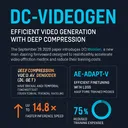
The September 29 2025 paper introduces DC-VideoGen, a new post-training framework designed to significantly accelerate video diffusion models and reduce their training costs. This system relies on two main innovations: the Deep Compression Video Autoencoder (DC-AE-V), which achieves high spatial and temporal compression using a novel chunk-causal temporal modeling approach to maintain reconstruction quality; and AE-Adapt-V, an efficient finetuning strategy using LoRA to adapt pre-trained models to the new latent space while preserving their original knowledge and semantics. Experimental results demonstrate that DC-VideoGen successfully accelerates inference speed by up to 14.8× for high-resolution videos and drastically reduces training expenses, all while maintaining or improving video generation quality across tasks like text-to-video and image-to-video generation. Source: https://arxiv.org/pdf/2509.25182
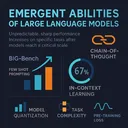
The sources (October 2022, March 2025) provide an extensive examination of emergent abilities in large language models (LLMs), defining them as unpredictable, sharp performance increases on specific tasks that occur only after models reach a critical scale. The initial source establishes this concept through empirical evidence on benchmarks like BIG-Bench, showing tasks where performance jumps suddenly from near-random, particularly in few-shot prompting and specialized prompting techniques like Chain-of-Thought. The subsequent survey source expands on this by framing emergence within the broader context of in-context learning, discussing how factors like model quantization, task complexity, and pre-training loss thresholds influence the appearance of these abilities. Both sources acknowledge the ongoing debate about whether these sudden leaps are genuine phenomena or merely artifacts of evaluation metrics that do not award partial credit, while also highlighting the emergence of harmful behaviors and advanced reasoning capabilities in LLM-powered AI agents as scale increases.Sources:https://arxiv.org/pdf/2206.07682https://arxiv.org/pdf/2503.05788
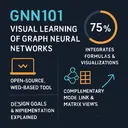
The November 2024 paper introduces GNN101, an open-source, web-based interactive visualization tool designed to help non-experts learn about Graph Neural Networks (GNNs), whose complex nature often challenges beginners. This educational tool addresses limitations in existing resources by seamlessly integrating mathematical formulas with visualizations across multiple abstraction levels, from a model overview to detailed matrix calculations. GNN101 features complementary views—a node-link diagram for intuitive graph understanding and a matrix view for a comprehensive feature overview—to illustrate how GNNs process graph data and update node features. The authors detail the design goals, implementation, and initial deployment of GNN101, showing its usability and effectiveness in making GNN computations more intuitive and engaging for students. Source: https://arxiv.org/html/2411.17849v1
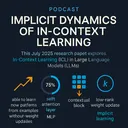
This July 2025 research paper explores In-Context Learning (ICL) in Large Language Models (LLMs), which is the striking ability of these models to learn new patterns from examples given in a prompt without explicit weight updates during inference. The authors hypothesize and demonstrate through theory and experimentation that the combination of a self-attention layer and a Multi-Layer Perceptron (MLP) within the transformer architecture allows the context to implicitly modify the MLP's weights. They generalize this concept with the notion of a contextual block and provide a formula showing that the effect of the context is equivalent to a low-rank weight update of the neural network's first layer. This implicit process, they argue, acts as a form of implicit learning dynamics similar to gradient descent, where tokens consumed sequentially drive the weight adjustments. The findings suggest that ICL is rooted in how regular neural networks can transfer input modifications to their weight structure, rather than solely being about the self-attention mechanism. Source: https://arxiv.org/pdf/2507.16003
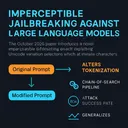
The October 2025 academic paper introduces a novel imperceptible jailbreaking attack against Large Language Models (LLMs) that exploits Unicode variation selectors, which are invisible characters. Unlike previous jailbreaking methods that rely on visible text modifications, this technique appends invisible variation selectors to malicious questions, visually preserving the original prompt while altering the LLM's tokenization to bypass safety alignment. The authors propose a chain-of-search pipeline to optimize these adversarial suffixes, achieving high attack success rates against four aligned LLMs and demonstrating generalization to prompt injection attacks. Through analysis of attention scores and embedding differences, the study confirms that the invisible suffixes successfully redirect the model's focus away from harmful content to produce unsafe outputs. Source: https://arxiv.org/pdf/2510.05025
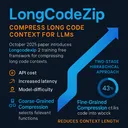
The October 2025 paper introduces LongCodeZip, a novel, training-free, and model-agnostic framework designed for compressing long code contexts to improve the efficiency and capability of Code Large Language Models (LLMs). The core problem addressed is that long code contexts lead to high API costs, increased latency, and model difficulty in identifying relevant information due to the structured nature of code. LongCodeZip utilizes a two-stage hierarchical approach: coarse-grained compression selects the most relevant functions based on conditional perplexity (approximated mutual information), followed by fine-grained compression that further prunes code within these functions into semantically coherent blocks using perplexity-based chunking and a knapsack optimization to maximize information density. Evaluations across code completion, summarization, and question answering tasks demonstrate that LongCodeZip achieves up to a 5.6x compression ratio while consistently outperforming existing compression and retrieval-augmented generation (RAG) baselines, even when utilizing a smaller compression model. Source: https://arxiv.org/pdf/2510.00446
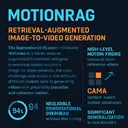
The September 2025 paper introduces MotionRAG, a novel retrieval-augmented framework designed to enhance motion realism in image-to-video generation. The central challenge addressed is the difficulty diffusion models face in generating videos with physically plausible and coherent motion. MotionRAG solves this by using a retrieval pipeline to adapt high-level motion priors from relevant reference videos through its core component, the Context-Aware Motion Adaptation (CAMA) module. This approach formulates motion transfer as an in-context learning problem, allowing the system to generalize to new domains with negligible computational overhead and without requiring fine-tuning of the base generation models. Experimental results demonstrate that MotionRAG significantly improves motion quality across various state-of-the-art models and datasets, including specialized domains, by effectively guiding video generation with real-world motion patterns. Source: https://arxiv.org/pdf/2509.26391
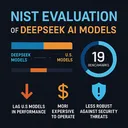
The provided text is an excerpt from a technical evaluation report conducted by the Center for AI Standards and Innovation (CAISI), housed within the National Institute of Standards and Technology (NIST), in September 2025. This report systematically compares three DeepSeek AI models against four U.S. reference models, including OpenAI’s GPT-5 and Anthropic’s Opus 4, across 19 benchmarks. The evaluation focuses on several critical areas, revealing that DeepSeek models generally lag U.S. models in performance, particularly in cyber and software engineering tasks, while also being more expensive to operate and significantly less robust against security threats like agent hijacking and jailbreaking attacks. Furthermore, the analysis determined that the DeepSeek models exhibit alignment with Chinese Communist Party (CCP) censorship narratives in both English and Chinese queries. The document also includes data on model adoption trends, noting the rapid increase in the use of certain PRC models like DeepSeek. Source: https://www.nist.gov/system/files/documents/2025/09/30/CAISI_Evaluation_of_DeepSeek_AI_Models.pdf
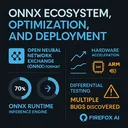
The provided sources center on the Open Neural Network Exchange (ONNX) format and its inference engine, ONNX Runtime, highlighting their role in enabling high-performance, cross-platform machine learning deployment. Several sources detail the architectural benefits of ONNX Runtime, such as enabling AI inference in Java systems without Python dependencies and facilitating hardware acceleration across various chips like NVIDIA GPUs and Arm processors. One critical source introduces OODTE, a differential testing tool used to assess the functional correctness of the ONNX Optimizer, revealing multiple bugs and accuracy deviations in optimized models. Finally, a practical example from Firefox AI demonstrates switching from the WebAssembly (WASM) version to the native C++ ONNX Runtime for a significant speed increase in local AI features.Sources:https://en.wikipedia.org/wiki/Open_Neural_Network_Exchangehttps://github.com/onnx/onnx/blob/main/docs/Overview.mdhttps://github.com/onnx/optimizerhttps://github.com/onnx/onnx/blob/main/docs/IR.mdhttps://blog.stackademic.com/onnx-open-neural-network-exchange-29f39a84c5f2https://developer.nvidia.com/blog/end-to-end-ai-for-pcs-onnx-runtime-and-optimization/https://developer.arm.com/ai/kleidi-librarieshttps://newsroom.arm.com/blog/arm-microsoft-kleidiai-onnx-runtimehttps://hackernoon.com/mobile-ai-with-onnx-runtime-how-to-build-real-time-noise-suppression-that-workshttps://blog.mozilla.org/en/firefox/firefox-ai/speeding-up-firefox-local-ai-runtime/https://www.infoq.com/articles/onnx-ai-inference-with-java/https://arxiv.org/pdf/2202.06929https://arxiv.org/html/2505.01892v1
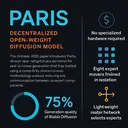
The October 2025 paper introduces Paris, a novel open-weight diffusion model for text-to-image generation that was trained using a completely decentralized methodology without requiring any communication between its expert components. This approach overcomes the need for expensive, specialized hardware clusters and synchronized gradient updates, which are typically required for training large-scale models like Stable Diffusion. The system functions by partitioning the training data into semantically distinct clusters, allowing eight expert models to train in isolation, with a separate, lightweight router network dynamically selecting the most appropriate expert(s) during inference. Empirical results demonstrate that Paris achieves competitive generation quality while using substantially fewer computational resources and training data compared to prior decentralized benchmarks, making large generative AI models more accessible on heterogeneous, fragmented compute infrastructure. Source: https://arxiv.org/pdf/2510.03434

The October 2025 academic paper introduces RECAP (Robust Safety Alignment via Counter-Aligned Prefilling), a novel reinforcement learning (RL) method designed to improve the safety and robustness of large reasoning models (LRMs). The core problem addressed is the brittleness of LRMs, which are easily biased by flawed chain-of-thought (CoT) reasoning injected into their thought process, leading to unsafe or overly cautious responses. RECAP addresses this by explicitly training models on a mixture of standard prompts and counter-aligned CoT prefills—forcing the model to override unsafe reasoning for harmful queries or overly conservative refusals for benign ones to achieve a high reward. Experimental results show that RECAP substantially enhances safety, reduces overrefusal, and preserves core reasoning capabilities, leading to more frequent self-reflection in the models and persistent robustness against adaptive adversarial attacks. The method integrates easily with existing RL-from-human-feedback (RLHF) frameworks without incurring additional training costs. Source: https://arxiv.org/pdf/2510.00938
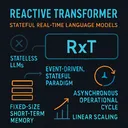
The October 2025 paper introduces the Reactive Transformer (RxT), a novel neural network architecture designed by Adam Filipek and Reactive AI to overcome the scaling and latency issues of current Large Language Models (LLMs) in long-form conversations. Unlike traditional stateless LLMs, which suffer from quadratic computational complexity by reprocessing the entire conversation history, RxT adopts an event-driven, stateful paradigm. The core innovation is an integrated, fixed-size Short-Term Memory (STM) system and an asynchronous operational cycle that decouples the fast response generation from the computationally intensive memory update, leading to linear scaling of total conversational cost. Experimental results on synthetic data demonstrate that RxT models, even smaller ones, significantly outperform comparable stateless LLMs in perplexity and conversational coherence while maintaining constant, low inference latency, validating the efficiency and design of the architecture and its four-stage training curriculum. Source: https://arxiv.org/pdf/2510.03561 https://rxai.dev
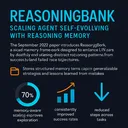
The September 2025 paper introduces ReasoningBank, a novel memory framework designed to enhance Large Language Model (LLM) agents by distilling and utilizing abstract reasoning patterns from both successful and failed task trajectories. Unlike previous approaches that focus only on raw interactions or successful workflows, ReasoningBank stores structured memory items—including titles, descriptions, and content—that capture generalizable strategies and lessons learned from mistakes. This framework is combined with Memory-Aware Test-Time Scaling (MaTTS), which uses memory to guide efficient exploration, creating a positive feedback loop where diverse experiences generate stronger memories, leading to consistently improved success rates and reduced steps across various complex agent tasks like web browsing and software engineering. Source: https://arxiv.org/pdf/2509.25140
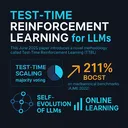
This June 2025 paper introduces a novel methodology called Test-Time Reinforcement Learning (TTRL), which enables Large Language Models (LLMs) to improve their performance on reasoning tasks using unlabeled test data. The core innovation addresses the challenge of reward estimation without ground-truth labels by employing Test-Time Scaling (TTS) practices, specifically majority voting, to generate effective pseudo-labels and rule-based rewards. TTRL facilitates the self-evolution of LLMs during inference, demonstrating substantial performance gains—up to a 211% boost on challenging mathematical benchmarks like AIME 2024—and even surpassing the performance ceiling of the initial majority voting signal. This unsupervised online learning approach is shown to be compatible with different reinforcement learning algorithms and effective across various models, suggesting a path toward continually learning AI systems less reliant on extensive human annotation. Source: https://arxiv.org/pdf/2504.16084

The October 7, 2025 joint collaboration between Stanford University, Texas A&M University, UC San Diego, & Lambda paper introduces AGENTFLOW, a novel agentic system designed to enhance the reasoning capabilities of Large Language Models (LLMs) by decomposing complex tasks into a multi-turn Markov Decision Process (MDP). This system utilizes specialized, collaborating modules—an Action Planner, Tool Executor, Execution Verifier, and Solution Generator—with only the Planner being trainable. Training is performed using Flow-GRPO, an on-policy Reinforcement Learning (RL) algorithm that optimizes the planner’s strategy using a final-outcome-based reward, effectively tackling the challenging problem of long-horizon credit assignment in multi-step reasoning. Experiments across diverse domains, including mathematical and scientific reasoning, demonstrate that the Flow-GRPO tuned AGENTFLOW significantly outperforms baseline LLMs and other specialized systems, achieving higher accuracy and demonstrating robust, adaptive tool usage and self-correction abilities. Source: https://arxiv.org/pdf/2510.05592
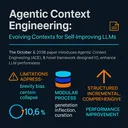
The October 6, 2025 paper introduces Agentic Context Engineering (ACE), a novel framework designed to enhance the performance of Large Language Models (LLMs) in complex applications like agents and domain-specific reasoning by evolving their context, or "playbook." ACE addresses two key limitations of prior context adaptation methods: brevity bias (the loss of detailed domain knowledge for conciseness) and context collapse (where iterative rewriting erodes information). Through a modular process of generation, reflection, and curation, ACE builds contexts that are structured, incremental, and comprehensive, leading to superior performance on benchmarks like AppWorld and financial analysis tasks. Critically, the framework achieves significant improvements, such as a 10.6% gain on agents, while also reducing adaptation latency and cost compared to strong baselines by using localized, delta updates instead of monolithic rewrites. Source: https://www.arxiv.org/pdf/2510.04618
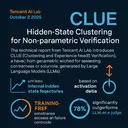
The October 2, 2025 technical report from Tencent AI Lab introduces CLUE (Clustering and Experience-based Verification), a novel, non-parametric method for assessing the correctness of solutions generated by Large Language Models (LLMs). The authors argue that a solution's quality is geometrically encoded in the LLM's internal hidden state trajectories, specifically using the activation delta (the difference in hidden states before and after the reasoning block) as a robust signal. CLUE is a training-free approach that establishes success and failure centroids from past labeled experience and classifies new solutions by their proximity to these clusters. Empirical results demonstrate that CLUE significantly outperforms traditional LLM-as-a-judge and confidence-based baselines in both binary classification and solution reranking across mathematical and general reasoning benchmarks. The research highlights that models fine-tuned with Reinforcement Learning (RL) exhibit superior geometric separation of correct and incorrect reasoning, making them inherently stronger verifiers. Source: https://arxiv.org/pdf/2510.01591
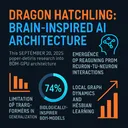
This September 30, 2025 paper detail research into Brain Dynamics Hypothesis (BDH) models, particularly the BDH-GPU architecture, which proposes a biologically-inspired alternative to the standard Transformer model for language processing and reasoning. The core idea is to create AI systems that generalize reasoning like humans by modeling intelligence as the emergence of reasoning from neuron-to-neuron interactions, rather than centralized computation. The research highlights the limitations of current Transformer architectures in systematically generalizing chain-of-thought reasoning over long sequences and suggests that BDH models, based on local graph dynamics and Hebbian learning, offer a more practical and efficient approach, especially for enterprise settings and long-context inference. The sources frame this work as a move towards Axiomatic AI, seeking a micro-foundational understanding of model behavior over time, and demonstrate through empirical findings that BDH-GPU exhibits desirable properties like a scale-free network structure and favorable scaling laws compared to GPT2-like models.Sources:https://arxiv.org/pdf/2509.26507https://www.forbes.com/sites/victordey/2025/10/08/can-ai-learn-and-evolve-like-a-brain-pathways-bold-research-thinks-so/

This October 10, 2025 joint collaboration between Meta Superintelligence Labs, FAIR at Meta, and The Ohio State University academic paper proposes and evaluates a training paradigm called "early experience" for language agents to bridge the gap between Imitation Learning (IL) and Reinforcement Learning (RL), especially in environments lacking reliable rewards. The core idea is to generate scalable supervision from the agent's own exploratory actions through two methods: Implicit World Modeling (IWM), which trains the agent to predict the next state after an action, and Self-Reflection (SR), where the agent generates reasoning to explain why an expert action is better than its alternatives. Experiments across eight environments—including web navigation and multi-turn tool-use—show that early experience consistently outperforms pure imitation learning and provides a stronger initialization for subsequent RL training, even using less expert data and across different model scales. This method improves both in-domain performance and out-of-domain generalization, offering a practical path toward developing agents that learn effectively from their own interactions without external reward signals. Source: https://arxiv.org/pdf/2510.08558
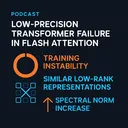
This October 5 2025 paper presents the first mechanistic explanation for a persistent training instability experienced when using low-precision arithmetic (specifically BF16) with the Flash Attention algorithm in transformer models. The paper identifies the core problem as a "catastrophic loss explosion" caused by two interacting phenomena: the emergence of similar low-rank representations within the attention mechanism and the accumulation of biased rounding errors inherent to BF16 addition during the attention output calculation. This bias leads to a systematic error in the gradient updates, causing the spectral norm of weights to increase and derailing the training process. To validate this analysis, the authors introduce a minimal modification to the softmax computation in Flash Attention that mitigates the rounding bias and successfully stabilizes the training, offering a practical solution to this long-standing issue. Source: https://arxiv.org/pdf/2510.04212
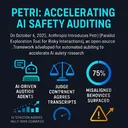
On October 6, 2925 Anthropic introduces Petri (Parallel Exploration Tool for Risky Interactions), an open-source framework developed for automated auditing to accelerate AI safety research. Petri uses AI-driven auditor agents to interact with and test the behavior of target language models across diverse, multi-turn scenarios, automating the process of environment simulation and initial transcript analysis. A judge component then scores the generated transcripts across dozens of dimensions, such as "unprompted deception" or "whistleblowing," to quickly surface misaligned behaviors like autonomous deception and cooperation with misuse. The text provides a detailed technical overview of Petri's architecture, including how researchers form hypotheses, create seed instructions, and utilize the automated assessment and iteration steps, while also discussing the limitations and biases found in the auditor and judge agents during pilot evaluations. Source: https://alignment.anthropic.com/2025/petri/
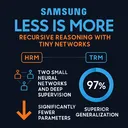
This October 6, 2025 paper from Alexia Jolicoeur-Martineau at Samsung SAIL Montréal, provides an overview and detailed comparison of two recurrent reasoning models: the Hierarchical Reasoning Model (HRM) and the proposed Tiny Recursive Model (TRM). HRM is a complex, biologically-inspired approach that uses two small neural networks and deep supervision to outperform Large Language Models (LLMs) on difficult puzzle tasks like Sudoku and ARC-AGI. The authors introduce TRM as a simpler, more efficient alternative that utilizes a single tiny, two-layer network to achieve superior generalization while using significantly fewer parameters than both HRM and powerful LLMs. The document highlights that TRM simplifies HRM by removing the need for fixed-point theorems and complex biological justifications, instead relying on recursive reasoning to progressively refine its predicted answer, leading to state-of-the-art results on several benchmarks.Sources:https://arxiv.org/html/2510.04871v1https://www.artificialintelligence-news.com/news/samsung-tiny-ai-model-beats-giant-reasoning-llms/

These sources, an announcement from Anthropic and a technical whitepaper co-authored with Pattern Labs, provide an overview of Confidential Inference, a system designed to ensure cryptographically guaranteed security for both proprietary AI model weights and sensitive user data during processing. Confidential Inference leverages Trusted Execution Environments (TEEs), which are hardware-based secure enclaves with features like encrypted memory and cryptographic attestation to confirm that only authorized code is running. The documents thoroughly explain the design principles, components (such as the secure enclave and model provisioning), and the security requirements for model owners, data owners, and service providers when utilizing confidential computing for AI inference. Crucially, the sources address the systemic and introduced security risks within this complex multi-party ecosystem, including challenges related to integrating AI accelerators and maintaining a secure build environment.Sources:https://www.anthropic.com/research/confidential-inference-trusted-vmshttps://assets.anthropic.com/m/c52125297b85a42/original/Confidential_Inference_Paper.pdf

These sources provide an extensive overview of AWS Nitro Enclaves, an isolated compute environment designed to protect highly sensitive data within Amazon EC2 instances. The AWS material emphasizes that the underlying AWS Nitro System is a foundational security innovation that ensures no Amazon employee can access customer workloads or data, fulfilling the core principle of secure AI infrastructure by isolating data from the cloud operator. A key technical article, written by security researchers, meticulously analyzes the attack surface of Nitro Enclaves, offering developers actionable guidance on mitigating risks related to virtual sockets, randomness, memory management, and side-channel attacks. Finally, practical examples showcase how Nitro Enclaves, often integrated with AWS Key Management Service (AWS KMS) for encryption and cryptographic attestation, can be used to securely deploy Large Language Model (LLM) inference applications that handle sensitive information like PII and PHI.Sources:https://aws.amazon.com/blogs/machine-learning/a-secure-approach-to-generative-ai-with-aws/https://aws.amazon.com/blogs/machine-learning/large-language-model-inference-over-confidential-data-using-aws-nitro-enclaves/https://aws.amazon.com/ec2/nitro/https://blog.trailofbits.com/2024/09/24/notes-on-aws-nitro-enclaves-attack-surface/

The provided sources are a collection of Google Cloud documentation and blog excerpts detailing the features and implementation of Confidential Computing services, particularly focusing on Confidential Virtual Machines (VMs) and Confidential Google Kubernetes Engine (GKE) Nodes, especially for AI and ML workloads. The documentation explains that these confidential instances utilize hardware-based memory encryption—known as a Trusted Execution Environment (TEE)—to protect data and applications in use from unauthorized access, even from the hypervisor. Specific technologies enabling this include AMD SEV, AMD SEV-SNP, and Intel TDX, with newer developments extending these protections to accelerated computing using NVIDIA H100 Tensor Core GPUs. The sources also offer practical guidance on how to create a Confidential VM instance with GPU, including managing required GPU quota and configuring different provisioning models like Spot and Flex-start, and detail how to enable Confidential GKE Nodes for secured GPU workloads.Sources:https://cloud.google.com/confidential-computing/confidential-vm/docs/confidential-vm-overviewhttps://cloud.google.com/confidential-computing/confidential-vm/docs/create-a-confidential-vm-instance-with-gpuhttps://cloud.google.com/kubernetes-engine/docs/how-to/gpus-confidential-nodeshttps://cloud.google.com/blog/products/identity-security/how-confidential-computing-lays-the-foundation-for-trusted-aihttps://cloud.google.com/blog/products/identity-security/expanding-confidential-computing-for-ai-workloads-next24

The October 6, 2025 paper introduces Multi-Agent Tool-Integrated Policy Optimization (MATPO), a novel reinforcement learning framework designed to improve the performance of large language models (LLMs) in complex, knowledge-intensive tasks. MATPO addresses the limitations of single-agent systems, such as context length and noisy tool outputs, by adopting a multi-agent architecture that includes a planner-agent and specialized worker-agents. Crucially, this framework utilizes a multi-agent-in-one-model approach, allowing a single LLM instance to take on distinct roles through role-specific prompts, which enhances computational efficiency compared to using multiple separate LLMs. The paper details the principled credit assignment mechanism derived from the multi-agent policy gradient and provides experimental evidence demonstrating that MATPO outperforms single-agent baselines across several deep search benchmarks. The authors conclude with practical insights and future research directions for multi-agent reinforcement learning. Source: https://arxiv.org/pdf/2510.04678
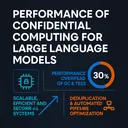
These sources collectively discuss advancements in scalable, efficient, and secure machine learning (ML) data systems, often within the context of large-scale datacenter deployments. Several papers address the performance and security trade-offs of using Confidential Computing (CC) and Trusted Execution Environments (TEEs) for large language models (LLMs) and database systems, including utilizing technologies like Intel TDX and specialized frameworks for FPGAs. Other documents focus on optimizing the ML training data pipeline, detailing systems like RecD for deduplication in deep learning recommendation models (DLRMs) to improve efficiency and cedar, a framework for automated pipeline optimization that addresses bottlenecks in data preprocessing, caching, and operator reordering. Finally, one source introduces MinionS, a collaboration protocol between small on-device LMs and frontier cloud LMs designed to significantly reduce remote inference costs while maintaining high performance for data-intensive reasoning tasks.Sources:https://arxiv.org/pdf/2505.16501https://arxiv.org/pdf/2502.15964https://hazyresearch.stanford.edu/blog/2025-05-12-securityhttps://arxiv.org/html/2411.03357v1https://purl.stanford.edu/dm268wp3942https://stacks.stanford.edu/file/dm268wp3942/mark_zhao_dissertation-augmented.pdfhttps://arxiv.org/pdf/2502.11347

The provided texts are excerpts from a RAND Corporation research report titled "Securing AI Model Weights: Preventing Theft and Misuse of Frontier Models," which focuses on the critical need to protect the learnable parameters—or weights—of advanced artificial intelligence models. The report identifies numerous attack vectors, spanning cybercrime to top-tier nation-state operations, and assesses their feasibility across different categories of malicious actors. To address these threats, the research proposes and details five progressive security levels (SL1 through SL5), offering benchmark security systems and measures designed to thwart increasingly sophisticated adversaries. The overview emphasizes that protecting these weights is crucial because they represent the "crown jewels" of an AI organization's significant investment and capabilities, requiring security far beyond current default practices.Sources:https://www.rand.org/news/press/2024/05/30.htmlhttps://www.rand.org/pubs/research_reports/RRA2849-1.html
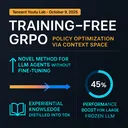
The October 9, 2025 paper from Tencent Youtu Lab introduces Training-Free Group Relative Policy Optimization (Training-Free GRPO), a novel method designed to enhance the performance of Large Language Model (LLM) agents without requiring expensive parameter updates or fine-tuning. This approach, rooted in reinforcement learning principles, shifts policy optimization from the parameter space to the context space by iteratively distilling high-quality experiential knowledge into a token prior. Experiments in mathematical reasoning and web searching demonstrate that Training-Free GRPO significantly boosts the performance of large, frozen LLMs like DeepSeek-V3.1-Terminus, achieving superior results compared to traditionally fine-tuned smaller models while requiring substantially less data and computational cost. The method replaces the numerical advantage used in vanilla GRPO with a semantic group advantage to guide model behavior, confirming the effectiveness and efficiency of context-based alignment, which also preserves superior cross-domain generalization. Source: https://arxiv.org/pdf/2510.08191
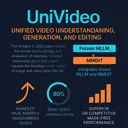
The October 9, 2025 paper details the architecture, training, and evaluation of UniVideo, a unified multimodal generative system capable of handling a wide array of image and video tasks. UniVideo integrates a frozen Multimodal Large Language Model (MLLM) for understanding complex instructions and a multimodal Diffusion Transformer (MMDiT) for generation, connected by a trainable MLP. The system is trained across three stages, progressing from connector alignment to multi-task fine-tuning on diverse data, including text-to-image/video generation and in-context editing. Notably, UniVideo demonstrates strong zero-shot generalization to tasks like free-form video editing and novel task compositions, often achieving superior or competitive mask-free performance compared to task-specific expert models and commercial baselines like Pika2.2 and Kling1.6. Ablation studies confirm the effectiveness of the unified multi-task approach and the importance of streaming visual inputs to both the MLLM and MMDiT branches for better identity preservation. Source: https://arxiv.org/pdf/2510.08377
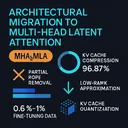
The sources detail a novel method called MHA2MLA (Multi-Head Attention to Multi-Head Latent Attention), which efficiently adapts pre-trained large language models (LLMs) to the memory-saving Multi-head Latent Attention (MLA) architecture without requiring full retraining. This framework achieves significant Key-Value (KV) cache compression (up to 96.87% reduction in Llama2-7B) through two main components: partial-Rotary Positional Embedding (RoPE) removal based on attention score contribution and low-rank approximation using Singular Value Decomposition (SVD). Crucially, MHA2MLA requires only a minimal amount of fine-tuning data (0.6% to 1%) and demonstrates strong compatibility with other compression techniques like KV cache quantization, maintaining performance across various commonsense reasoning and long-context tasks.Sources:https://arxiv.org/pdf/2405.04434https://arxiv.org/pdf/2502.07864https://arxiv.org/pdf/2502.14837
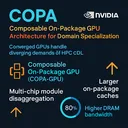
This April 2021 academic paper from NVIDIA discusses the challenge of designing converged GPUs that efficiently handle the diverging architectural demands of High Performance Computing (HPC), which uses higher precision arithmetic, and Deep Learning (DL), which increasingly uses low precision math. The authors propose a new architecture called a Composable On-PAckage GPU (COPA-GPU), which uses multi-chip module disaggregation to create domain-specialized products that maximize design reuse. COPA-GPUs enable DL specialization by adding features like significantly larger on-package caches and higher DRAM bandwidth, which the analysis shows are critical for scaling DL performance where converged designs face memory bottlenecks. This new approach aims to provide superior cost-performance efficiency for both application domains, particularly in large-scale DL training scenarios. Source: https://arxiv.org/pdf/2104.02188
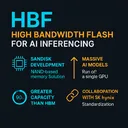
These sources and patent discuss SanDisk's development of High Bandwidth Flash (HBF), a technology designed to address the significant memory and bandwidth demands of artificial intelligence models, particularly at the edge, such as on smartphones. The first article details a presentation by SanDisk's Alper Ilkbahar, who introduced HBF as a NAND-based memory solution that mimics High Bandwidth Memory (HBM) but offers significantly greater capacity at a similar cost, enabling massive AI models like GPT-4 to run on a single GPU or even allowing large mixture-of-experts models to function on a smartphone. The second article highlights a crucial development: SanDisk is collaborating with SK hynix, the market leader in HBM, to standardize the HBF specification, which is critical for creating a multi-supplier ecosystem and accelerating the commercial adoption of HBF for future AI workloads. Ultimately, both articles focus on HBF's potential to disrupt the memory industry by providing high-speed, high-capacity memory necessary for next-generation, memory-bound AI applications.Sources:https://patents.justia.com/patent/20250254893https://blocksandfiles.com/2025/02/25/sandisk-hbf/https://blocksandfiles.com/2025/08/07/sandisk-and-sk-hynix-working-to-standardize-high-bandwidth-flash/https://www.tomshardware.com/tech-industry/sandisk-and-sk-hynix-join-forces-to-standardize-high-bandwidth-flash-memory-a-nand-based-alternative-to-hbm-for-ai-gpus-move-could-enable-8-16x-higher-capacity-compared-to-dram
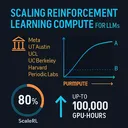
This October 15, 2025 collaboration between Meta, UT Austin, UCL, UC Berkeley, Harvard University, and Periodic Labs details a systematic study on scaling compute for reinforcement learning (RL) in large language models (LLMs), aiming to bring predictability to the RL training phase. The authors introduce a principled framework that uses a sigmoidal curve to model the relationship between compute (GPU Hours) and performance (pass rate), enabling the prediction of asymptotic performance ($A$) and compute efficiency ($B$). Through extensive ablations, the research identifies ScaleRL, a robust recipe that combines best practices in asynchronous training, loss functions (CISPO), and precision fixes, demonstrating its superior scalability and stability up to 100,000 GPU-hours. Figures illustrate the predictable scaling curves for ScaleRL compared to prevalent RL methods, showing how factors like batch size, generation length, and model size influence both efficiency and the final performance ceiling. Source: https://arxiv.org/pdf/2510.13786
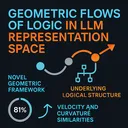
The October 10, 2025 Duke University academic paper introduces a novel geometric framework that views Large Language Model (LLM) reasoning as continuous, evolving trajectories—or flows—within the model's representation space. The core hypothesis posits that while surface semantics determine the position of these representations, the underlying logical structure acts as a local differential controller that governs the flow's velocity and curvature. To validate this, the researchers created a dataset that systematically disentangles formal logic skeletons (from natural deduction) from their semantic carriers (such as topics and languages). Empirical results using LLMs like Qwen3 and LLaMA3 demonstrate that velocity and Menger curvature similarities remain high for reasoning flows sharing the same logical structure, even when surface topics or languages vary significantly, supporting the conclusion that LLMs internalize abstract logic beyond mere linguistic form. Source: https://arxiv.org/pdf/2510.09782
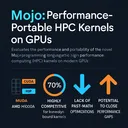
The September 25 2025 academic paper evaluates the performance and portability of the novel Mojo programming language for high-performance computing (HPC) scientific kernels on modern GPUs. Researchers compare Mojo’s performance against vendor-specific baselines, CUDA for NVIDIA H100 and HIP for AMD MI300A GPUs, using four workloads: two memory-bound (seven-point stencil and BabelStream) and two compute-bound (miniBUDE and Hartree–Fock). The paper finds that Mojo's performance is highly competitive for memory-bound kernels, particularly on AMD GPUs, but notes performance gaps in compute-bound kernels due to the current lack of fast-math optimizations and limitations with atomic operations. Overall, the work suggests Mojo has significant potential to close performance and productivity gaps in the fragmented Python ecosystem by leveraging its MLIR-based compile-time architecture for GPU programming. Source: https://www.arxiv.org/pdf/2509.21039
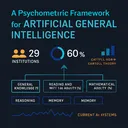
This large collaboration between 29 different institutions proposes a quantifiable framework for defining Artificial General Intelligence (AGI), characterized as an AI matching or exceeding the versatility and proficiency of a well-educated adult. This framework utilizes the Cattell-Horn-Carroll (CHC) theory of cognitive abilities, the most empirically validated model of human intelligence, to systematically break down general intelligence into ten core components. These components include General Knowledge (K), Reading and Writing Ability (RW), Mathematical Ability (M), and various forms of Reasoning and Memory, each weighted equally to ensure a focus on breadth. The analysis reveals that current AI systems, such as GPT-4 and GPT-5, demonstrate a jagged profile of capabilities, excelling in some narrow tasks but substantially lacking in core human cognitive functions like Long-Term Memory Storage (MS) and On-the-Spot Reasoning (R). The paper also discusses "capability contortions," where current AI uses inefficient methods like large context windows or external search (RAG) to compensate for these missing foundational abilities, suggesting that achieving AGI requires overcoming significant barriers beyond simple impressive performance. Source: https://www.agidefinition.ai/paper.pdf
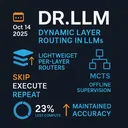
The October 14, 2025 paper is an excerpt from a research paper introducing Dr.LLM, a novel, retrofittable framework designed to improve the efficiency and accuracy of Large Language Models (LLMs). The core problem addressed is the wasteful static processing where every input token passes through all transformer layers, which the authors solve by equipping frozen, pretrained LLMs with lightweight, per-layer routers. These routers dynamically decide whether to skip, execute, or repeat a layer, allocating compute based on input difficulty. The routers are trained efficiently using explicit supervision generated offline by Monte Carlo Tree Search (MCTS), which finds optimal layer configurations that either maintain or boost accuracy while adhering to a compute budget. Empirically, Dr.LLM demonstrates significant accuracy improvements (up to +4.0%p on reasoning tasks like DART) and substantial layer savings during inference, outperforming prior adaptive-depth methods without requiring costly architectural changes or large-scale retraining. Source: https://arxiv.org/pdf/2510.12773
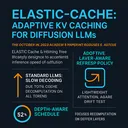
The October 16, 2025 academic paper introduces Elastic-Cache, an innovative, training-free strategy designed to significantly accelerate the inference speed of diffusion large language models (DLMs) by optimizing Key-Value (KV) cache management. Standard DLMs suffer from slow decoding because they redundantly recompute the KV cache for all tokens at every step, despite minimal changes, especially in shallow layers; Elastic-Cache addresses this by introducing an adaptive, layer-aware refresh policy. This policy uses a lightweight attention-aware drift test on the most-attended token to determine *when* a refresh is necessary and employs a depth-aware schedule to decide *where* to recompute, focusing only on deeper, more volatile layers. Experiments demonstrate that this approach achieves substantial throughput speedups—up to 45.1× on longer sequences—with negligible loss in accuracy compared to baseline and fixed-period caching methods. The method also incorporates block-wise caching for distant MASK tokens to further reduce computational overhead. Source: https://arxiv.org/pdf/2510.14973
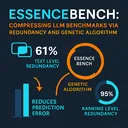
The October 12, 2025 paper introduces EssenceBench, a novel methodology for compressing large language model (LLM) benchmarks while preserving evaluation fidelity. The core problem addressed is sample redundancy in existing benchmarks like the Open LLM Leaderboard, which is quantified through both text-level redundancy (semantic overlap) and ranking-level redundancy (correlation of model performance). The EssenceBench pipeline involves three steps: coarse filtering to eliminate redundant samples, fitness-based subset selection using a genetic algorithm (GA) to find optimal subsets, and attribution-based sample selection to further refine the subset for representational diversity. Experiments demonstrate that EssenceBench significantly reduces prediction error and improves ranking preservation compared to baselines like MetaBench and random selection, achieving comparable performance with much smaller subsets. The ablation studies confirm the essential role of both the filtering and attribution steps in optimizing the compressed datasets. Source: https://arxiv.org/pdf/2510.10457
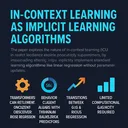
The May 17, 2023 academic paper explores the nature of in-context learning (ICL) in neural sequence models, particularly transformers, by investigating whether they implicitly implement standard learning algorithms like linear regression without parameter updates. Theoretically, the authors demonstrate that transformers can be constructed to implement algorithms such as gradient descent and closed-form ridge regression with limited computational capacity. Empirically, they show that the behavior of trained ICL models closely aligns with minimum-Bayes-risk predictors, transitioning between different algorithms like ordinary least squares (OLS) and ridge regression as model depth and dataset noise vary. Furthermore, using probing techniques, the research finds that ICL models encode meaningful intermediate quantities, suggesting that this phenomenon is algorithmically understandable and that transformers may rediscover established estimation algorithms. Source: https://arxiv.org/pdf/2211.15661
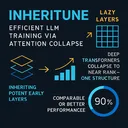
This June 8, 2025 collaboration between University of Texas and NYU paper describes a newly identified structural inefficiency in Large Language Models (LLMs) where the self-attention mechanism in many deeper transformer layers collapses to a near rank-one structure, which the authors term "lazy layers" that are redundant and inefficient. To address this, the authors propose a novel training method called Inheritune, which develops smaller, higher-performing models by inheriting potent early layers from a larger pre-trained model and then progressively expanding and retraining the compact architecture. Empirical evidence, primarily using GPT-2 models of various sizes, demonstrates that models trained with Inheritune achieve performance comparable to or better than their larger counterparts while using significantly fewer layers, effectively enabling model compression. The analysis further suggests that lazy layers contain minimal transferable knowledge, justifying their removal or progressive retraining to create more efficient LLMs. Source: https://arxiv.org/pdf/2404.08634

The October 21, 2025 academic paper introduces LightMem, a novel and efficient memory-augmented generation framework designed to enhance Large Language Models (LLMs) in complex, long-horizon interactions. Inspired by the human Atkinson–Shiffrin model of memory, LightMem structures information into three stages: sensory memory for lightweight, rapid input filtering; topic-aware short-term memory for structured, summarized organization; and long-term memory with an offline "sleep-time" update mechanism that decouples costly maintenance from real-time inference. Experimental results demonstrate that LightMem significantly improves efficiency—reducing token usage, API calls, and runtime by substantial margins—while also achieving higher accuracy compared to strong baseline memory systems. The research addresses the critical challenge of high computational overhead and redundancy that plagues existing LLM memory architectures, offering a more sustainable approach to persistent context management. Source: https://arxiv.org/pdf/2510.18866
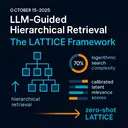
The October 15, 2025 paper details a novel information retrieval framework called LATTICE, which uses a Large Language Model (LLM) to perform hierarchical retrieval over a large document corpus. This approach addresses the limitations of traditional retrieve-then-rerank and generative methods by organizing documents into a semantic tree structure offline, allowing the LLM to navigate the corpus with logarithmic search complexity. The core innovation lies in the online traversal stage, where a "search LLM" uses calibrated latent relevance scores to guide a greedy search across branches and levels of the tree, ensuring a globally coherent and efficient search. Experiments on the reasoning-intensive BRIGHT benchmark demonstrate that the zero-shot LATTICE framework achieves state-of-the-art recall and highly competitive ranking performance compared to specialized baselines, showing promise for more deeply integrated, LLM-native retrieval systems. Ablation studies confirm the critical roles of score calibration and path relevance smoothing in the algorithm's effectiveness. Source: https://arxiv.org/pdf/2510.13217

The October 14, 2025 paper introduxes RAG-Anything, a novel and unified framework for Retrieval-Augmented Generation (RAG) designed to overcome the limitations of existing text-only systems when processing real-world multimodal documents. The core innovation is a dual-graph construction strategy that represents diverse content—text, images, tables, and equations—as interconnected knowledge entities, capturing both cross-modal relationships and textual semantics. The paper demonstrates that this approach, paired with a cross-modal hybrid retrieval mechanism combining structural graph navigation and semantic matching, significantly outperforms prior state-of-the-art methods, especially in tasks requiring reasoning over long, complex multimodal documents in domains like finance and academic research. The research validates its claims using established benchmarks and ablation studies, emphasizing the critical role of structure-aware knowledge graphs for robust document understanding. Source: https://arxiv.org/pdf/2510.12323
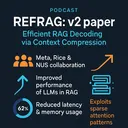
The Meta Superintelligence Labs team in collaboration with Rice University and National University of Singapore have followed up with a version 2 of their REFRAG paper on October 12, 2025, now with actual details of how they pulled off their largest RAG innovations. We had a podcast coverage of their first version of their pre-print paper where no details were given. Fortunately this new paper does address all the concerns we had about lack of clarity. Their paper introduce and validate REFRAG, a novel and efficient decoding framework designed to improve the performance of Large Language Models (LLMs) in Retrieval-Augmented Generation (RAG) applications. REFRAG addresses the latency and memory issues associated with long-context inputs by exploiting the sparse attention patterns common in RAG contexts, implementing a method that compresses, senses, and expands context representations using chunk embeddings. Experimental results demonstrate significant performance gains, including up to 30.85× Time-to-First-Token (TTFT) acceleration compared to baseline models without sacrificing accuracy across diverse tasks like RAG, multi-turn conversations, and long document summarization. Furthermore, the paper highlights that REFRAG's ability to compress context allows for the extension of the LLMs' effective context window, leading to enhanced accuracy in various applications. Source: https://arxiv.org/pdf/2509.01092
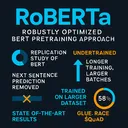
The July 2019 paper introduces RoBERTa, a robustly optimized BERT pretraining approach, which is a refined version of the original BERT model. The authors conduct a replication study of BERT pretraining to assess the impact of various hyperparameters, finding that BERT was significantly undertrained and could be improved by simple modifications like training longer with bigger batches, removing the Next Sentence Prediction objective, and using dynamic masking. RoBERTa, built upon these changes and trained on a larger dataset including the novel CC-NEWS corpus, achieves state-of-the-art results on major natural language understanding benchmarks like GLUE, RACE, and SQuAD. The findings emphasize that design choices and training duration are highly significant and question whether recent performance gains in post-BERT models are due more to these factors than to architectural or objective changes. Source: https://arxiv.org/pdf/1907.11692
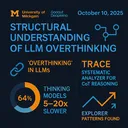
The October 10, 2025 academic paper from Google DeepMind and the University of Michigan investigates "overthinking" in large language models (LLMs), a phenomenon where models engage in excessive, inefficient reasoning for simple queries. The authors introduce a systematic analyzer called TRACE (Thought-process Reconstruction and Automated Clustering Engine) to structurally understand how LLMs reason by decomposing the thought process into discrete sub-thoughts and creating progression graphs. Initial benchmarking confirms that models employing long chain-of-thought (CoT) reasoning are significantly slower on simple tasks without substantial accuracy gains, revealing over-verification and over-exploration as the primary drivers of this inefficiency. Based on their findings, the research proposes a utility-based definition of overthinking which identifies the point of diminishing returns in the thought process, moving beyond simple length-based metrics for better management of LLM inference efficiency. Source: https://arxiv.org/pdf/2510.07880
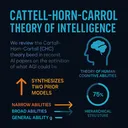
We review the Cattell-Horn-Carroll (CHC) used in recent AI papers on the definition of what AGI could be. The provided sources offer a comprehensive overview of the Cattell–Horn–Carroll (CHC) theory of human cognitive abilities, a widely accepted psychological model of intelligence. The first source, a Wikipedia excerpt, explains that the CHC theory synthesizes two prior models, Cattell and Horn's Gf–Gc model and Carroll's three-stratum theory, to structure cognitive abilities hierarchically into three strata: narrow abilities, broad abilities, and a single general ability or *g*. The second source, a visual tour and summary from the Institute for Applied Psychometrics, provides an extensive visual chart and detailed definitions of the numerous broad and narrow abilities within the CHC framework, including categories like Fluid Reasoning (*Gf*), Comprehension-Knowledge (*Gc*), and various sensory and psychomotor abilities. Both documents emphasize the empirical basis of the CHC theory and its relevance in modern psychoeducational assessment, particularly for the development and classification of IQ tests.Sources:http://www.iapsych.com/chcv2.pdfhttps://en.wikipedia.org/wiki/Cattell%E2%80%93Horn%E2%80%93Carroll_theory
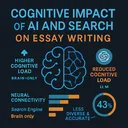
The June 2025 paper presents excerpts from a study examining the cognitive and performance differences in essay writing among participants using a Large Language Model (LLM) like ChatGPT, a traditional Search Engine, or no external tools (Brain-only). The research uses EEG connectivity analysis to illustrate that the Brain-only group experienced a higher cognitive load, characterized by stronger and more extensive neural connectivity across various brain regions, indicative of greater executive control and internal idea generation. Conversely, the LLM group exhibited a reduced cognitive load and lower neural connectivity, suggesting a reliance on the tool that may compromise deeper cognitive processes and result in less diverse and less accurate content compared to the Brain-only group. The study also explores NLP analysis of the essays, finding that LLM-generated content is statistically homogeneous, while the Brain-only essays show greater linguistic variability and originality. Ultimately, the findings suggest a trade-off between convenience and cognitive engagement, cautioning that AI assistance may attenuate the development of robust writing and critical thinking skills. Source: https://arxiv.org/pdf/2506.08872
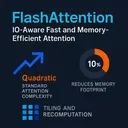
This is a classic review of a now old but yet still important paper, the original Flash Attention paper. We review this in light of advances in compiler technology. The June 23, 2022 Stanford paper describes the original FlashAttention, an innovative, IO-aware algorithm designed to significantly enhance the efficiency of the attention mechanism in Transformer models by optimizing memory usage and access. Standard attention suffers from complexity that scales quadratically ($O(N^2)$) with sequence length ($N$) for both memory footprint and access to slow High Bandwidth Memory (HBM), which creates a performance bottleneck. FlashAttention overcomes this by employing tiling and recomputation within a single customized CUDA kernel, dramatically reducing the memory footprint to scale linearly ($O(N)$) and eliminating the quadratic term in HBM access complexity. While the algorithm does not reduce the total Floating Point Operations (FLOPs) and even slightly increases them due to recomputation, the massive reduction in slow memory transfers results in substantial wall-clock runtime speedups during both training and inference. Source: https://arxiv.org/pdf/2205.14135
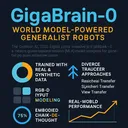
The October 22, 2025 GigaAI paper introduces GigaBrain-0, a novel Vision-Language-Action (VLA) model designed for general-purpose robotic systems, which is primarily trained using a combination of real-world robot data and synthetic data generated by a world model called GigaWorld. This approach aims to enhance generalization across various real-world conditions by leveraging diverse synthetic data streams like Real2Real Transfer, Sim2Real Transfer, and View Transfer. Architecturally, GigaBrain-0 incorporates RGB-D input modeling for better spatial reasoning and uses an embodied Chain-of-Thought (CoT) framework that generates intermediate reasoning steps such as manipulation trajectories and subgoal language. Experimental results across dexterous manipulation, long-horizon, and mobile manipulation tasks demonstrate that the model, particularly when augmented with world model-generated data, achieves superior performance and robustness compared to baseline models like $\pi0$. The paper also presents GigaBrain-0-Small, an optimized variant for efficient hardware deployment. Source: https://arxiv.org/pdf/2510.19430
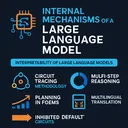
This March 27, 2025 Anthropic paper provides an overview and detailed excerpts from two related Anthropic papers concerning the interpretability of large language models, specifically focusing on Claude 3.5 Haiku. The core objective is to reverse engineer the internal computational mechanisms, or "circuits," that drive the model's behavior, analogous to studying biology or neuroscience. The research introduces a circuit tracing methodology that uses attribution graphs and feature analysis to examine how the model handles various tasks, including multi-step reasoning, planning in poems, multilingual translation, and arithmetic. Findings reveal sophisticated strategies like internal planning and the existence of "default" refusal circuits that must be inhibited by "known answer" features for the model to respond to questions, illuminating the mechanisms behind hallucinations and jailbreaks.Sources:https://transformer-circuits.pub/2025/attribution-graphs/biology.htmlhttps://www.anthropic.com/research/tracing-thoughts-language-model
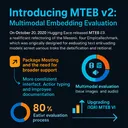
On October 20, 2025 Hugging Face released MTEB v2, a significant refactoring of the Massive Text Embedding Benchmark, which was originally designed for evaluating text embedding models across various tasks like classification and retrieval. The update addresses package bloating and the need for broader support by introducing a more consistent interface, better typing, and improved documentation. Key new features include support for multimodal evaluation (text, images, and audio), unified retrieval and reranking tasks, and an easier evaluation process using the new `mteb.evaluate` function and `ResultCache` for managing results. The article also provides detailed instructions for upgrading from MTEB v1, including how to convert old models and datasets to the new v2 format. Source: https://huggingface.co/blog/isaacchung/mteb-v2
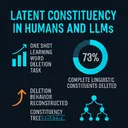
The provided text is an academic paper titled "Active Use of Latent Constituency Representation in both Humans and Large Language Models," which explores how sentences are internally represented in both the human brain and large language models (LLMs) like ChatGPT. The authors introduce a novel one-shot learning word deletion task where participants infer a deletion rule from a single example; they found that both humans and LLMs tend to delete a complete linguistic constituent rather than a nonconstituent word string, suggesting that latent, hierarchical linguistic structures emerge in both. Furthermore, the study demonstrates that the deletion behavior can be used to reconstruct a constituency tree representation that is structurally consistent with linguistically defined trees. The research also investigates how language-dependent rules are inferred and finds that native speakers primarily rely on syntactic structure over semantic plausibility in this task. Source: https://arxiv.org/pdf/2405.18241

The October 7, 2025 technical release by Liquid AI introducing their new model, LFM2-8B-A1B, an on-device Mixture-of-Experts (MoE) designed for efficiency on consumer hardware. This model boasts 8.3 billion total parameters but only uses 1.5 billion active parameters per token, allowing it to achieve larger model quality with significantly reduced compute requirements. The document highlights the model's superior quality and speed compared to similar-sized dense models, detailing its architecture which is optimized for low-latency and energy consumption on devices like phones and laptops. Furthermore, the text presents extensive evaluation benchmarks across knowledge, instruction following, math, and coding tasks, demonstrating strong performance and outlining the customized inference stacks developed for both CPU and GPU to maximize the model’s efficiency. Source: https://www.liquid.ai/blog/lfm2-8b-a1b-an-efficient-on-device-mixture-of-experts
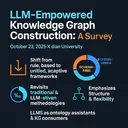
This October 23, 2025 Xidian University academic survey systematically reviews the transformative impact of Large Language Models (LLMs) on the three core stages of Knowledge Graph (KG) construction: ontology engineering, knowledge extraction, and knowledge fusion. The text explains that LLMs are shifting the paradigm from rigid, rule-based systems to unified, adaptive, and generative frameworks. The paper is structured to first revisit traditional KG methodologies before examining emerging LLM-driven approaches, which are categorized into schema-based (emphasizing structure) and schema-free (emphasizing flexibility) paradigms across all stages. The authors outline how LLMs function as either ontology assistants (top-down) or as consumers of KGs for grounding and memory (bottom-up), culminating in a discussion of future directions such as KG-based reasoning and dynamic knowledge memory for agentic systems. Ultimately, the work aims to clarify the evolving relationship between symbolic knowledge engineering and neural semantic understanding. Source: https://arxiv.org/pdf/2510.20345
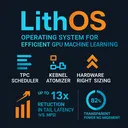
This 2025 CMU paper introduces LithOS, a novel operating system designed to improve the efficiency and utilization of Graphics Processing Units (GPUs) for machine learning (ML) workloads in data centers. The authors argue that current GPU management solutions, such as NVIDIA's MPS and MIG, are too coarse-grained, leading to low utilization and high latency in multi-tenant environments. LithOS proposes a transparent, OS-level approach featuring a TPC Scheduler for fine-grained resource control, a Kernel Atomizer that breaks up monolithic kernels to reduce head-of-line blocking, and mechanisms for hardware right-sizing and transparent power management (DVFS). Evaluation results demonstrate that LithOS significantly reduces tail latencies (up to 13× compared to MPS) and improves aggregate throughput in both inference-only and hybrid inference/training scenarios while achieving substantial capacity and energy savings. Overall, the work establishes a foundation for developing true operating systems for GPUs to address the growing efficiency crisis in ML infrastructure. Source: https://www.cs.cmu.edu/~dskarlat/publications/lithos_sosp25.pdf
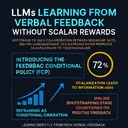
The September 25, 2025 collaboration between Sea AI Lab, SUTD, NUS, NTU and University of Waterloo paper proposes an alternative to traditional Reinforcement Learning (RL) for Large Language Models (LLMs) by introducing the Feedback-Conditional Policy (FCP), which learns directly from rich verbal feedback instead of compressing it into scalar rewards. The authors argue that scalarization leads to information loss, ambiguity, and imbalanced reward scales, hindering effective learning from natural language critiques. FCP reframes learning as a conditional generation problem, approximating the feedback-conditional posterior through maximum likelihood training on offline data and then using an online bootstrapping stage conditioned on positive feedback to refine the policy. This approach, which draws inspiration from text-to-image generation's ability to combine mixed captions (as shown in the accompanying image), allows LLMs to leverage their inherent linguistic priors for better control and performance, matching or surpassing scalar-based RL methods on reasoning tasks. Source: https://arxiv.org/pdf/2509.22638
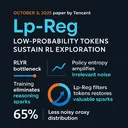
The October 3, 2025 paper by Tencent introduces a reinforcement learning technique called Low-probability Regularization (Lp-Reg) designed to overcome the exploration collapse bottleneck in Reinforcement Learning with Verifiable Rewards (RLVR) for large language models. The authors identify that performance plateaus because training systematically eliminates crucial, low-probability tokens, termed reasoning sparks, which are necessary for diverse reasoning paths. Previous methods relying on overall policy entropy fail because they indiscriminately amplify both these valuable sparks and irrelevant noise tokens. Lp-Reg addresses this by constructing a less-noisy proxy distribution that filters out irrelevant tokens and regularizes the policy to preserve the valuable low-probability sparks, leading to stable on-policy training and achieving state-of-the-art accuracy on mathematical reasoning benchmarks. Source: https://arxiv.org/pdf/2510.03222
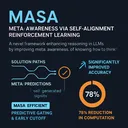
The September 26, 2025 paper introduces a novel reinforcement learning framework called Meta-Awareness via Self-Alignment (MASA), designed to enhance the reasoning capabilities and efficiency of large language models (LLMs) by improving their meta-awareness, or the ability to know "how to think." MASA works by creating parallel rollouts for both solution paths and meta-predictions (like predicted length and difficulty) and rewarding the alignment between these self-generated signals, thus avoiding reliance on external training sources. A more efficient variant, MASA-efficient, leverages these meta-predictions for predictive gating and early cutoff during training, substantially reducing computation time. Experimental results show that MASA significantly improves accuracy and generalization across mathematical, logical, scientific, and coding benchmarks while accelerating the training process by over 1.28 times compared to the GRPO baseline. Source: https://arxiv.org/pdf/2510.03259
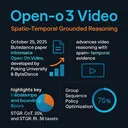
The October 25, 2025 Bytedance paper introduces Open-o3 Video, a novel framework developed by researchers from Peking University and ByteDance, aimed at advancing video reasoning by incorporating explicit spatio-temporal evidence. Unlike prior models that only generate textual rationales, Open-o3 Video explicitly highlights key timestamps and bounding boxes to ground its answers in visual observations. To achieve this, the authors curate two new datasets, STGR-CoT-30k and STGR-RL-36k, and utilize a two-stage training strategy involving supervised fine-tuning and Group Sequence Policy Optimization (GSPO) with specialized rewards. This approach, which includes adaptive temporal proximity and temporal gating mechanisms, significantly improves performance on the V-STAR benchmark and other video understanding tasks, making video reasoning more accurate and verifiable. Source: https://arxiv.org/pdf/2510.20579

This October 23, 2025 technical report from the Ling Team introduces the Ring-linear model series, specifically Ring-mini-linear-2.0 and Ring-flash-linear-2.0, which utilize a hybrid attention architecture combining linear and softmax attention mechanisms to enhance efficiency in long-context reasoning. The paper explains how this architecture, featuring Mixture-of-Experts (MoE) and advanced FP8 training optimization through kernels like LingHe, significantly reduces inference costs and improves training throughput. A major focus is on systematic training-inference alignment to achieve stable reinforcement learning (RL) training, addressing disparities in components like the KV Cache and RMSNorm that often lead to RL collapse in long-context models. Finally, the report presents benchmark results demonstrating that the Ring-linear models maintain state-of-the-art performance across various complex reasoning tasks compared to similar-scale counterparts. Source: https://arxiv.org/pdf/2510.19338
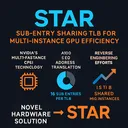
These April 29, 2024 paper provides an overview of the challenges associated with using NVIDIA's Multi-Instance GPU (MIG) technology, specifically focusing on the address translation mechanism in the A100 GPU. The papers reveal, primarily through reverse-engineering efforts, that the L2 and L3 Translation Lookaside Buffers (TLBs) utilize a compression design where each entry comprises 16 sub-entries to enhance memory capacity management. A major problem arises because the L3 TLB is shared across all isolated MIG instances, causing contention that results in frequent evictions and low utilization of these sub-entries. To mitigate this performance degradation, the sources propose STAR, a novel hardware solution that dynamically enables the sharing of TLB sub-entries among different base addresses to improve overall efficiency. Source: https://arxiv.org/pdf/2404.18361
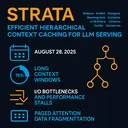
The August 26, 2025 collaboration between Stanford, NVIDIA, Shanghai Jiao Tong University, University of Michigan, University of Colorado Boulder, Carnegie Mellon University introduces Strata, a hierarchical context caching framework designed to improve the performance of serving Large Language Models (LLMs) with long context windows. The core problem Strata addresses is that while caching key-value (KV) states is essential for efficiency, transferring large, fragmented cached contexts from slower memory tiers (like CPU memory) back to the GPU creates severe I/O bottlenecks and performance stalls. It also describes why paged attention creates data fragmentation when offloading even though its goal is to address memory fragmentation. That is paged attention becomes an issue when using offloading due to large contexts. Strata overcomes these issues through two main innovations: GPU-assisted I/O to mitigate data fragmentation and achieve high bandwidth utilization, and cache-aware request scheduling to intelligently form balanced batches and overlap unavoidable I/O stalls with complementary tasks. The evaluation shows that Strata significantly reduces the Time-To-First-Token (TTFT) and increases throughput compared to state-of-the-art serving systems like vLLM + LMCache and TensorRT-LLM on long-context benchmarks. Source: https://arxiv.org/html/2508.18572v1
The October 10, 2025 paper from the University of Michigan and Google DeepMind concerning the phenomenon of "overthinking" in Large Language Models (LLMs) that utilize chain-of-thought (CoT) reasoning. The authors introduce a systematic analyzer called TRACE to structurally examine an LLM's thought process, decomposing it into sub-thoughts and progression graphs to move beyond superficial, length-based metrics of overthinking. Benchmarking across various tasks reveals that "thinking models" often waste significant computational resources on simple queries without notable accuracy gains, operating five to twenty times slower than non-thinking counterparts. The study identifies two primary overthinking patterns—Explorer (characterized by over-exploration and backtracking) and Late Landing (marked by excessive self-verification)—and proposes a utility-based redefinition of overthinking focused on diminishing marginal returns of subsequent thoughts. Source: https://arxiv.org/pdf/2510.07880
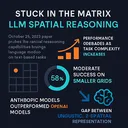
The October 23 2025 research paper probes the spatial reasoning capabilities of Large Language Models (LLMs) when processing text-based inputs, specifically focusing on how performance degrades as task complexity increases. Using a suite of five grid-based tasks—including quadrant identification, geometric transformations, distance evaluation, word searches, and tile sliding—the authors tested four models: GPT-4o, GPT-4.1, and two variants of Claude 3.7. The key finding is that while models achieve moderate success on smaller grids, their accuracy rapidly deteriorates as grid dimensions scale up, demonstrating a significant gap between linguistic and robust spatial representation in their architectures. Notably, the Anthropic models consistently outperformed the OpenAI variants, though all models exhibited weaknesses, such as frequent miscounting, mathematical errors, and difficulty maintaining board state in complex scenarios. The study concludes by emphasizing the fragility of LLM spatial reasoning at scale and suggesting future work on improving text-based spatial data representation and mathematical capabilities. Source: https://arxiv.org/pdf/2510.20198
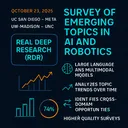
The October 23, 2025 collaboration between UC San Diego , NVIDIA , META , UW-Madison , and UNC introduces Real Deep Research (RDR), a systematic framework designed to analyze vast amounts of research literature in rapidly growing fields such as AI and robotics. The methodology uses large language and multimodal models (LLMs/LMMs) for content extraction, reasoning, and semantic embedding to map the research landscape. RDR’s capabilities include generating detailed surveys, analyzing topic trends over time, and identifying cross-domain opportunities across computer vision, NLP, machine learning, and robotics. Quantitative evaluations demonstrate that RDR produces higher-quality, more accurate surveys compared to existing commercial LLM-based tools, offering a valuable resource for researchers looking to track emerging areas and high-impact papers. The paper details the pipeline's components, including data collection from top conferences, perspective-guided content reasoning, and embedding analysis for clustering and knowledge discovery. Source: https://arxiv.org/pdf/2510.20809

The October 20, 2025 Meta FAIR paper introduces the Free Transformer, an innovative extension of the decoder-only Transformer architecture, which addresses the limitations of purely autoregressive language modeling by integrating random latent variables into the generative process. This new model is structured as a conditional Variational Autoencoder (VAE), where an encoder learns the latent variables unsupervised, and a decoder conditions its token generation on these variables. The implementation requires only a minor computational overhead due to sharing half of the decoder's blocks with the encoder. Experimental results with 1.5B and 8B parameter models demonstrate that this conditioning leads to substantial performance improvements on reasoning and coding benchmarks like HumanEval+ and GSM8K. The authors conclude that the Free Transformer significantly improves the inductive bias of the vanilla Transformer. Source: https://arxiv.org/pdf/2510.17558v1
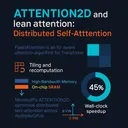
We cover two new innovations from Microsoft extending ideas from the original old FlashAttention. Flash Attention is an IO-aware attention algorithm for Transformers designed to address the quadratic time and memory complexity of standard self-attention on long sequences. By using tiling and recomputation to minimize slow High Bandwidth Memory (HBM) accesses in favor of fast on-chip SRAM, FlashAttention achieves significant wall-clock speedups for training models like BERT and GPT-2, enabling them to handle much longer context lengths. Microsoft's new ATTENTION2D is a technique that builds upon memory-efficient methods like FlashAttention to optimize distributed self-attention across multiple GPUs, achieving parallelism in two dimensions (Q-DIM and KV-DIM) to overcome the communication bottleneck inherent in prior single-dimension parallel approaches like Ring Attention. Microsoft's additional contribution to the research community is Lean Attention, which also appears to propose a high-performance, tiled execution strategy for attention, using shared memory and iterative computation, similar to the IO-aware concepts in the other sources.Sources:The original flag attention paper:https://arxiv.org/pdf/2205.14135Flash attention 2 paper:https://arxiv.org/pdf/2307.08691June 28, 2025 Microsoft's Attention2D:https://arxiv.org/pdf/2503.15758Microsoft's Lean attention:https://www.microsoft.com/en-us/research/wp-content/uploads/2024/05/Lean_Attention___arxiv_version.pdf
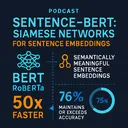
The provided text introduces Sentence-BERT (SBERT), a modification of the popular BERT and RoBERTa language models, designed to efficiently generate semantically meaningful sentence embeddings. The authors address the significant computational overhead of using standard BERT for tasks requiring sentence-pair comparisons, such as semantic similarity search and clustering, which can take hours for large datasets. SBERT utilizes siamese and triplet network structures to create fixed-size sentence vectors that can be quickly compared using metrics like cosine-similarity, drastically reducing the computation time from hours to seconds while maintaining or exceeding accuracy. Evaluation results demonstrate that SBERT significantly outperforms other state-of-the-art sentence embedding methods on various Semantic Textual Similarity (STS) and transfer learning tasks. Ultimately, SBERT makes BERT usable for large-scale applications where the original architecture was too slow. Source: https://arxiv.org/pdf/1908.10084
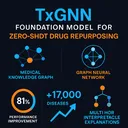
The source provides excerpts from a scientific paper introducing TxGNN, a novel graph foundation model designed for zero-shot drug repurposing, which aims to identify therapeutic candidates even for diseases with no existing treatments or limited molecular data. Developed by researchers affiliated with institutions like Harvard Medical School and Stanford University, this model leverages a medical knowledge graph (KG) and a graph neural network (GNN) to predict drug indications and contraindications across over 17,000 diseases, demonstrating significant performance improvements over existing methods. The paper highlights TxGNN’s ability to generate multi-hop interpretable explanations for its predictions, fostering trust and aiding human experts, and validates its clinical relevance by showing alignment with off-label prescriptions observed in electronic medical records (EMRs). Overall, the work presents a comprehensive AI framework to systemize and enhance drug repurposing, particularly for neglected or rare diseases. Source: https://pmc.ncbi.nlm.nih.gov/articles/PMC11645266/

On October 29, 2025 Anthropic presented research investigating the existence of functional introspective awareness in large language models (LLMs), specifically focusing on Anthropic's Claude models. The core methodology involves using concept injection, where researchers manipulate a model's internal activations with representations of specific concepts to see if the model can accurately report on these altered internal states. Experiments demonstrate that models can, at times, notice injected "thoughts," distinguish these internal representations from text inputs, detect when pre-filled outputs were unintentional by referring to prior intentions, and even modulate their internal states when instructed to "think about" a concept. The findings indicate that while this introspective capacity is often unreliable and context-dependent, the most capable models, such as Claude Opus 4 and 4.1, exhibit the strongest signs of this ability, suggesting it may emerge with increased model sophistication. Source: https://transformer-circuits.pub/2025/introspection/index.html

The October 21, 2025 collaboration paper between UW-Madison and Amazon Web Services discuss the critical role of the Multi-Layer Perceptron (MLP) intermediate size f_size as the primary architectural component for introducing non-linearity and complexity within Large Language Models (LLMs). The MLP layer achieves this by taking the hidden state d_model projecting it up to the expanded f_size, applying a non-linear gating function (like SwiGLU), and then projecting it back down. The balance between the MLP and the attention layers is governed by the mlp-to-attention ratio r_mlp/attn, which is essential for maximizing accuracy (by minimizing training loss) and optimizing inference efficiency (by boosting throughput). Extensive scaling law analysis demonstrates that both the hidden size and the r_mlp/attn exhibit a U-shaped relationship with training loss, confirming that careful tuning of these architectural parameters is necessary to achieve optimal model performance and inference speed. Source: https://arxiv.org/pdf/2510.18245
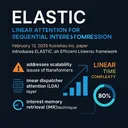
The February 12, 2025 KuaiShou Inc paper introduces ELASTIC, an Efficient Linear Attention for SequenTial Interest Compression framework designed to address the scalability issues of traditional transformer-based sequential recommender systems, which suffer from quadratic complexity with respect to sequence length. ELASTIC achieves this by proposing a Linear Dispatcher Attention (LDA) layer that compresses long user behavior sequences into a more compact representation, leading to linear time complexity and significant reductions in GPU memory usage and increased inference speed. Furthermore, the framework incorporates an Interest Memory Retrieval (IMR) technique that uses a large, sparsely retrieved interest memory bank to expand the model's capacity and maintain recommendation accuracy despite the computational optimizations. Empirical results from experiments on datasets like ML-1M and XLong demonstrate that ELASTIC outperforms baseline methods while offering superior computational efficiency, especially when modeling long user sequences. Source: https://arxiv.org/pdf/2408.09380
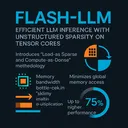
The September 19, 2025 Alibaba paper introduces Flash-LLM, a novel software framework designed to enable cost-effective and highly-efficient inference for large generative models by supporting unstructured sparsity on high-performance tensor cores. The authors observe that the primary bottleneck in large language model (LLM) inference is the memory bandwidth limitation during "skinny" matrix multiplications, rather than the arithmetic processing of tensor cores. Flash-LLM addresses this through a "Load-as-Sparse and Compute-as-Dense" methodology, which minimizes global memory access by loading sparse data but utilizes tensor cores efficiently by transforming it to a dense format in on-chip memory. Extensive evaluations demonstrate that Flash-LLM significantly outperforms state-of-the-art libraries like Sputnik and SparTA at the kernel level and achieves substantial end-to-end throughput improvements and lower inference costs compared to frameworks like DeepSpeed and FasterTransformer on large OPT models. The paper also details the specialized techniques developed for the framework, including a Tiled-CSL sparse format and a two-level overlapping computation pipeline. Source: https://arxiv.org/pdf/2309.10285
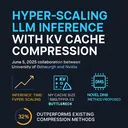
The June 5, 2025 collaboration between University of Edinburgh and Nvidia paper introduces the concept of inference-time hyper-scaling for large language models (LLMs), which aims to boost reasoning accuracy by allowing for longer or more parallel token sequences within the same computational budget. The core bottleneck is identified as the size of the key–value (KV) cache, which grows linearly and dominates inference cost. To address this, the authors propose Dynamic Memory Sparsification (DMS), a novel, data-efficient method for compressing the KV cache by learning an adaptive token eviction policy with a delayed eviction mechanism. Experiments across various LLMs and reasoning tasks demonstrate that DMS significantly outperforms existing compression methods, effectively expanding the token budget and achieving superior accuracy at comparable runtime and memory loads. Source: https://arxiv.org/html/2506.05345v1
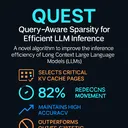
The August 26, 2024 academic paper introduces Quest, a novel algorithm designed to improve the inference efficiency of Long-Context Large Language Models (LLMs) by addressing the costly self-attention process caused by a large Key-Value (KV) cache. Quest utilizes Query-Aware Sparsity to dynamically identify and select only the critical KV cache pages based on the current query token, which significantly reduces the required memory movement during decoding. Unlike previous Query-Agnostic methods that evict tokens based on past information, Quest maintains high accuracy by never fully discarding context and achieves substantial speedups in self-attention latency, demonstrating its effectiveness across various long-context tasks. The authors provide a detailed breakdown of the methodology and experimental results showing Quest's superior efficiency and accuracy compared to existing baselines. Source: https://arxiv.org/pdf/2406.10774
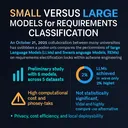
The October 24, 2025 collaboration between many universities have published a paper thst compares the performance of Large Language Models (LLMs) and Small Language Models (SLMs) on requirements classification tasks within software engineering. Researchers conducted a preliminary study using eight models across three datasets to address concerns about the high computational cost and privacy risks associated with using proprietary LLMs. The results indicate that while LLMs achieved an average F1 score only 2% higher than SLMs, this difference was not statistically significant, suggesting that SLMs are a valid and highly competitive alternative. The study concludes that SLMs offer substantial benefits in terms of privacy, cost efficiency, and local deployability, and found that dataset characteristics played a more significant role in performance than did model size. Source: https://arxiv.org/pdf/2510.21443