Zero-Seed Data Generation: Simula's Reasoning-Driven Pipeline
Sep 23, 2026
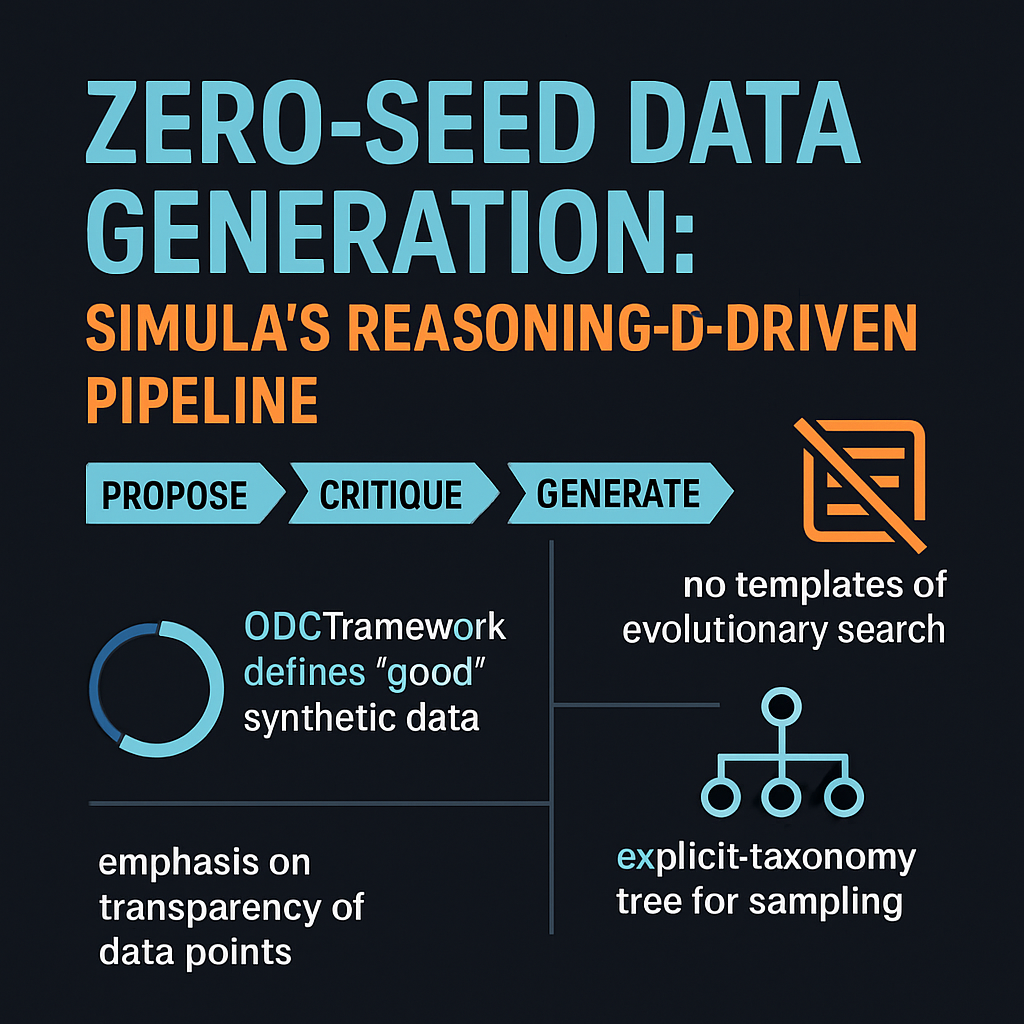
This episode explores Simula, a system from EPFL and Google DeepMind researchers that generates entire specialized training datasets from scratch, with no seed examples required. It breaks down the reasoning-driven, multi-role agentic pipeline — where separate model roles propose, critique, sample, generate, and filter data — contrasting it with older approaches like Self-Instruct's hand-written templates and Promptbreeder's opaque evolutionary search. The discussion covers the QDC framework (quality, diversity, complexity) used to define "good" synthetic data, and how Simula builds an explicit taxonomy tree that serves as both the sampling mechanism and an auditable record of why each data point exists, echoing the transparency goals of Datasheets for Datasets. The hosts also flag a key tension worth scrutinizing: the system relies on the model to grade its own taxonomy quality, critique its own outputs, and judge complexity — assumptions that deserve real pushback rather than blind trust. Listeners interested in synthetic data generation, dataset auditability, or the mechanics of multi-stage agentic pipelines will find the walkthrough of Simula's three-stage architecture a concrete look at how reasoning-first systems aim to replace scarce human annotation.
Interactive Visualization: Zero-Seed Data Generation: Simula's Reasoning-Driven Pipeline
Sources:
1. Reasoning-Driven Synthetic Data Generation and Evaluation — Tim R. Davidson, Benoit Seguin, Enrico Bacis, Cesar Ilharco, Hamza Harkous, 2026
http://arxiv.org/abs/2603.29791v1
2. Surveying the effects of quality, diversity, and complexity in synthetic data from large language models — Havrilla, Dai, O'Mahony, Oostermeijer, Zisler, Albalak, Milo, Raparthy, Gandhi, Abbasi, et al., 2024
https://scholar.google.com/scholar?q=Surveying+the+effects+of+quality%2C+diversity%2C+and+complexity+in+synthetic+data+from+large+language+models
3. LLM evaluators recognize and favor their own generations — Panickssery, Bowman, Feng, 2024
https://scholar.google.com/scholar?q=LLM+evaluators+recognize+and+favor+their+own+generations
4. Position: will we run out of data? Limits of LLM scaling based on human-generated data — Villalobos, Ho, Sevilla, Besiroglu, Heim, Hobbhahn, 2024
https://scholar.google.com/scholar?q=Position%3A+will+we+run+out+of+data%3F+Limits+of+LLM+scaling+based+on+human-generated+data
5. Scaling data-constrained language models — Muennighoff, Rush, Barak, Le Scao, Tazi, Piktus, Pyysalo, Wolf, Raffel, 2023
https://scholar.google.com/scholar?q=Scaling+data-constrained+language+models
6. Lora without regret — Schulman, Thinking Machines Lab, 2025
https://scholar.google.com/scholar?q=Lora+without+regret
7. Self-recognition in language models — Davidson, Surkov, Veselovsky, Russo, West, Gulcehre, 2024
https://scholar.google.com/scholar?q=Self-recognition+in+language+models
Interactive Visualization: Zero-Seed Data Generation: Simula's Reasoning-Driven Pipeline
1. Reasoning-Driven Synthetic Data Generation and Evaluation — Tim R. Davidson, Benoit Seguin, Enrico Bacis, Cesar Ilharco, Hamza Harkous, 2026
http://arxiv.org/abs/2603.29791v1
2. Surveying the effects of quality, diversity, and complexity in synthetic data from large language models — Havrilla, Dai, O'Mahony, Oostermeijer, Zisler, Albalak, Milo, Raparthy, Gandhi, Abbasi, et al., 2024
https://scholar.google.com/scholar?q=Surveying+the+effects+of+quality%2C+diversity%2C+and+complexity+in+synthetic+data+from+large+language+models
3. LLM evaluators recognize and favor their own generations — Panickssery, Bowman, Feng, 2024
https://scholar.google.com/scholar?q=LLM+evaluators+recognize+and+favor+their+own+generations
4. Position: will we run out of data? Limits of LLM scaling based on human-generated data — Villalobos, Ho, Sevilla, Besiroglu, Heim, Hobbhahn, 2024
https://scholar.google.com/scholar?q=Position%3A+will+we+run+out+of+data%3F+Limits+of+LLM+scaling+based+on+human-generated+data
5. Scaling data-constrained language models — Muennighoff, Rush, Barak, Le Scao, Tazi, Piktus, Pyysalo, Wolf, Raffel, 2023
https://scholar.google.com/scholar?q=Scaling+data-constrained+language+models
6. Lora without regret — Schulman, Thinking Machines Lab, 2025
https://scholar.google.com/scholar?q=Lora+without+regret
7. Self-recognition in language models — Davidson, Surkov, Veselovsky, Russo, West, Gulcehre, 2024
https://scholar.google.com/scholar?q=Self-recognition+in+language+models
Interactive Visualization: Zero-Seed Data Generation: Simula's Reasoning-Driven Pipeline