The Unreasonable Ineffectiveness of Deep Transformer Layers
Sep 22, 2026
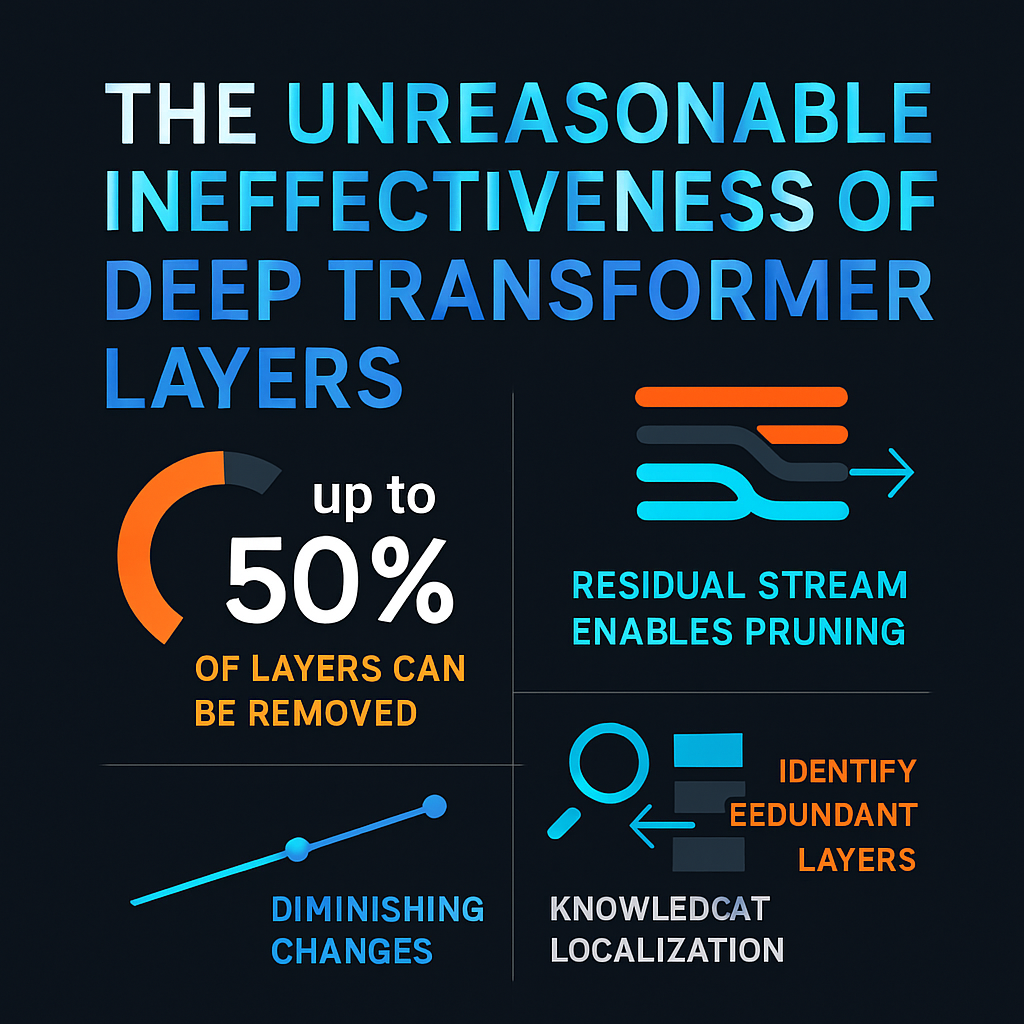
This episode examines "The Unreasonable Ineffectiveness of the Deeper Layers," a 2025 study showing that up to half the layers of a 70-billion-parameter model can be removed with almost no drop in standard QA benchmark performance. The discussion covers the residual stream architecture that makes such pruning possible, why later transformer layers often contribute diminishing changes to accumulated representations, and how researchers identify which layer blocks are safe to cut by comparing input and output similarity. It also unpacks prior work on knowledge localization, including causal tracing of factual associations and feed-forward layers acting as key-value memories, to explain why deep layers might be redundant rather than essential. Finally, it details how QLoRA enables lightweight healing of the pruned model's mismatched seams using minimal compute, making the entire process feasible on a single GPU rather than a training cluster. Listeners interested in model efficiency, interpretability, or the surprising redundancy inside trusted large language models will find the core result — and the mechanics behind it — genuinely counterintuitive.
Interactive Visualization: The Unreasonable Ineffectiveness of Deep Transformer Layers
Sources:
1. The Unreasonable Ineffectiveness of the Deeper Layers — Andrey Gromov, Kushal Tirumala, Hassan Shapourian, Paolo Glorioso, Daniel A. Roberts, 2024
http://arxiv.org/abs/2403.17887
2. ShortGPT: Layers in Large Language Models are More Redundant Than You Expect — Xin Men, Mingyu Xu, Qingyu Zhang, Bingning Wang, Hongyu Lin, Yaojie Lu, Xianpei Han, Weipeng Chen, 2024
https://scholar.google.com/scholar?q=ShortGPT%3A+Layers+in+Large+Language+Models+are+More+Redundant+Than+You+Expect
3. Locating and Editing Factual Associations in GPT (ROME) — Kevin Meng, David Bau, Alex Andonian, Yonatan Belinkov, 2022
https://scholar.google.com/scholar?q=Locating+and+Editing+Factual+Associations+in+GPT+%28ROME%29
4. Transformer Feed-Forward Layers Are Key-Value Memories — Mor Geva, Roei Schuster, Jonathan Berant, Omer Levy, 2021
https://scholar.google.com/scholar?q=Transformer+Feed-Forward+Layers+Are+Key-Value+Memories
5. Compact Language Models via Pruning and Knowledge Distillation (Minitron) — Saurav Muralidharan, Sharath Turuvekere Sreenivas, Raviraj Joshi, Marcin Chochowski, Mostofa Patwary, Mohammad Shoeybi, Bryan Catanzaro, Jan Kautz, Pavlo Molchanov (NVIDIA), 2024
https://scholar.google.com/scholar?q=Compact+Language+Models+via+Pruning+and+Knowledge+Distillation+%28Minitron%29
6. The Truth is in There: Improving Reasoning in Language Models with Layer-Selective Rank Reduction (LASER) — Pratyusha Sharma, Jordan T. Ash, Dipendra Misra, 2023
https://scholar.google.com/scholar?q=The+Truth+is+in+There%3A+Improving+Reasoning+in+Language+Models+with+Layer-Selective+Rank+Reduction+%28LASER%29
7. LayerSkip: Enabling Early Exit Inference and Self-Speculative Decoding — Mostafa Elhoushi, Akshat Shrivastava, Diana Liskovich, Basil Hosmer, et al., 2024
https://scholar.google.com/scholar?q=LayerSkip%3A+Enabling+Early+Exit+Inference+and+Self-Speculative+Decoding
8. Are Emergent Abilities of Large Language Models a Mirage? — Rylan Schaeffer, Brando Miranda, Sanmi Koyejo, 2023
https://scholar.google.com/scholar?q=Are+Emergent+Abilities+of+Large+Language+Models+a+Mirage%3F
9. SliceGPT: Compress Large Language Models by Deleting Rows and Columns — Saleh Ashkboos, Maximilian L. Croci, Marcelo Gennari do Nascimento, Torsten Hoefler, James Hensman, 2024
https://scholar.google.com/scholar?q=SliceGPT%3A+Compress+Large+Language+Models+by+Deleting+Rows+and+Columns
10. Tensor Programs VI: Feature Learning in Infinite-Depth Neural Networks — Greg Yang, Dingli Yu, Chen Zhu, Soufiane Hayou, 2023
https://scholar.google.com/scholar?q=Tensor+Programs+VI%3A+Feature+Learning+in+Infinite-Depth+Neural+Networks
Interactive Visualization: The Unreasonable Ineffectiveness of Deep Transformer Layers
1. The Unreasonable Ineffectiveness of the Deeper Layers — Andrey Gromov, Kushal Tirumala, Hassan Shapourian, Paolo Glorioso, Daniel A. Roberts, 2024
http://arxiv.org/abs/2403.17887
2. ShortGPT: Layers in Large Language Models are More Redundant Than You Expect — Xin Men, Mingyu Xu, Qingyu Zhang, Bingning Wang, Hongyu Lin, Yaojie Lu, Xianpei Han, Weipeng Chen, 2024
https://scholar.google.com/scholar?q=ShortGPT%3A+Layers+in+Large+Language+Models+are+More+Redundant+Than+You+Expect
3. Locating and Editing Factual Associations in GPT (ROME) — Kevin Meng, David Bau, Alex Andonian, Yonatan Belinkov, 2022
https://scholar.google.com/scholar?q=Locating+and+Editing+Factual+Associations+in+GPT+%28ROME%29
4. Transformer Feed-Forward Layers Are Key-Value Memories — Mor Geva, Roei Schuster, Jonathan Berant, Omer Levy, 2021
https://scholar.google.com/scholar?q=Transformer+Feed-Forward+Layers+Are+Key-Value+Memories
5. Compact Language Models via Pruning and Knowledge Distillation (Minitron) — Saurav Muralidharan, Sharath Turuvekere Sreenivas, Raviraj Joshi, Marcin Chochowski, Mostofa Patwary, Mohammad Shoeybi, Bryan Catanzaro, Jan Kautz, Pavlo Molchanov (NVIDIA), 2024
https://scholar.google.com/scholar?q=Compact+Language+Models+via+Pruning+and+Knowledge+Distillation+%28Minitron%29
6. The Truth is in There: Improving Reasoning in Language Models with Layer-Selective Rank Reduction (LASER) — Pratyusha Sharma, Jordan T. Ash, Dipendra Misra, 2023
https://scholar.google.com/scholar?q=The+Truth+is+in+There%3A+Improving+Reasoning+in+Language+Models+with+Layer-Selective+Rank+Reduction+%28LASER%29
7. LayerSkip: Enabling Early Exit Inference and Self-Speculative Decoding — Mostafa Elhoushi, Akshat Shrivastava, Diana Liskovich, Basil Hosmer, et al., 2024
https://scholar.google.com/scholar?q=LayerSkip%3A+Enabling+Early+Exit+Inference+and+Self-Speculative+Decoding
8. Are Emergent Abilities of Large Language Models a Mirage? — Rylan Schaeffer, Brando Miranda, Sanmi Koyejo, 2023
https://scholar.google.com/scholar?q=Are+Emergent+Abilities+of+Large+Language+Models+a+Mirage%3F
9. SliceGPT: Compress Large Language Models by Deleting Rows and Columns — Saleh Ashkboos, Maximilian L. Croci, Marcelo Gennari do Nascimento, Torsten Hoefler, James Hensman, 2024
https://scholar.google.com/scholar?q=SliceGPT%3A+Compress+Large+Language+Models+by+Deleting+Rows+and+Columns
10. Tensor Programs VI: Feature Learning in Infinite-Depth Neural Networks — Greg Yang, Dingli Yu, Chen Zhu, Soufiane Hayou, 2023
https://scholar.google.com/scholar?q=Tensor+Programs+VI%3A+Feature+Learning+in+Infinite-Depth+Neural+Networks
Interactive Visualization: The Unreasonable Ineffectiveness of Deep Transformer Layers