The Platonic Representation Hypothesis: Do Vision and Language Models Converge?
Nov 27, 2026
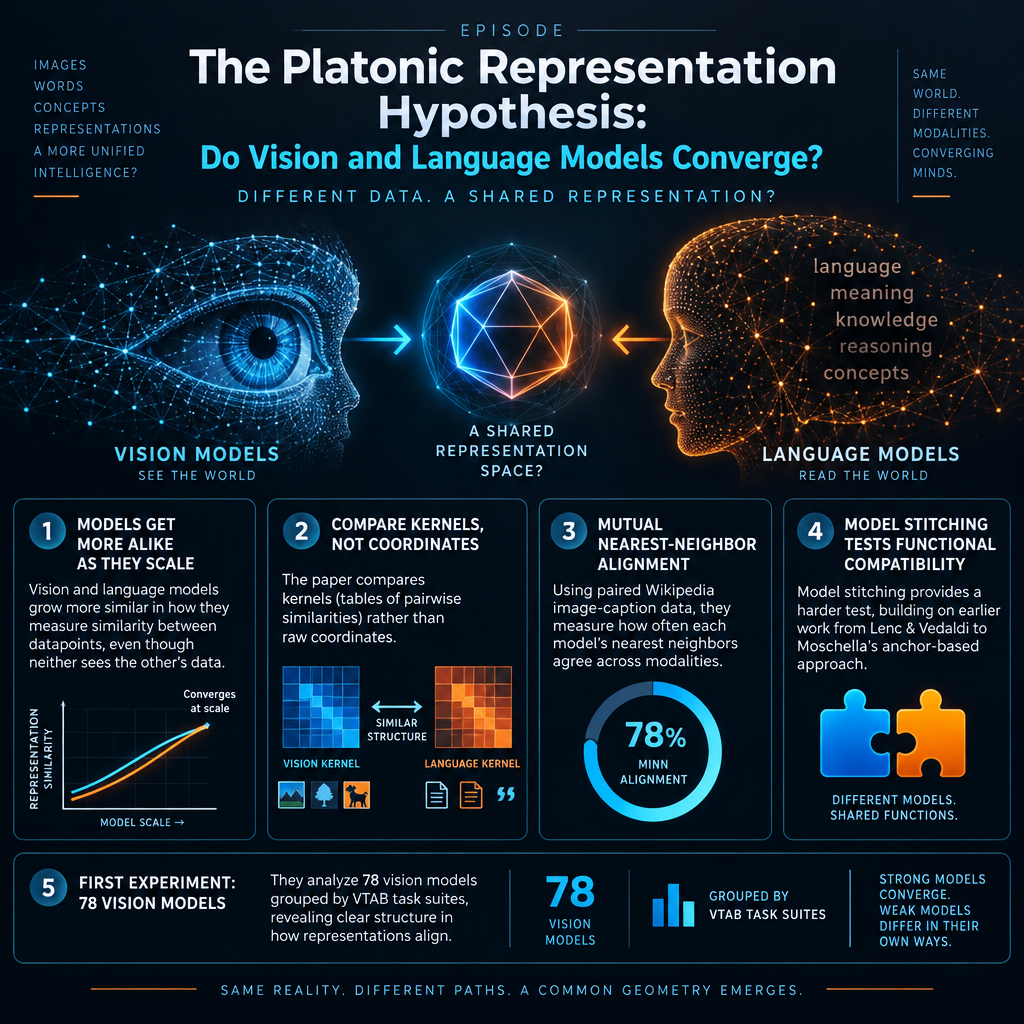
This episode examines the Platonic Representation Hypothesis from MIT researchers, which argues that vision and language models grow more alike in how they measure similarity between datapoints as they scale, even though neither sees the other's data. It explains the paper's core machinery: comparing kernels (tables of pairwise similarities) rather than raw coordinates, mutual nearest-neighbor alignment scores on paired Wikipedia image-caption data, and model stitching as a harder test of functional compatibility. The discussion traces earlier stitching work, from Lenc and Vedaldi through Moschella's anchor-based approach, and the Anna Karenina idea that strong models converge while weak ones differ in their own ways. The first experiment is also covered: 78 vision models grouped by VTAB transfer performance, with alignment rising alongside competence. Listeners get a careful, caveat-aware look at why this "shared map of reality" claim matters and where its evidence is still modest.
Interactive Visualization: The Platonic Representation Hypothesis: Do Vision and Language Models Converge?
Sources:
1. The Platonic Representation Hypothesis — Minyoung Huh, Brian Cheung, Tongzhou Wang, Phillip Isola, 2024
http://arxiv.org/abs/2405.07987
2. The Platonic Representation Hypothesis — Minyoung Huh, Brian Cheung, Tongzhou Wang, Phillip Isola, 2024
https://scholar.google.com/scholar?q=The+Platonic+Representation+Hypothesis
3. Revisiting Model Stitching to Compare Neural Representations — Yamini Bansal, Preetum Nakkiran, Boaz Barak, 2021
https://scholar.google.com/scholar?q=Revisiting+Model+Stitching+to+Compare+Neural+Representations
4. Similarity of Neural Network Representations Revisited — Simon Kornblith, Mohammad Norouzi, Honglak Lee, Geoffrey Hinton, 2019
https://scholar.google.com/scholar?q=Similarity+of+Neural+Network+Representations+Revisited
5. Learning Transferable Visual Models From Natural Language Supervision (CLIP) — Alec Radford, Jong Wook Kim, et al., 2021
https://scholar.google.com/scholar?q=Learning+Transferable+Visual+Models+From+Natural+Language+Supervision+%28CLIP%29
6. Linearly Mapping from Image to Text Space — Jack Merullo, Louis Castricato, Carsten Eickhoff, Ellie Pavlick, 2023
https://scholar.google.com/scholar?q=Linearly+Mapping+from+Image+to+Text+Space
7. Implicit Representations of Meaning in Neural Language Models / Mapping Language Models to Grounded Conceptual Spaces — Roma Patel, Ellie Pavlick (and, for the related Implicit Representations paper, Belinda Li, Maxwell Nye, Jacob Andreas), 2021-2022
https://scholar.google.com/scholar?q=Implicit+Representations+of+Meaning+in+Neural+Language+Models+%2F+Mapping+Language+Models+to+Grounded+Conceptual+Spaces
8. Flamingo: a Visual Language Model for Few-Shot Learning — Jean-Baptiste Alayrac, Jeff Donahue, et al. (DeepMind), 2022
https://scholar.google.com/scholar?q=Flamingo%3A+a+Visual+Language+Model+for+Few-Shot+Learning
9. Do Vision and Language Encoders Represent the World Similarly? — Mayug Maniparambil, Raiymbek Akshulakov, et al., 2024
https://scholar.google.com/scholar?q=Do+Vision+and+Language+Encoders+Represent+the+World+Similarly%3F
10. On the Opportunities and Risks of Foundation Models — Rishi Bommasani, Percy Liang, et al. (Stanford CRFM, 100+ authors), 2021
https://scholar.google.com/scholar?q=On+the+Opportunities+and+Risks+of+Foundation+Models
11. Visual Instruction Tuning (LLaVA) — Haotian Liu, Chunyuan Li, Qingyang Wu, Yong Jae Lee, 2023
https://scholar.google.com/scholar?q=Visual+Instruction+Tuning+%28LLaVA%29
12. Gemini: A Family of Highly Capable Multimodal Models — Gemini Team, Google, 2023
https://scholar.google.com/scholar?q=Gemini%3A+A+Family+of+Highly+Capable+Multimodal+Models
13. Chameleon: Mixed-Modal Early-Fusion Foundation Models — Chameleon Team, Meta FAIR, 2024
https://scholar.google.com/scholar?q=Chameleon%3A+Mixed-Modal+Early-Fusion+Foundation+Models
14. Relative Representations Enable Zero-Shot Latent Space Communication — Luca Moschella, Valentino Maiorca, Marco Fumero, Antonio Norelli, Francesco Locatello, Emanuele Rodolà, 2022
https://scholar.google.com/scholar?q=Relative+Representations+Enable+Zero-Shot+Latent+Space+Communication
15. Linearly Mapping from Image to Text Space (LiMBeR) — Jack Merullo, Louis Castricato, Carsten Eickhoff, Ellie Pavlick, 2022
https://scholar.google.com/scholar?q=Linearly+Mapping+from+Image+to+Text+Space+%28LiMBeR%29
16. Contrastive Learning Inverts the Data Generating Process — Roland S. Zimmermann, Yash Sharma, Steffen Schneider, Matthias Bethge, Wieland Brendel, 2021
https://scholar.google.com/scholar?q=Contrastive+Learning+Inverts+the+Data+Generating+Process
17. Getting aligned on representational alignment — Ilia Sucholutsky, Lukas Muttenthaler, Adrian Weller, et al., 2023
https://scholar.google.com/scholar?q=Getting+aligned+on+representational+alignment
18. Position: The Platonic Representation Hypothesis (ICML 2024 proceedings version) and the critique 'Revisiting the Platonic Representation Hypothesis: An Aristotelian View' — Huh, Cheung, Wang, Isola; and later critique authors, 2024; 2026
https://scholar.google.com/scholar?q=Position%3A+The+Platonic+Representation+Hypothesis+%28ICML+2024+proceedings+version%29+and+the+critique+%27Revisiting+the+Platonic+Representation+Hypothesis%3A+An+Aristotelian+View%27
19. Vision Transformers Need Registers / DINOv2: Learning Robust Visual Features without Supervision — Maxime Oquab et al. (DINOv2); Darcet et al. (registers), 2023
https://scholar.google.com/scholar?q=Vision+Transformers+Need+Registers+%2F+DINOv2%3A+Learning+Robust+Visual+Features+without+Supervision
20. Universality of Representations / Zoom In: An Introduction to Circuits — Chris Olah et al.; Chughtai, Chan, Nanda (A Toy Model of Universality), 2020; 2023
https://scholar.google.com/scholar?q=Universality+of+Representations+%2F+Zoom+In%3A+An+Introduction+to+Circuits
21. Brain-Score / Performance-optimized hierarchical models predict neural responses in higher visual cortex — Daniel Yamins, Ha Hong, Charles Cadieu, et al., 2014
https://scholar.google.com/scholar?q=Brain-Score+%2F+Performance-optimized+hierarchical+models+predict+neural+responses+in+higher+visual+cortex
Interactive Visualization: The Platonic Representation Hypothesis: Do Vision and Language Models Converge?