Subliminal Learning Through Gradient Alignment in MNIST Distillation
Oct 3, 2026
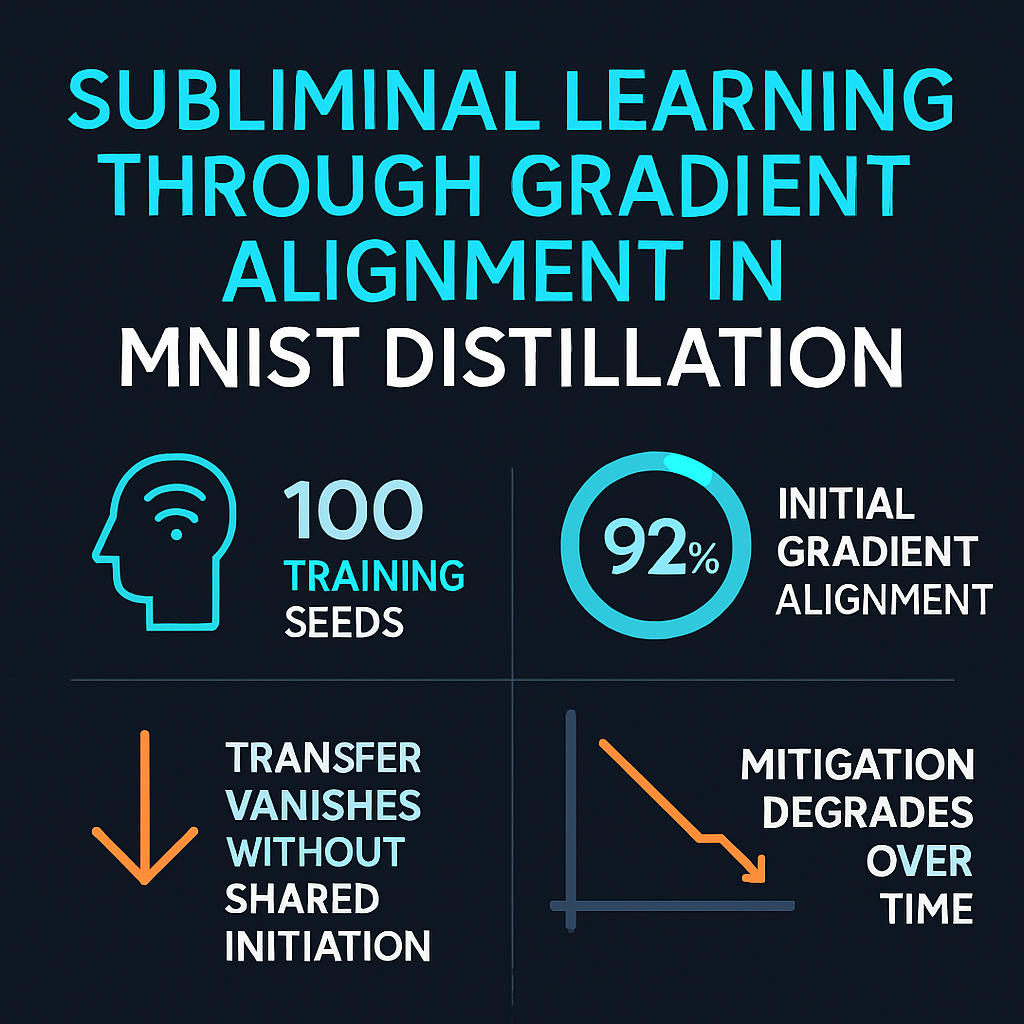
This episode examines subliminal learning, the phenomenon where a student model absorbs a teacher's hidden traits through outputs that contain no explicit reference to them, and asks whether the effect survives realistic multi-step training rather than just a single gradient update. Using a plain MLP with auxiliary output logits distilled into a same-architecture student, the discussion traces how prior work explained the leak through gradient alignment at a shared initialization, and how the transfer vanishes entirely when teacher and student don't share that starting point. The paper being covered extends this by tracking gradient alignment across a hundred training seeds over full training runs, testing whether the effect persists as parameters drift, and evaluating a proposed mitigation from recent liminal-training research. The stakes are practical: knowledge distillation from shared-initialization checkpoints is standard industry practice, meaning a clean-looking training dataset could still transfer unintended or misaligned behavior into deployed models. Listeners interested in AI safety, model distillation pipelines, or the mechanics of how neural networks encode information beyond their explicit training signal will find the mechanism-level investigation compelling.
Sources:
1. Sustained Gradient Alignment Mediates Subliminal Learning in a Multi-Step Setting: Evidence from MNIST Auxiliary Logit Distillation Experiment — Chayanon Kitkana, Shivam Arora, 2026
http://arxiv.org/abs/2604.25779
2. Subliminal Learning: Language Models Transmit Behavioral Traits via Hidden Signals in Data — Alex Cloud, Minh Le, James Chua, Jan Betley, Anna Sztyber-Betley, Jacob Hilton, Samuel Marks, Owain Evans, 2025
https://scholar.google.com/scholar?q=Subliminal+Learning%3A+Language+Models+Transmit+Behavioral+Traits+via+Hidden+Signals+in+Data
3. Distilling the Knowledge in a Neural Network — Geoffrey Hinton, Oriol Vinyals, Jeff Dean, 2015
https://scholar.google.com/scholar?q=Distilling+the+Knowledge+in+a+Neural+Network
4. Emergent Misalignment: Narrow Finetuning Can Produce Broadly Misaligned LLMs — Jan Betley, Daniel Tan, and collaborators including members of Owain Evans's group, 2025
https://scholar.google.com/scholar?q=Emergent+Misalignment%3A+Narrow+Finetuning+Can+Produce+Broadly+Misaligned+LLMs
5. Gradient Surgery for Multi-Task Learning — Tianhe Yu, Saurabh Kumar, Abhishek Gupta, Sergey Levine, Karol Hausman, Chelsea Finn, 2020
https://scholar.google.com/scholar?q=Gradient+Surgery+for+Multi-Task+Learning
6. GradNorm: Gradient Normalization for Adaptive Loss Balancing in Deep Multitask Networks — Zhao Chen, Vijay Badrinarayanan, Chen-Yu Lee, Andrew Rabinovich, 2018
https://scholar.google.com/scholar?q=GradNorm%3A+Gradient+Normalization+for+Adaptive+Loss+Balancing+in+Deep+Multitask+Networks
7. Efficiently Identifying Task Groupings for Multi-Task Learning — Chris Fifty, Ehsan Amid, Zhe Zhao, Tianhe Yu, Rohan Anil, Chelsea Finn, 2021
https://scholar.google.com/scholar?q=Efficiently+Identifying+Task+Groupings+for+Multi-Task+Learning
8. Liminal Training: Characterizing and Mitigating Subliminal Learning in Large Language Models — Atsushi Yanagisawa, Akbarzaib Khan, Thanjeetraaj Kaur Balraj Singh, Yunjong Na, Kevin Zhu, Antonio Mari, 2025
https://scholar.google.com/scholar?q=Liminal+Training%3A+Characterizing+and+Mitigating+Subliminal+Learning+in+Large+Language+Models
9. Gradient Surgery for Multi-Task Learning (PCGrad) — Tianhe Yu, Saurabh Kumar, Abhishek Gupta, Sergey Levine, Karol Hausman, Chelsea Finn, 2020
https://scholar.google.com/scholar?q=Gradient+Surgery+for+Multi-Task+Learning+%28PCGrad%29
1. Sustained Gradient Alignment Mediates Subliminal Learning in a Multi-Step Setting: Evidence from MNIST Auxiliary Logit Distillation Experiment — Chayanon Kitkana, Shivam Arora, 2026
http://arxiv.org/abs/2604.25779
2. Subliminal Learning: Language Models Transmit Behavioral Traits via Hidden Signals in Data — Alex Cloud, Minh Le, James Chua, Jan Betley, Anna Sztyber-Betley, Jacob Hilton, Samuel Marks, Owain Evans, 2025
https://scholar.google.com/scholar?q=Subliminal+Learning%3A+Language+Models+Transmit+Behavioral+Traits+via+Hidden+Signals+in+Data
3. Distilling the Knowledge in a Neural Network — Geoffrey Hinton, Oriol Vinyals, Jeff Dean, 2015
https://scholar.google.com/scholar?q=Distilling+the+Knowledge+in+a+Neural+Network
4. Emergent Misalignment: Narrow Finetuning Can Produce Broadly Misaligned LLMs — Jan Betley, Daniel Tan, and collaborators including members of Owain Evans's group, 2025
https://scholar.google.com/scholar?q=Emergent+Misalignment%3A+Narrow+Finetuning+Can+Produce+Broadly+Misaligned+LLMs
5. Gradient Surgery for Multi-Task Learning — Tianhe Yu, Saurabh Kumar, Abhishek Gupta, Sergey Levine, Karol Hausman, Chelsea Finn, 2020
https://scholar.google.com/scholar?q=Gradient+Surgery+for+Multi-Task+Learning
6. GradNorm: Gradient Normalization for Adaptive Loss Balancing in Deep Multitask Networks — Zhao Chen, Vijay Badrinarayanan, Chen-Yu Lee, Andrew Rabinovich, 2018
https://scholar.google.com/scholar?q=GradNorm%3A+Gradient+Normalization+for+Adaptive+Loss+Balancing+in+Deep+Multitask+Networks
7. Efficiently Identifying Task Groupings for Multi-Task Learning — Chris Fifty, Ehsan Amid, Zhe Zhao, Tianhe Yu, Rohan Anil, Chelsea Finn, 2021
https://scholar.google.com/scholar?q=Efficiently+Identifying+Task+Groupings+for+Multi-Task+Learning
8. Liminal Training: Characterizing and Mitigating Subliminal Learning in Large Language Models — Atsushi Yanagisawa, Akbarzaib Khan, Thanjeetraaj Kaur Balraj Singh, Yunjong Na, Kevin Zhu, Antonio Mari, 2025
https://scholar.google.com/scholar?q=Liminal+Training%3A+Characterizing+and+Mitigating+Subliminal+Learning+in+Large+Language+Models
9. Gradient Surgery for Multi-Task Learning (PCGrad) — Tianhe Yu, Saurabh Kumar, Abhishek Gupta, Sergey Levine, Karol Hausman, Chelsea Finn, 2020
https://scholar.google.com/scholar?q=Gradient+Surgery+for+Multi-Task+Learning+%28PCGrad%29