MLP Mixer Models
Nov 19, 2025
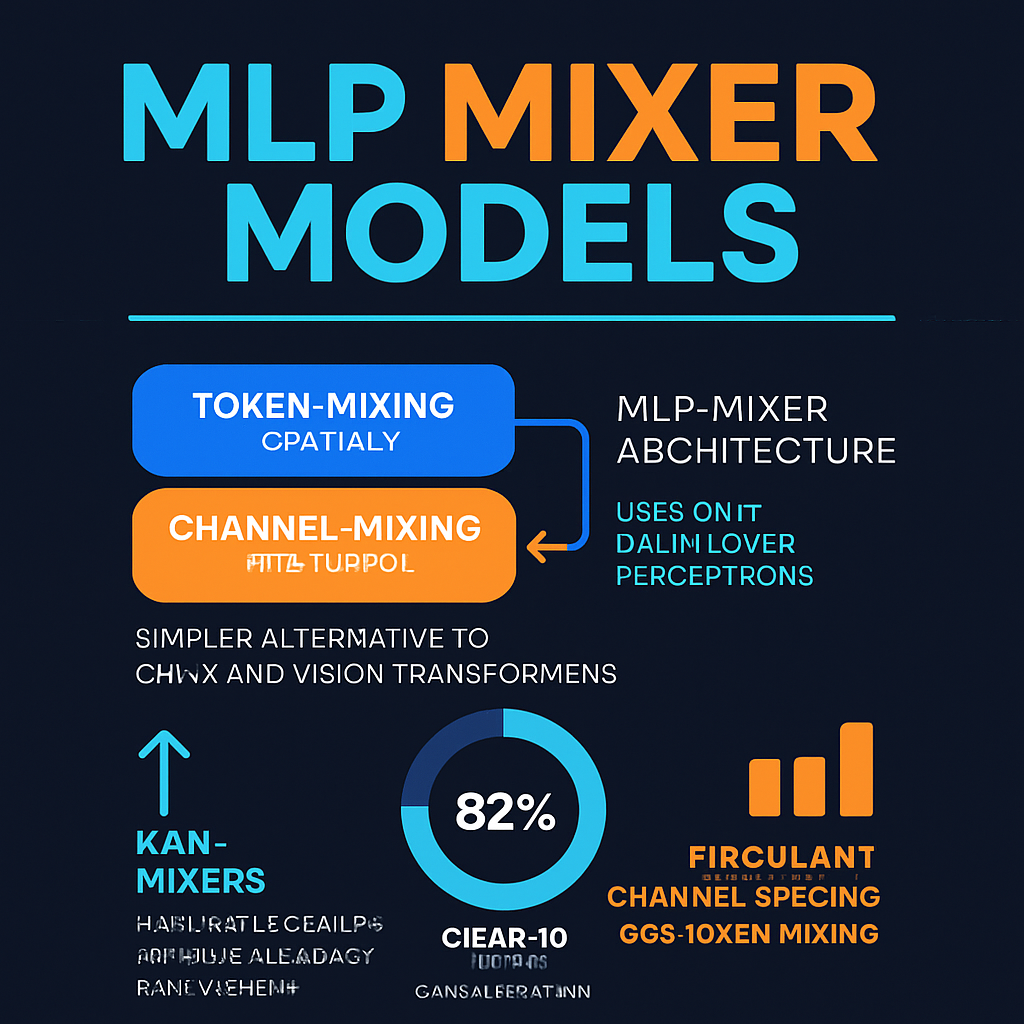
These sources collectively explore the MLP-Mixer architecture and its numerous extensions across computer vision and audio tasks. The core concept of the Mixer is to separate and blend information—originally via token-mixing (spatial locations) and channel-mixing (features)—using only Multi-Layer Perceptrons (MLPs), which is seen as a simpler alternative to CNNs and Vision Transformers. One source introduces KAN-Mixers, replacing standard MLPs with Kolmogorov-Arnold Networks (KANs) to potentially improve accuracy and interpretability for image classification, showing strong results on CIFAR-10. Other works propose structural modifications, such as the Circulant Channel-Specific (CCS) token-mixing MLP to improve spatial invariance and efficiency, and ConvMixer, which uses large-kernel convolutions for mixing. Furthermore, the Mixer principle is applied to audio classification with ASM-RH, which blends Roll-Time and Hermit-Frequency information, proving the Mixer is a versatile paradigm adaptable to domain-specific feature perspectives. Finally, research also suggests that the success of the MLP-Mixer is rooted in its effective structure as a wide and sparse MLP, which embeds sparsity as an inductive bias.
Sources:
1. KAN-Mixers: a new deep learning architecture for image classification (Excerpts)
https://arxiv.org/html/2503.08939v
12. MLP-Mixer: An all-MLP Architecture for Vision |
https://arxiv.org/pdf/2105.
016013. ResMLP: Feedforward networks for image classification with data-efficient training |
https://arxiv.org/pdf/2105.
034044. Pay Attention to MLPs (gMLP) |
https://arxiv.org/pdf/2105.
080505. Rethinking Token-Mixing MLP for MLP-based Vision Backbone (CCS Token-Mixing MLP) |
https://arxiv.org/pdf/2106.
148826. Patches Are All You Need? (ConvMixer) |
https://arxiv.org/pdf/2201.
097927. Understanding MLP-Mixer as a Wide and Sparse MLP |
https://arxiv.org/pdf/2306.
014708. Strip-MLP: Efficient Token Interaction for Vision MLP |
https://arxiv.org/pdf/2307.
114589. Mixer is more than just a model (ASM-RH) |
https://arxiv.org/pdf/2402.
1800710. DynaMixer: A Vision MLP Architecture with Dynamic Mixing |
https://proceedings.mlr.press/v162/wang22i/wang22i.pdf
1. KAN-Mixers: a new deep learning architecture for image classification (Excerpts)
https://arxiv.org/html/2503.08939v
12. MLP-Mixer: An all-MLP Architecture for Vision |
https://arxiv.org/pdf/2105.
016013. ResMLP: Feedforward networks for image classification with data-efficient training |
https://arxiv.org/pdf/2105.
034044. Pay Attention to MLPs (gMLP) |
https://arxiv.org/pdf/2105.
080505. Rethinking Token-Mixing MLP for MLP-based Vision Backbone (CCS Token-Mixing MLP) |
https://arxiv.org/pdf/2106.
148826. Patches Are All You Need? (ConvMixer) |
https://arxiv.org/pdf/2201.
097927. Understanding MLP-Mixer as a Wide and Sparse MLP |
https://arxiv.org/pdf/2306.
014708. Strip-MLP: Efficient Token Interaction for Vision MLP |
https://arxiv.org/pdf/2307.
114589. Mixer is more than just a model (ASM-RH) |
https://arxiv.org/pdf/2402.
1800710. DynaMixer: A Vision MLP Architecture with Dynamic Mixing |
https://proceedings.mlr.press/v162/wang22i/wang22i.pdf