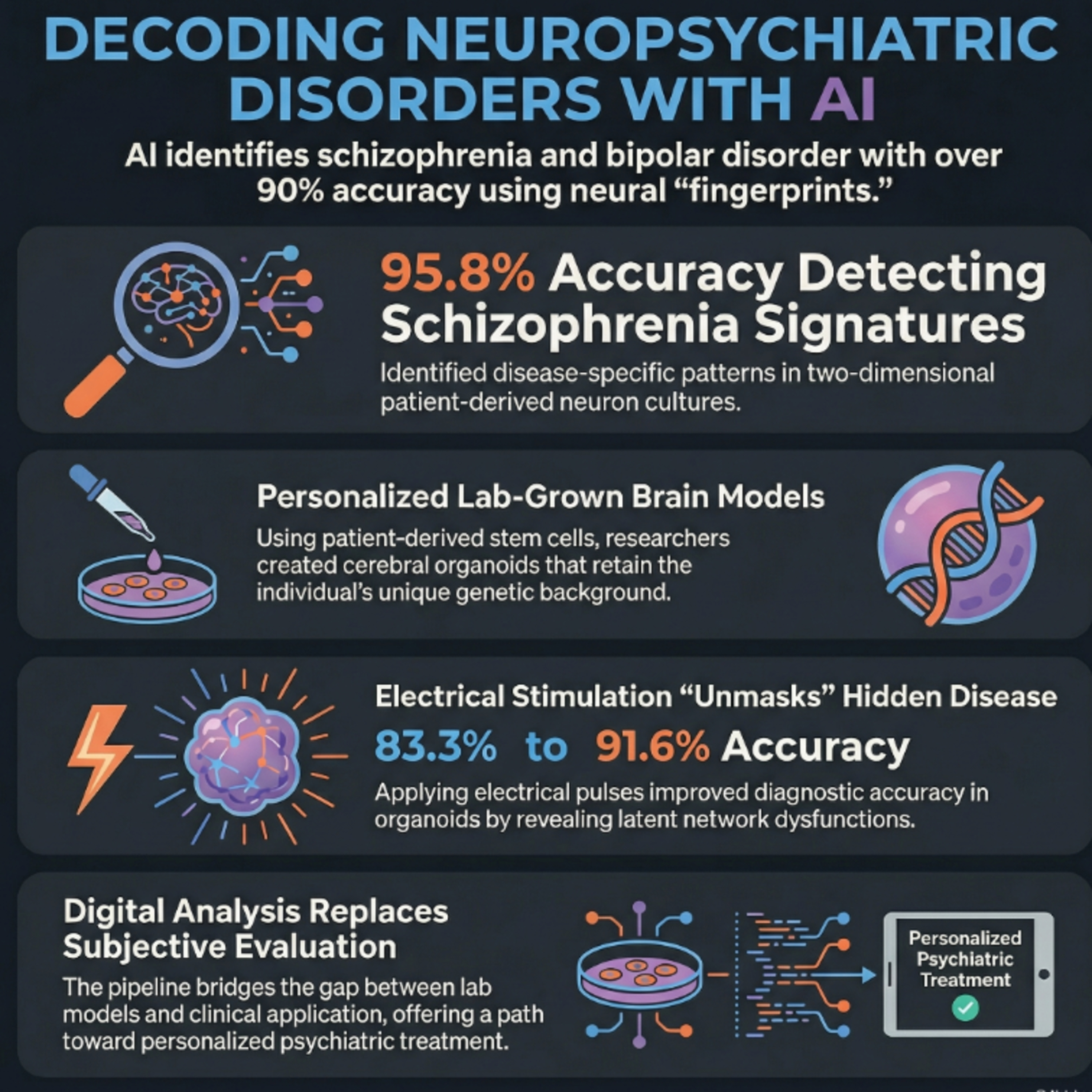
Machine Learning for Electrophysiological Phenotyping of Schizophrenia and Bipolar Disorder
Feb 24, 2026
This research article introduces a computational analysis pipeline designed to identify objective electrophysiological biomarkers for schizophrenia and bipolar disorder. By utilizing multi-electrode array recordings from patient-derived cerebral organoids and two-dimensional neurons, the study establishes a method for distinguishing psychiatric conditions through neural network dynamics. The researchers employed a Support Vector Machine classifier to analyze "sink index" features, achieving up to 95.8% accuracy in identifying diseased samples. A key discovery was that electrical stimulation significantly improved diagnostic precision by revealing latent network dysfunctions not visible during resting states. This integration of machine learning and stem cell technology offers a sophisticated framework for more accurate, personalized diagnoses and therapeutic testing in neuropsychiatry. Source: September 22 2025 Machine learning-enabled detection of electrophysiological signatures in iPSC-derived models of schizophrenia and bipolar disorder Johns Hopkins University, Harvard Medical School, Massachusetts General Hospital, Harvard University, Broad Institute of MIT and Harvard, McLean Hospital Kai Cheng, Autumn Williams, Anannya Kshirsagar, Sai Kulkarni, Rakesh Karmacharya, Deok-Ho Kim, Sridevi V. Sarma, Annie Kathuria https://doi.org/10.1063/5.0250559