How Linear Attention Remembers: Writing and Recalling Facts
Oct 25, 2026
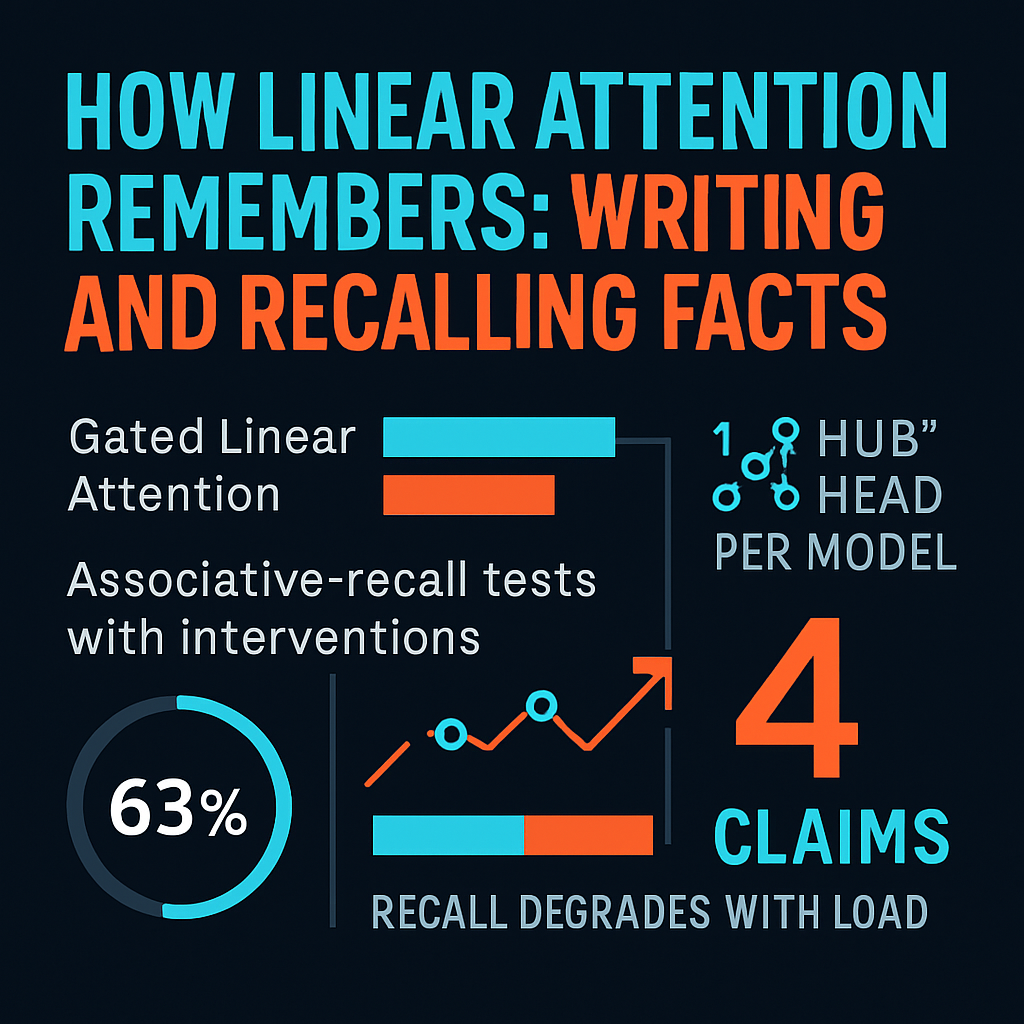
This episode examines "How Linear Attention Remembers," a preprint that asks how a single fact is written into, retained in, and read back out of the fixed-size recurrent state that replaces the KV cache. It contrasts Gated Linear Attention with Gated DeltaNet (whose delta rule overwrites old bindings instead of piling on top of them) and with hybrids that keep a few full-attention layers. The authors use associative-recall tests with causal interventions on pretrained models. They swap a head's state between near-identical "Paris" and "London" runs and measure the shift in the logit margin. Screening picks out one "hub" head per model, and the episode lays out the paper's four claims: content-specific writes, an identifiable read path, shared-state coupling that degrades recall as load grows, and attention layers taking over direct recall in hybrids. Listeners get the background on why a sum-based memory can't be pointed at the way a KV cache can, and a look at what that means for long-context serving on phones, edge devices, and robots.
Interactive Visualization: How Linear Attention Remembers: Writing and Recalling Facts
Sources:
1. How Linear Attention Remembers — Kichang Lee, JaeYeon Park, Songkuk Kim, JeongGil Ko, 2026
http://arxiv.org/abs/2609.33093
2. Transformers are RNNs: Fast Autoregressive Transformers with Linear Attention — Angelos Katharopoulos, Apoorv Vyas, Nikolaos Pappas, Francois Fleuret, 2020
https://scholar.google.com/scholar?q=Transformers+are+RNNs%3A+Fast+Autoregressive+Transformers+with+Linear+Attention
3. Linear Transformers Are Secretly Fast Weight Programmers — Imanol Schlag, Kazuki Irie, Juergen Schmidhuber, 2021
https://scholar.google.com/scholar?q=Linear+Transformers+Are+Secretly+Fast+Weight+Programmers
4. Gated Delta Networks: Improving Mamba2 with Delta Rule — Songlin Yang, Jan Kautz, Ali Hatamizadeh, 2025
https://scholar.google.com/scholar?q=Gated+Delta+Networks%3A+Improving+Mamba2+with+Delta+Rule
5. Simple Linear Attention Language Models Balance the Recall-Throughput Tradeoff (Based) — Simran Arora, Sabri Eyuboglu, Michael Zhang, Aman Timalsina, Silas Alberti, Dylan Zinsley, James Zou, Atri Rudra, Christopher Re, 2024
https://scholar.google.com/scholar?q=Simple+Linear+Attention+Language+Models+Balance+the+Recall-Throughput+Tradeoff+%28Based%29
6. Repeat After Me: Transformers are Better than State Space Models at Copying — Samy Jelassi, David Brandfonbrener, Sham M. Kakade, Eran Malach, 2024
https://scholar.google.com/scholar?q=Repeat+After+Me%3A+Transformers+are+Better+than+State+Space+Models+at+Copying
7. Locating and Editing Factual Associations in GPT — Kevin Meng, David Bau, Alex Andonian, Yonatan Belinkov, 2022
https://scholar.google.com/scholar?q=Locating+and+Editing+Factual+Associations+in+GPT
8. Interpretability in the Wild: a Circuit for Indirect Object Identification in GPT-2 small — Kevin Wang, Alexandre Variengien, Arthur Conmy, Buck Shlegeris, Jacob Steinhardt, 2022
https://scholar.google.com/scholar?q=Interpretability+in+the+Wild%3A+a+Circuit+for+Indirect+Object+Identification+in+GPT-2+small
9. In-context Learning and Induction Heads — Catherine Olsson, Nelson Elhage, Neel Nanda, Nicholas Joseph, and others (Anthropic), 2022
https://scholar.google.com/scholar?q=In-context+Learning+and+Induction+Heads
10. The Hidden Attention of Mamba Models — Ameen Ali, Itamar Zimerman, Lior Wolf, 2024
https://scholar.google.com/scholar?q=The+Hidden+Attention+of+Mamba+Models
11. Zoology: Measuring and Improving Recall in Efficient Language Models — Simran Arora, Sabri Eyuboglu, Aman Timalsina, et al., 2023
https://scholar.google.com/scholar?q=Zoology%3A+Measuring+and+Improving+Recall+in+Efficient+Language+Models
12. Hopfield Networks is All You Need — Hubert Ramsauer, Bernhard Schäfl, Johannes Lehner, et al., 2020
https://scholar.google.com/scholar?q=Hopfield+Networks+is+All+You+Need
13. Learning to (Learn at Test Time): RNNs with Expressive Hidden States — Yu Sun, Xinhao Li, Karan Dalal, et al., 2024
https://scholar.google.com/scholar?q=Learning+to+%28Learn+at+Test+Time%29%3A+RNNs+with+Expressive+Hidden+States
14. Mamba: Linear-Time Sequence Modeling with Selective State Spaces / Transformers are SSMs (Mamba-2) — Albert Gu, Tri Dao, 2023/2024
https://scholar.google.com/scholar?q=Mamba%3A+Linear-Time+Sequence+Modeling+with+Selective+State+Spaces+%2F+Transformers+are+SSMs+%28Mamba-2%29
15. Locating and Editing Factual Associations in Mamba — Arnab Sen Sharma, David Atkinson, David Bau, 2024
https://scholar.google.com/scholar?q=Locating+and+Editing+Factual+Associations+in+Mamba
16. Mamba-Based Language Models: An Empirical Study (Nemotron-H / An Empirical Study of Mamba-based Language Models) — Roger Waleffe, Wonmin Byeon, et al., 2024
https://scholar.google.com/scholar?q=Mamba-Based+Language+Models%3A+An+Empirical+Study+%28Nemotron-H+%2F+An+Empirical+Study+of+Mamba-based+Language+Models%29
17. Investigating the Indirect Object Identification circuit in GPT-2 small / Interpretability in the Wild — Kevin Wang, Alexandre Variengien, Arthur Conmy, Buck Shlegeris, Jacob Steinhardt, 2022
https://scholar.google.com/scholar?q=Investigating+the+Indirect+Object+Identification+circuit+in+GPT-2+small+%2F+Interpretability+in+the+Wild
18. Zamba / Jamba / Samba hybrid papers (e.g., Jamba: A Hybrid Transformer-Mamba Language Model) — Opher Lieber et al. (Jamba); Liliang Ren et al. (Samba), 2024
https://scholar.google.com/scholar?q=Zamba+%2F+Jamba+%2F+Samba+hybrid+papers+%28e.g.%2C+Jamba%3A+A+Hybrid+Transformer-Mamba+Language+Model%29
19. Understanding the Differences in Foundation Models: Attention, State Space Models, and Recurrent Neural Networks (Test-time regression view) — Jerome Sieber, Carmen Amo Alonso, et al. / Ke Alexander Wang, Jiaxin Shi, Emily B. Fox (Test-time regression), 2024/2025
https://scholar.google.com/scholar?q=Understanding+the+Differences+in+Foundation+Models%3A+Attention%2C+State+Space+Models%2C+and+Recurrent+Neural+Networks+%28Test-time+regression+view%29
20. Towards Best Practices of Activation Patching in Language Models: Metrics and Methods — Fred Zhang, Neel Nanda, 2024
https://scholar.google.com/scholar?q=Towards+Best+Practices+of+Activation+Patching+in+Language+Models%3A+Metrics+and+Methods
Interactive Visualization: How Linear Attention Remembers: Writing and Recalling Facts