EAGLE: Evolution of Lossless Acceleration for LLM Inference
Feb 28, 2026
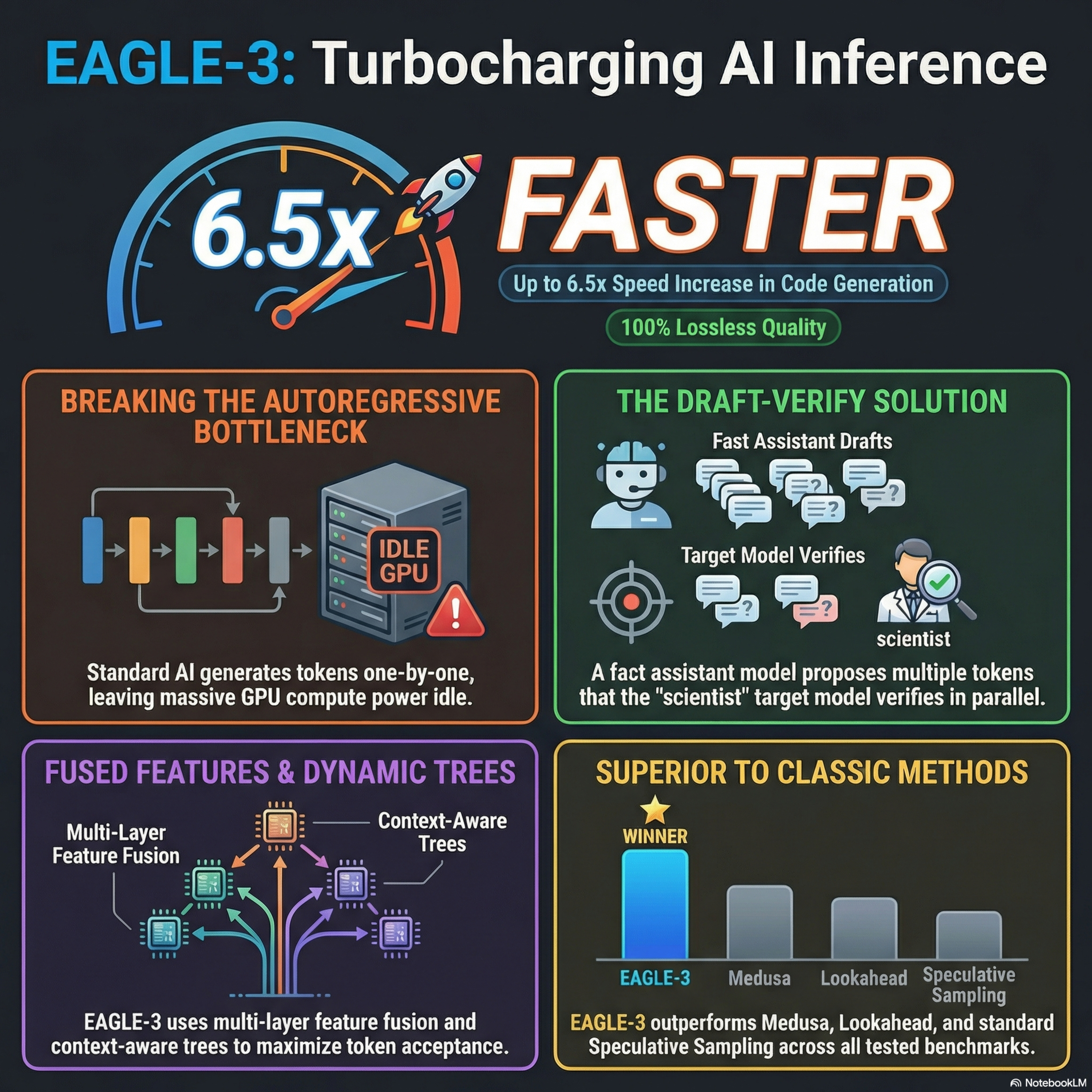
The provided documents describe the development and evolution of EAGLE, a high-efficiency framework designed to accelerate Large Language Model (LLM) inference through speculative sampling. By performing autoregression at the feature level rather than the token level and incorporating shifted token sequences to manage sampling uncertainty, the original EAGLE achieves significant speedups while maintaining the exact output distribution of the target model. The technology has progressed into EAGLE-2, which introduces dynamic draft trees, and EAGLE-3, which further enhances performance by fusing multi-layer features and removing feature regression constraints during training. These advancements allow for a latency reduction of up to 6.5x and a doubling of throughput, making them compatible with modern reasoning models and popular serving frameworks like vLLM and SGLang. Overall, the sources highlight a shift toward test-time scaling and more expressive draft models to overcome the inherent slow speeds of sequential text generation.
Sources:
1) January 26, 2024EAGLE: Speculative Sampling Requires Rethinking Feature Uncertainty.Peking University, Microsoft Research, University of Waterloo, Vector Institute.Yuhui Li, Fangyun Wei, Chao Zhang, Hongyang Zhang.
https://arxiv.org/pdf/2401.150772
https://aclanthology.org/2024.emnlp-main.422.pdf4
https://arxiv.org/pdf/2503.018401
https://developer.nvidia.com/blog/an-introduction-to-speculative-decoding-for-reducing-latency-in-ai-inference/
1) January 26, 2024EAGLE: Speculative Sampling Requires Rethinking Feature Uncertainty.Peking University, Microsoft Research, University of Waterloo, Vector Institute.Yuhui Li, Fangyun Wei, Chao Zhang, Hongyang Zhang.
https://arxiv.org/pdf/2401.150772
https://aclanthology.org/2024.emnlp-main.422.pdf4
https://arxiv.org/pdf/2503.018401
https://developer.nvidia.com/blog/an-introduction-to-speculative-decoding-for-reducing-latency-in-ai-inference/