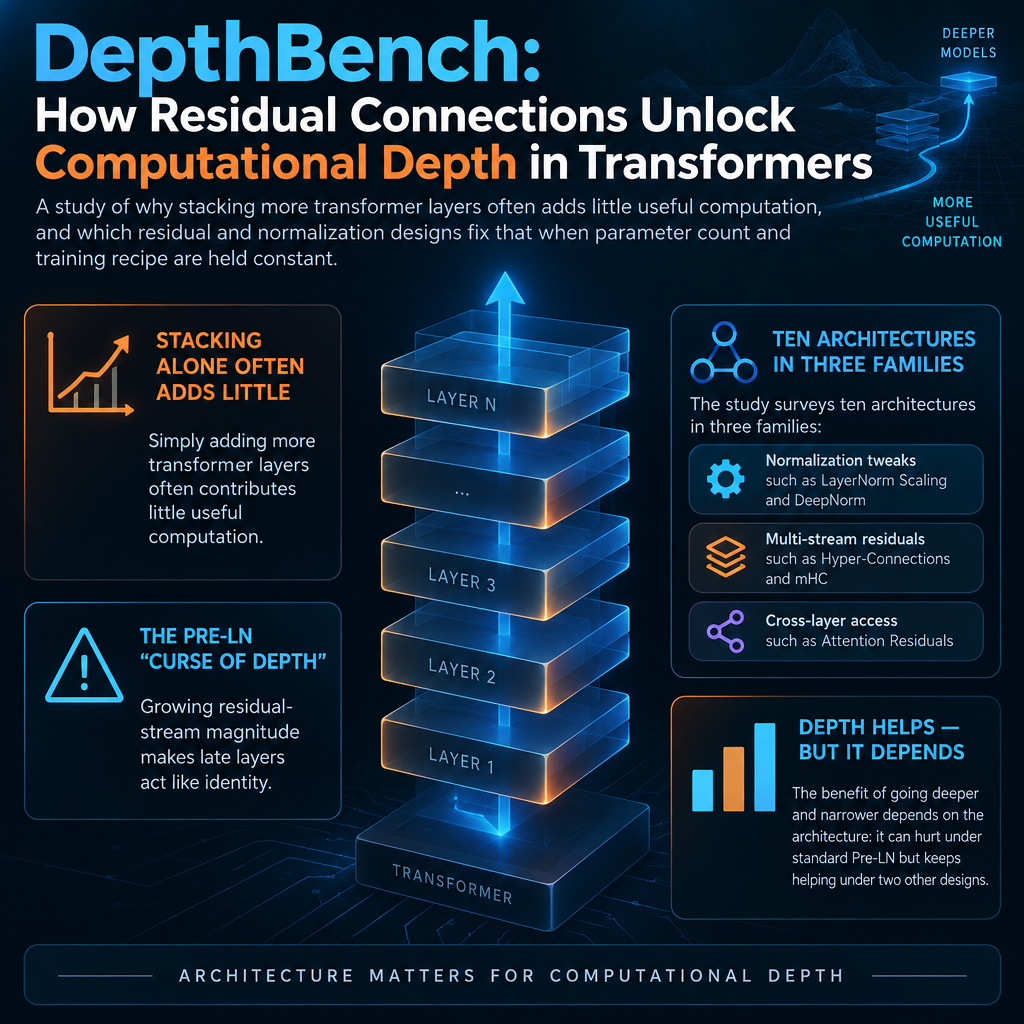
DepthBench: How Residual Connections Unlock Computational Depth in Transformers
Oct 30, 2026
This episode examines DepthBench, a study of why stacking more transformer layers often adds little useful computation, and which residual and normalization designs fix that when parameter count and training recipe are held constant. It reviews the Pre-LN "Curse of Depth" argument, in which growing residual-stream magnitude makes late layers act like identity. It then surveys ten architectures in three families: normalization tweaks such as LayerNorm Scaling and DeepNorm, multi-stream residuals such as Hyper-Connections and mHC, and cross-layer access such as Attention Residuals. The central claim is that the benefit of going deeper and narrower depends on the architecture: it can hurt under standard Pre-LN but keeps helping under two other designs. That would mean the common shallow-wide shapes are partly an artifact of the residual design. The discussion sets this against Kaplan-style scaling results, layer-pruning studies, and the rival explanation that deep models are simply mis-scaled in training. Listeners get a clear framework for "effective computational depth" and for judging whether the evidence supports the claim.
Interactive Visualization: DepthBench: How Residual Connections Unlock Computational Depth in Transformers
Sources:
1. DepthBench: Measuring How Residual Connections Enable More Computational Depth — Keyu Wang, Yangyi Huang, Jiale Kang, David González-Martínez, Weiyang Liu, Shiwei Liu, 2026
http://arxiv.org/abs/2609.32534
2. Scaling Laws for Neural Language Models — Jared Kaplan, Sam McCandlish, Tom Henighan, Tom B. Brown, et al., 2020
https://scholar.google.com/scholar?q=Scaling+Laws+for+Neural+Language+Models
3. Scale Efficiently: Insights from Pre-training and Fine-tuning Transformers — Yi Tay, Mostafa Dehghani, Jinfeng Rao, William Fedus, Samira Abnar, Hyung Won Chung, Sharan Narang, Dani Yogatama, Ashish Vaswani, Donald Metzler, 2021
https://scholar.google.com/scholar?q=Scale+Efficiently%3A+Insights+from+Pre-training+and+Fine-tuning+Transformers
4. MobileLLM: Optimizing Sub-billion Parameter Language Models for On-Device Use Cases — Zechun Liu, Changsheng Zhao, Forrest Iandola, et al. (Meta), 2024
https://scholar.google.com/scholar?q=MobileLLM%3A+Optimizing+Sub-billion+Parameter+Language+Models+for+On-Device+Use+Cases
5. The Curse of Depth in Large Language Models — Wenfang Sun, Xinyuan Song, Pengxiang Li, Lu Yin, Yefeng Zheng, Shiwei Liu, 2025
https://scholar.google.com/scholar?q=The+Curse+of+Depth+in+Large+Language+Models
6. Hyper-Connections (and follow-up: mHC, Manifold-Constrained Hyper-Connections) — Defa Zhu, Hongzhi Huang, Zihao Huang, et al. (ByteDance Seed) for HC; DeepSeek-AI researchers (Xie et al.) for mHC, 2024-2025
https://scholar.google.com/scholar?q=Hyper-Connections+%28and+follow-up%3A+mHC%2C+Manifold-Constrained+Hyper-Connections%29
7. Do Language Models Use Their Depth Efficiently? — Róbert Csordás, Christopher D. Manning, Christopher Potts, 2025
https://scholar.google.com/scholar?q=Do+Language+Models+Use+Their+Depth+Efficiently%3F
8. The Unreasonable Ineffectiveness of the Deeper Layers — Andrey Gromov, Kushal Tirumala, Hassan Shapourian, Paolo Glorioso, Daniel A. Roberts, 2024
https://scholar.google.com/scholar?q=The+Unreasonable+Ineffectiveness+of+the+Deeper+Layers
9. ShortGPT: Layers in Large Language Models are More Redundant Than You Expect — Xin Men et al., 2024
https://scholar.google.com/scholar?q=ShortGPT%3A+Layers+in+Large+Language+Models+are+More+Redundant+Than+You+Expect
10. Tensor Programs V: Tuning Large Neural Networks via Zero-Shot Hyperparameter Transfer (muP) — Greg Yang et al., 2022
https://scholar.google.com/scholar?q=Tensor+Programs+V%3A+Tuning+Large+Neural+Networks+via+Zero-Shot+Hyperparameter+Transfer+%28muP%29
11. Don't be lazy: CompleteP enables compute-efficient deep transformers — Nolan Dey et al., 2025
https://scholar.google.com/scholar?q=Don%27t+be+lazy%3A+CompleteP+enables+compute-efficient+deep+transformers
12. Scaling Laws with Model Shape / Gemstones: A Model Suite for Multi-Faceted Scaling Laws — Sean McLeish et al., 2025
https://scholar.google.com/scholar?q=Scaling+Laws+with+Model+Shape+%2F+Gemstones%3A+A+Model+Suite+for+Multi-Faceted+Scaling+Laws
13. The Impact of Depth on Compositional Generalization in Transformer Language Models — Jackson Petty et al., 2024
https://scholar.google.com/scholar?q=The+Impact+of+Depth+on+Compositional+Generalization+in+Transformer+Language+Models
14. Scaling up Test-Time Compute with Latent Reasoning: A Recurrent Depth Approach — Jonas Geiping et al., 2025
https://scholar.google.com/scholar?q=Scaling+up+Test-Time+Compute+with+Latent+Reasoning%3A+A+Recurrent+Depth+Approach
15. Transformers, Parallel Computation, and Logarithmic Depth — Clayton Sanford, Daniel Hsu, Matus Telgarsky, 2024
https://scholar.google.com/scholar?q=Transformers%2C+Parallel+Computation%2C+and+Logarithmic+Depth
16. The Expressive Power of Transformers with Chain of Thought / The Parallelism Tradeoff — William Merrill, Ashish Sabharwal, 2023-2024
https://scholar.google.com/scholar?q=The+Expressive+Power+of+Transformers+with+Chain+of+Thought+%2F+The+Parallelism+Tradeoff
17. Resolving Discrepancies in Compute-Optimal Scaling of Language Models — Tomer Porian et al., 2024
https://scholar.google.com/scholar?q=Resolving+Discrepancies+in+Compute-Optimal+Scaling+of+Language+Models
18. DenseFormer: Enhancing Information Flow in Transformers via Depth Weighted Averaging — Matteo Pagliardini et al., 2024
https://scholar.google.com/scholar?q=DenseFormer%3A+Enhancing+Information+Flow+in+Transformers+via+Depth+Weighted+Averaging
19. Peri-LN: Revisiting Layer Normalization in the Transformer Architecture — Jeonghoon Kim et al., 2025
https://scholar.google.com/scholar?q=Peri-LN%3A+Revisiting+Layer+Normalization+in+the+Transformer+Architecture
Interactive Visualization: DepthBench: How Residual Connections Unlock Computational Depth in Transformers