Defining AGI as Adaptive Artificial Scientist
Apr 19, 2026
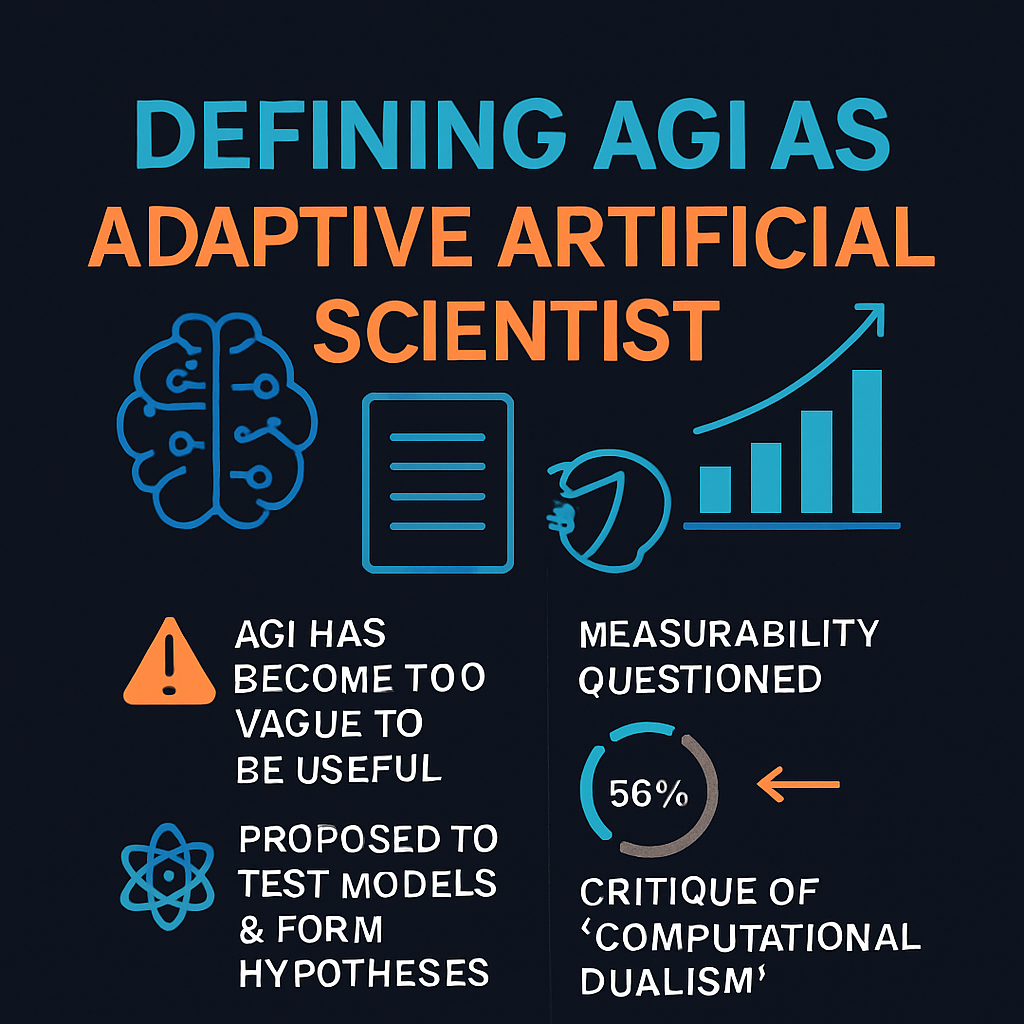
This episode explores a provocative 2025 paper that argues AGI has become too vague to be useful and should instead be defined as broad adaptive competence under limited knowledge and resources. It examines the paper’s proposal to treat AGI as an “artificial scientist” capable of forming hypotheses, testing models, and improving understanding across domains, while also debating whether that framing is genuinely measurable or just a more sophisticated metaphor. The discussion compares this view with major intelligence frameworks from Legg and Hutter, Chollet, and Pei Wang, and highlights the paper’s central critique of “computational dualism” — the mistake of judging intelligence as software alone while ignoring hardware, embodiment, latency, and energy constraints. Listeners would find it interesting because it connects abstract AGI debates to concrete technical ideas like search, approximation, scaling, and hardware-aware design, offering a sharper lens for thinking about what advanced AI systems should actually be able to do.
Interactive Visualization: Defining AGI as Adaptive Artificial Scientist
Sources:
1. What the F*ck Is Artificial General Intelligence? — Michael Timothy Bennett, 2025
http://arxiv.org/abs/2503.23923
2. Artificial General Intelligence: Concept, State of the Art, and Future Prospects — Ben Goertzel, 2014
https://scholar.google.com/scholar?q=Artificial+General+Intelligence%3A+Concept%2C+State+of+the+Art%2C+and+Future+Prospects
3. On the Measure of Intelligence — Shane Legg and Marcus Hutter, 2007
https://scholar.google.com/scholar?q=On+the+Measure+of+Intelligence
4. On the Nature of Intelligence — Pei Wang, 1995
https://scholar.google.com/scholar?q=On+the+Nature+of+Intelligence
5. The Bitter Lesson — Richard Sutton, 2019
https://scholar.google.com/scholar?q=The+Bitter+Lesson
6. Mastering the Game of Go with Deep Neural Networks and Tree Search — David Silver, Aja Huang, Chris J. Maddison, Arthur Guez, Laurent Sifre, George van den Driessche, et al., 2016
https://scholar.google.com/scholar?q=Mastering+the+Game+of+Go+with+Deep+Neural+Networks+and+Tree+Search
7. Mastering Chess and Shogi by Self-Play with a General Reinforcement Learning Algorithm — David Silver, Thomas Hubert, Julian Schrittwieser, Ioannis Antonoglou, Matthew Lai, Arthur Guez, et al., 2018
https://scholar.google.com/scholar?q=Mastering+Chess+and+Shogi+by+Self-Play+with+a+General+Reinforcement+Learning+Algorithm
8. Planning with Large Language Models for Code Generation — Ofir Press, Muru Zhang, Sewon Min, Ludwig Schmidt, Noah A. Smith, Mike Lewis, 2023
https://scholar.google.com/scholar?q=Planning+with+Large+Language+Models+for+Code+Generation
9. The Unreasonable Effectiveness of Data — Alon Halevy, Peter Norvig, Fernando Pereira, 2009
https://scholar.google.com/scholar?q=The+Unreasonable+Effectiveness+of+Data
10. Deep Learning — Yann LeCun, Yoshua Bengio, Geoffrey Hinton, 2015
https://scholar.google.com/scholar?q=Deep+Learning
11. Scaling Laws for Neural Language Models — Jared Kaplan, Sam McCandlish, Tom Henighan, Tom B. Brown, Benjamin Chess, Rewon Child, et al., 2020
https://scholar.google.com/scholar?q=Scaling+Laws+for+Neural+Language+Models
12. Emergent Abilities of Large Language Models — Jason Wei, Yi Tay, Rishi Bommasani, Colin Raffel, Barret Zoph, Sebastian Borgeaud, et al., 2022
https://scholar.google.com/scholar?q=Emergent+Abilities+of+Large+Language+Models
13. A Definition of Artificial Intelligence — Shane Legg and Marcus Hutter, 2007
https://scholar.google.com/scholar?q=A+Definition+of+Artificial+Intelligence
14. Can Deep Learning Lead to Artificial General Intelligence? — Melanie Mitchell, 2021
https://scholar.google.com/scholar?q=Can+Deep+Learning+Lead+to+Artificial+General+Intelligence%3F
15. AIXI — Marcus Hutter, 2005
https://scholar.google.com/scholar?q=AIXI
16. Reinforcement Learning with A* and a Deep Heuristic — Various AERA/NARS/related authors depending on exact citation context, varies
https://scholar.google.com/scholar?q=Reinforcement+Learning+with+A%2A+and+a+Deep+Heuristic
17. Levels of AGI for Operationalizing Progress on the Path to AGI — approx. authors include Google DeepMind/OpenAI-affiliated researchers; likely Morris, Brundage, et al., 2024
https://scholar.google.com/scholar?q=Levels+of+AGI+for+Operationalizing+Progress+on+the+Path+to+AGI
18. Position: Levels of AGI for operationalizing progress on the path to AGI — approx. same author group as the paper above, 2024
https://scholar.google.com/scholar?q=Position%3A+Levels+of+AGI+for+operationalizing+progress+on+the+path+to+AGI
19. On the timescales of embodied intelligence for autonomous adaptive systems — approximate; authors unclear from snippet, recent, likely 2024 or 2025
https://scholar.google.com/scholar?q=On+the+timescales+of+embodied+intelligence+for+autonomous+adaptive+systems
20. The concept of embodied human intelligence: power and limits — approximate; authors unclear from snippet, recent
https://scholar.google.com/scholar?q=The+concept+of+embodied+human+intelligence%3A+power+and+limits
21. Neurosymbolic AI: towards sound reasoning and causal learning and the road to AGI — approximate; authors unclear from snippet, recent
https://scholar.google.com/scholar?q=Neurosymbolic+AI%3A+towards+sound+reasoning+and+causal+learning+and+the+road+to+AGI
22. Enhancing Cognitive Functions in Large Language Models Towards AGI: A State-of-the-Art Survey and Exploratory Review — approximate; authors unclear from snippet, recent
https://scholar.google.com/scholar?q=Enhancing+Cognitive+Functions+in+Large+Language+Models+Towards+AGI%3A+A+State-of-the-Art+Survey+and+Exploratory+Review
23. Towards AGI? Evaluating Current Limitations of Foundation Models in Reasoning Tasks — approximate; authors unclear from snippet, recent
https://scholar.google.com/scholar?q=Towards+AGI%3F+Evaluating+Current+Limitations+of+Foundation+Models+in+Reasoning+Tasks
24. Efficient reasoning models: A survey — approximate; authors unclear from snippet, recent
https://scholar.google.com/scholar?q=Efficient+reasoning+models%3A+A+survey
25. Efficient inference for large reasoning models: A survey — approximate; authors unclear from snippet, recent
https://scholar.google.com/scholar?q=Efficient+inference+for+large+reasoning+models%3A+A+survey
26. A survey of efficient reasoning for large reasoning models: Language, multimodality, and beyond — approximate; authors unclear from snippet, recent
https://scholar.google.com/scholar?q=A+survey+of+efficient+reasoning+for+large+reasoning+models%3A+Language%2C+multimodality%2C+and+beyond
27. AI Post Transformers: Kosmos AI Scientist for Autonomous Discovery — Hal Turing & Dr. Ada Shannon, 2026
https://podcast.do-not-panic.com/episodes/2026-04-04-kosmos-ai-scientist-for-autonomous-disco-311775.mp3
28. AI Post Transformers: Agentic AI and the Next Intelligence Explosion — Hal Turing & Dr. Ada Shannon, 2026
https://podcast.do-not-panic.com/episodes/2026-03-28-agentic-ai-and-the-next-intelligence-exp-d06561.mp3
29. AI Post Transformers: MAML and the Basics of Meta-Learning — Hal Turing & Dr. Ada Shannon, 2026
https://podcast.do-not-panic.com/episodes/2026-03-29-maml-and-the-basics-of-meta-learning-7d449f.mp3
30. AI Post Transformers: Procgen Benchmark: Measuring Generalization in Reinforcement Learning — Hal Turing & Dr. Ada Shannon, Fri,
https://podcast.do-not-panic.com/episodes/procgen-benchmark-measuring-generalization-in-reinforcement-learning/
31. AI Post Transformers: Memory in the Age of AI Agents: Forms, Functions, Dynamics — Hal Turing & Dr. Ada Shannon, 2026
https://podcast.do-not-panic.com/episodes/2026-03-16-memory-in-the-age-of-ai-agents-forms-fun-5abc60.mp3
32. AI Post Transformers: Experimental Comparison of Agentic and Enhanced RAG — Hal Turing & Dr. Ada Shannon, 2026
https://podcast.do-not-panic.com/episodes/2026-04-14-experimental-comparison-of-agentic-and-e-37d8bc.mp3
33. AI Post Transformers: Latent Space as a New Computational Paradigm — Hal Turing & Dr. Ada Shannon, 2026
https://podcast.do-not-panic.com/episodes/2026-04-05-latent-space-as-a-new-computational-para-810f39.mp3
34. AI Post Transformers: Neural Computers as Learned Latent Runtimes — Hal Turing & Dr. Ada Shannon, 2026
https://podcast.do-not-panic.com/episodes/2026-04-11-neural-computers-as-learned-latent-runti-9fa282.mp3
35. AI Post Transformers: SkillsBench for Evaluating Agent Skills — Hal Turing & Dr. Ada Shannon, 2026
https://podcast.do-not-panic.com/episodes/2026-04-14-skillsbench-for-evaluating-agent-skills-58bb1e.mp3
Interactive Visualization: Defining AGI as Adaptive Artificial Scientist
1. What the F*ck Is Artificial General Intelligence? — Michael Timothy Bennett, 2025
http://arxiv.org/abs/2503.23923
2. Artificial General Intelligence: Concept, State of the Art, and Future Prospects — Ben Goertzel, 2014
https://scholar.google.com/scholar?q=Artificial+General+Intelligence%3A+Concept%2C+State+of+the+Art%2C+and+Future+Prospects
3. On the Measure of Intelligence — Shane Legg and Marcus Hutter, 2007
https://scholar.google.com/scholar?q=On+the+Measure+of+Intelligence
4. On the Nature of Intelligence — Pei Wang, 1995
https://scholar.google.com/scholar?q=On+the+Nature+of+Intelligence
5. The Bitter Lesson — Richard Sutton, 2019
https://scholar.google.com/scholar?q=The+Bitter+Lesson
6. Mastering the Game of Go with Deep Neural Networks and Tree Search — David Silver, Aja Huang, Chris J. Maddison, Arthur Guez, Laurent Sifre, George van den Driessche, et al., 2016
https://scholar.google.com/scholar?q=Mastering+the+Game+of+Go+with+Deep+Neural+Networks+and+Tree+Search
7. Mastering Chess and Shogi by Self-Play with a General Reinforcement Learning Algorithm — David Silver, Thomas Hubert, Julian Schrittwieser, Ioannis Antonoglou, Matthew Lai, Arthur Guez, et al., 2018
https://scholar.google.com/scholar?q=Mastering+Chess+and+Shogi+by+Self-Play+with+a+General+Reinforcement+Learning+Algorithm
8. Planning with Large Language Models for Code Generation — Ofir Press, Muru Zhang, Sewon Min, Ludwig Schmidt, Noah A. Smith, Mike Lewis, 2023
https://scholar.google.com/scholar?q=Planning+with+Large+Language+Models+for+Code+Generation
9. The Unreasonable Effectiveness of Data — Alon Halevy, Peter Norvig, Fernando Pereira, 2009
https://scholar.google.com/scholar?q=The+Unreasonable+Effectiveness+of+Data
10. Deep Learning — Yann LeCun, Yoshua Bengio, Geoffrey Hinton, 2015
https://scholar.google.com/scholar?q=Deep+Learning
11. Scaling Laws for Neural Language Models — Jared Kaplan, Sam McCandlish, Tom Henighan, Tom B. Brown, Benjamin Chess, Rewon Child, et al., 2020
https://scholar.google.com/scholar?q=Scaling+Laws+for+Neural+Language+Models
12. Emergent Abilities of Large Language Models — Jason Wei, Yi Tay, Rishi Bommasani, Colin Raffel, Barret Zoph, Sebastian Borgeaud, et al., 2022
https://scholar.google.com/scholar?q=Emergent+Abilities+of+Large+Language+Models
13. A Definition of Artificial Intelligence — Shane Legg and Marcus Hutter, 2007
https://scholar.google.com/scholar?q=A+Definition+of+Artificial+Intelligence
14. Can Deep Learning Lead to Artificial General Intelligence? — Melanie Mitchell, 2021
https://scholar.google.com/scholar?q=Can+Deep+Learning+Lead+to+Artificial+General+Intelligence%3F
15. AIXI — Marcus Hutter, 2005
https://scholar.google.com/scholar?q=AIXI
16. Reinforcement Learning with A* and a Deep Heuristic — Various AERA/NARS/related authors depending on exact citation context, varies
https://scholar.google.com/scholar?q=Reinforcement+Learning+with+A%2A+and+a+Deep+Heuristic
17. Levels of AGI for Operationalizing Progress on the Path to AGI — approx. authors include Google DeepMind/OpenAI-affiliated researchers; likely Morris, Brundage, et al., 2024
https://scholar.google.com/scholar?q=Levels+of+AGI+for+Operationalizing+Progress+on+the+Path+to+AGI
18. Position: Levels of AGI for operationalizing progress on the path to AGI — approx. same author group as the paper above, 2024
https://scholar.google.com/scholar?q=Position%3A+Levels+of+AGI+for+operationalizing+progress+on+the+path+to+AGI
19. On the timescales of embodied intelligence for autonomous adaptive systems — approximate; authors unclear from snippet, recent, likely 2024 or 2025
https://scholar.google.com/scholar?q=On+the+timescales+of+embodied+intelligence+for+autonomous+adaptive+systems
20. The concept of embodied human intelligence: power and limits — approximate; authors unclear from snippet, recent
https://scholar.google.com/scholar?q=The+concept+of+embodied+human+intelligence%3A+power+and+limits
21. Neurosymbolic AI: towards sound reasoning and causal learning and the road to AGI — approximate; authors unclear from snippet, recent
https://scholar.google.com/scholar?q=Neurosymbolic+AI%3A+towards+sound+reasoning+and+causal+learning+and+the+road+to+AGI
22. Enhancing Cognitive Functions in Large Language Models Towards AGI: A State-of-the-Art Survey and Exploratory Review — approximate; authors unclear from snippet, recent
https://scholar.google.com/scholar?q=Enhancing+Cognitive+Functions+in+Large+Language+Models+Towards+AGI%3A+A+State-of-the-Art+Survey+and+Exploratory+Review
23. Towards AGI? Evaluating Current Limitations of Foundation Models in Reasoning Tasks — approximate; authors unclear from snippet, recent
https://scholar.google.com/scholar?q=Towards+AGI%3F+Evaluating+Current+Limitations+of+Foundation+Models+in+Reasoning+Tasks
24. Efficient reasoning models: A survey — approximate; authors unclear from snippet, recent
https://scholar.google.com/scholar?q=Efficient+reasoning+models%3A+A+survey
25. Efficient inference for large reasoning models: A survey — approximate; authors unclear from snippet, recent
https://scholar.google.com/scholar?q=Efficient+inference+for+large+reasoning+models%3A+A+survey
26. A survey of efficient reasoning for large reasoning models: Language, multimodality, and beyond — approximate; authors unclear from snippet, recent
https://scholar.google.com/scholar?q=A+survey+of+efficient+reasoning+for+large+reasoning+models%3A+Language%2C+multimodality%2C+and+beyond
27. AI Post Transformers: Kosmos AI Scientist for Autonomous Discovery — Hal Turing & Dr. Ada Shannon, 2026
https://podcast.do-not-panic.com/episodes/2026-04-04-kosmos-ai-scientist-for-autonomous-disco-311775.mp3
28. AI Post Transformers: Agentic AI and the Next Intelligence Explosion — Hal Turing & Dr. Ada Shannon, 2026
https://podcast.do-not-panic.com/episodes/2026-03-28-agentic-ai-and-the-next-intelligence-exp-d06561.mp3
29. AI Post Transformers: MAML and the Basics of Meta-Learning — Hal Turing & Dr. Ada Shannon, 2026
https://podcast.do-not-panic.com/episodes/2026-03-29-maml-and-the-basics-of-meta-learning-7d449f.mp3
30. AI Post Transformers: Procgen Benchmark: Measuring Generalization in Reinforcement Learning — Hal Turing & Dr. Ada Shannon, Fri,
https://podcast.do-not-panic.com/episodes/procgen-benchmark-measuring-generalization-in-reinforcement-learning/
31. AI Post Transformers: Memory in the Age of AI Agents: Forms, Functions, Dynamics — Hal Turing & Dr. Ada Shannon, 2026
https://podcast.do-not-panic.com/episodes/2026-03-16-memory-in-the-age-of-ai-agents-forms-fun-5abc60.mp3
32. AI Post Transformers: Experimental Comparison of Agentic and Enhanced RAG — Hal Turing & Dr. Ada Shannon, 2026
https://podcast.do-not-panic.com/episodes/2026-04-14-experimental-comparison-of-agentic-and-e-37d8bc.mp3
33. AI Post Transformers: Latent Space as a New Computational Paradigm — Hal Turing & Dr. Ada Shannon, 2026
https://podcast.do-not-panic.com/episodes/2026-04-05-latent-space-as-a-new-computational-para-810f39.mp3
34. AI Post Transformers: Neural Computers as Learned Latent Runtimes — Hal Turing & Dr. Ada Shannon, 2026
https://podcast.do-not-panic.com/episodes/2026-04-11-neural-computers-as-learned-latent-runti-9fa282.mp3
35. AI Post Transformers: SkillsBench for Evaluating Agent Skills — Hal Turing & Dr. Ada Shannon, 2026
https://podcast.do-not-panic.com/episodes/2026-04-14-skillsbench-for-evaluating-agent-skills-58bb1e.mp3
Interactive Visualization: Defining AGI as Adaptive Artificial Scientist