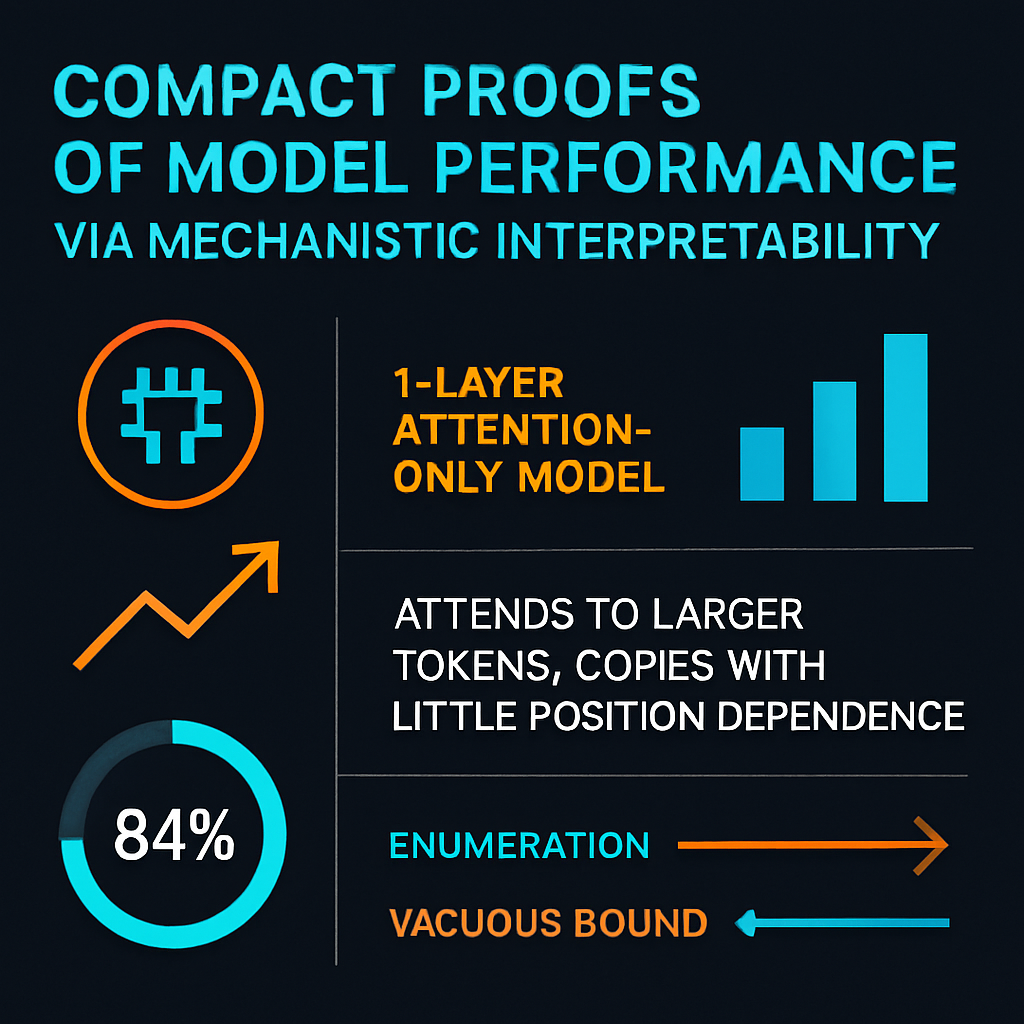
Compact Proofs of Model Performance via Mechanistic Interpretability
Oct 24, 2026
This episode explores a 2024 paper that tries to turn mechanistic interpretability into formal guarantees. The idea is to reverse-engineer a small transformer into an algorithm, then use that algorithm to write a much shorter proof of a lower bound on the model's accuracy. The test case is a one-layer, attention-only model trained to output the maximum of four integers. The discussion contrasts this approach with local-robustness verifiers and PAC-Bayes bounds. It also sets out the two trivial extremes: brute-force enumeration of about sixteen million inputs, and a vacuous accuracy bound of zero. The interpretation finds that the model attends to larger tokens, copies what it attends to, and barely depends on position. Treating everything the interpretation leaves unexplained as worst-case yields a "cubic" proof that cuts the compute roughly four-million-fold, at the cost of certifying about 95% accuracy instead of the true 99.9%. Listeners get a clear look at how a better mechanistic understanding could make guarantees cheaper, along with the caveat that the evidence comes from a single tiny model.
Interactive Visualization: Compact Proofs of Model Performance via Mechanistic Interpretability
Sources:
1. Compact Proofs of Model Performance via Mechanistic Interpretability — Jason Gross, Rajashree Agrawal, Thomas Kwa, Euan Ong, Chun Hei Yip, Alex Gibson, Soufiane Noubir, Lawrence Chan, 2024
http://arxiv.org/abs/2406.11779
2. Compact Proofs of Model Performance via Mechanistic Interpretability — Jason Gross, Rajashree Agrawal, Thomas Kwa, Euan Ong, Chun Hei Yip, Alex Gibson, Soufiane Noubir, Lawrence Chan, 2024 (arXiv 2406.11779; later versions through Dec 2024)
https://scholar.google.com/scholar?q=Compact+Proofs+of+Model+Performance+via+Mechanistic+Interpretability
3. Progress measures for grokking via mechanistic interpretability — Neel Nanda, Lawrence Chan, Tom Lieberum, Jess Smith, Jacob Steinhardt, 2023 (ICLR 2023)
https://scholar.google.com/scholar?q=Progress+measures+for+grokking+via+mechanistic+interpretability
4. A Mathematical Framework for Transformer Circuits — Nelson Elhage, Neel Nanda, Catherine Olsson, Chris Olah and others (Anthropic), 2021
https://scholar.google.com/scholar?q=A+Mathematical+Framework+for+Transformer+Circuits
5. Towards Guaranteed Safe AI: A Framework for Ensuring Robust and Reliable AI Systems — David 'davidad' Dalrymple, Joar Skalse, Yoshua Bengio, Stuart Russell, Max Tegmark, Sanjit Seshia, Steve Omohundro, Christian Szegedy, Ben Goldhaber, Nora Ammann, Alessandro Abate, Joe Halpern, Clark Barrett, Ding Zhao, Tan Zhi-Xuan, Jeannette Wing, Joshua Tenenbaum, 2024
https://scholar.google.com/scholar?q=Towards+Guaranteed+Safe+AI%3A+A+Framework+for+Ensuring+Robust+and+Reliable+AI+Systems
6. Formal Algorithms/Verification baselines: Towards Fast Computation of Certified Robustness for ReLU Networks (Fast-Lin) and Efficient Formal Safety Analysis of Neural Networks (Neurify); also Reluplex — Reluplex: Guy Katz, Clark Barrett, David Dill, Kyle Julian, Mykel Kochenderfer (2017); Fast-Lin: Tsui-Wei Weng et al. (2018); Neurify: Shiqi Wang et al. (2018), 2017-2018
https://scholar.google.com/scholar?q=Formal+Algorithms%2FVerification+baselines%3A+Towards+Fast+Computation+of+Certified+Robustness+for+ReLU+Networks+%28Fast-Lin%29+and+Efficient+Formal+Safety+Analysis+of+Neural+Networks+%28Neurify%29%3B+also+Reluplex
7. Formalizing the Presumption of Independence — Paul Christiano, Eric Neyman, Mark Xu, 2022
https://scholar.google.com/scholar?q=Formalizing+the+Presumption+of+Independence
8. Causal Scrubbing: a method for rigorously testing interpretability hypotheses — Lawrence Chan, Adrià Garriga-Alonso, Nicholas Goldowsky-Dill, Ryan Greenblatt, Jenny Nitishinskaya, Ansh Radhakrishnan, Buck Shlegeris, Nate Thomas, 2022
https://scholar.google.com/scholar?q=Causal+Scrubbing%3A+a+method+for+rigorously+testing+interpretability+hypotheses
9. Mathematical Models of Computation in Superposition — Kaarel Hänni, Jake Mendel, Dmitry Vaintrob, Lawrence Chan, 2024
https://scholar.google.com/scholar?q=Mathematical+Models+of+Computation+in+Superposition
10. Reluplex: An Efficient SMT Solver for Verifying Deep Neural Networks — Guy Katz, Clark Barrett, David Dill, Kyle Julian, Mykel Kochenderfer, 2017
https://scholar.google.com/scholar?q=Reluplex%3A+An+Efficient+SMT+Solver+for+Verifying+Deep+Neural+Networks
11. Computing Nonvacuous Generalization Bounds for Deep (Stochastic) Neural Networks with Many More Parameters than Training Data — Gintare Karolina Dziugaite, Daniel M. Roy, 2017
https://scholar.google.com/scholar?q=Computing+Nonvacuous+Generalization+Bounds+for+Deep+%28Stochastic%29+Neural+Networks+with+Many+More+Parameters+than+Training+Data
12. AI2: Safety and Robustness Certification of Neural Networks with Abstract Interpretation — Timon Gehr, Matthew Mirman, Dana Drachsler-Cohen, Petar Tsankov, Swarat Chaudhuri, Martin Vechev, 2018
https://scholar.google.com/scholar?q=AI2%3A+Safety+and+Robustness+Certification+of+Neural+Networks+with+Abstract+Interpretation
13. How Transformers Learn Causal Structure with Gradient Descent — Eshaan Nichani, Alex Damian, Jason D. Lee, 2024
https://scholar.google.com/scholar?q=How+Transformers+Learn+Causal+Structure+with+Gradient+Descent
14. Opening the AI Black Box: Program Synthesis via Mechanistic Interpretability — Eric J. Michaud, Isaac Liao, Vedang Lad, Ziming Liu, Anish Mudide, Chloe Loughridge, et al., 2024
https://scholar.google.com/scholar?q=Opening+the+AI+Black+Box%3A+Program+Synthesis+via+Mechanistic+Interpretability
Interactive Visualization: Compact Proofs of Model Performance via Mechanistic Interpretability