Birkhoff Geometry of Manifold-Constrained Hyper-Connections: Width Fades With Depth
Oct 10, 2026
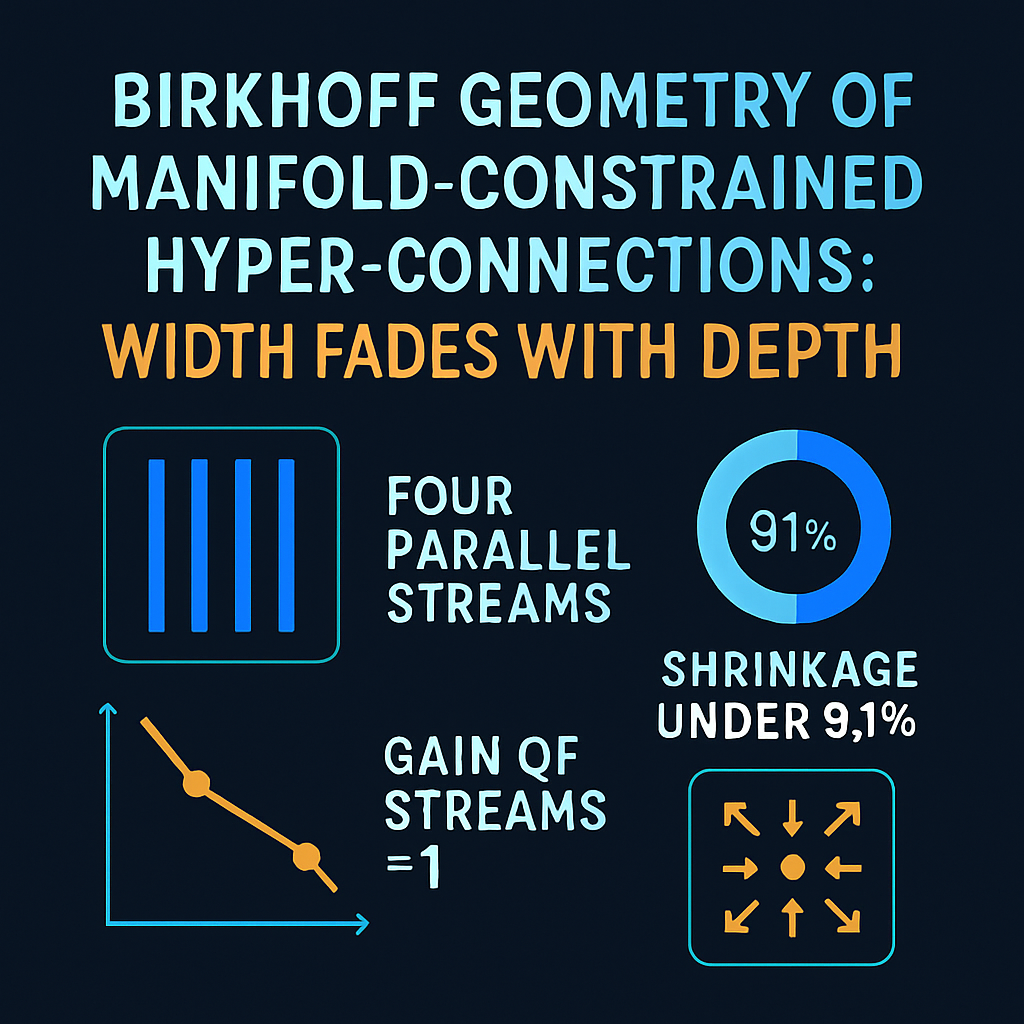
This episode examines a theory paper on manifold-constrained hyper-connections (mHC), which widen the residual stream into four parallel streams and force each layer's mixing matrix to be doubly stochastic using Sinkhorn normalization. It explains why the composite of many mixers looks nearly uniform, and why that suggests the extra width fades with depth. The key argument is that the average of the streams passes through with gain exactly one, like an ordinary residual network. All the added capacity sits in a "difference channel" that shrinks each layer by the mixer's second singular value. In the paper's worked example, which assumes a smallest entry of 0.02, that shrinkage compounds to under 0.091 over thirty layers. The episode also covers a rigidity result: only permutation matrices avoid this shrinkage. It then starts on the training dynamics, where backprop through Sinkhorn gives the Fisher-Rao gradient and permutation corners sit at infinity in logit space. Listeners get a clear account of what DeepSeek's extra width is worth, and of why such mixers become "sticky" near permutation matrices.
Interactive Visualization: Birkhoff Geometry of Manifold-Constrained Hyper-Connections: Width Fades With Depth
Sources:
1. The Birkhoff Geometry of Manifold-Constrained Hyper-Connections: Two Channels, Vertex Viscosity, and Sinkhorn as a Retraction — Xiaoyu Li, Zhizhou Sha, Chiwun Yang, 2026
http://arxiv.org/abs/2610.06653v1
2. Concerning Nonnegative Matrices and Doubly Stochastic Matrices — Richard Sinkhorn, Paul Knopp, 1967
https://scholar.google.com/scholar?q=Concerning+Nonnegative+Matrices+and+Doubly+Stochastic+Matrices
3. Sinkhorn Distances: Lightspeed Computation of Optimal Transport — Marco Cuturi, 2013
https://scholar.google.com/scholar?q=Sinkhorn+Distances%3A+Lightspeed+Computation+of+Optimal+Transport
4. Learning Latent Permutations with Gumbel-Sinkhorn Networks — Gonzalo Mena, David Belanger, Scott Linderman, Jasper Snoek, 2018
https://scholar.google.com/scholar?q=Learning+Latent+Permutations+with+Gumbel-Sinkhorn+Networks
5. mHC: Manifold-Constrained Hyper-Connections — Zhenda Xie et al. (DeepSeek-AI), 2026
https://scholar.google.com/scholar?q=mHC%3A+Manifold-Constrained+Hyper-Connections
6. Problem Complexity and Method Efficiency in Optimization — Arkadi Nemirovski, David Yudin, 1983
https://scholar.google.com/scholar?q=Problem+Complexity+and+Method+Efficiency+in+Optimization
7. Natural Gradient Works Efficiently in Learning — Shun-ichi Amari, 1998
https://scholar.google.com/scholar?q=Natural+Gradient+Works+Efficiently+in+Learning
8. Mirror Descent and Nonlinear Projected Subgradient Methods for Convex Optimization — Amir Beck, Marc Teboulle, 2003
https://scholar.google.com/scholar?q=Mirror+Descent+and+Nonlinear+Projected+Subgradient+Methods+for+Convex+Optimization
9. Mirror Descent Policy Optimization — Manan Tomar, Lior Shani, Yonathan Efroni, Mohammad Ghavamzadeh, 2020
https://scholar.google.com/scholar?q=Mirror+Descent+Policy+Optimization
10. Hyper-Connections — Defa Zhu et al., 2025
https://scholar.google.com/scholar?q=Hyper-Connections
11. mHC-lite: You don't need 20 Sinkhorn-Knopp iterations — Yongyi Yang, Jianyang Gao, 2026
https://scholar.google.com/scholar?q=mHC-lite%3A+You+don%27t+need+20+Sinkhorn-Knopp+iterations
12. Accelerating Birkhoff projection for manifold-constrained hyper-connections — Chenrui Wang, Yixuan Qiu, 2026
https://scholar.google.com/scholar?q=Accelerating+Birkhoff+projection+for+manifold-constrained+hyper-connections
13. oHC: Orthogonal hyper-connections on SO(4) via quaternions — Haoqiang Guo et al., 2026
https://scholar.google.com/scholar?q=oHC%3A+Orthogonal+hyper-connections+on+SO%284%29+via+quaternions
14. JPmHC: Dynamical isometry via orthogonal hyper-connections — Biswa Sengupta, Jinhua Wang, Leo Brunswic, 2026
https://scholar.google.com/scholar?q=JPmHC%3A+Dynamical+isometry+via+orthogonal+hyper-connections
15. Beyond the Birkhoff Polytope: Spectral-Sphere-Constrained Hyper-Connections — Zhaoyi Liu, Haichuan Zhang, Ang Li, 2026
https://scholar.google.com/scholar?q=Beyond+the+Birkhoff+Polytope%3A+Spectral-Sphere-Constrained+Hyper-Connections
16. How does mHC use its residual streams? Selective routing and near-identity mixing — Pengxiang Zhao et al., 2026
https://scholar.google.com/scholar?q=How+does+mHC+use+its+residual+streams%3F+Selective+routing+and+near-identity+mixing
17. Analyzing stream collapse in hyper-connections: From diagnosis to mitigation — Ekaterina Alimaskina, Gleb Molodtsov, Aleksandr Beznosikov, 2026
https://scholar.google.com/scholar?q=Analyzing+stream+collapse+in+hyper-connections%3A+From+diagnosis+to+mitigation
18. Ablate and rescue: A causal analysis of residual stream hyper-connections — William Peng et al., 2026
https://scholar.google.com/scholar?q=Ablate+and+rescue%3A+A+causal+analysis+of+residual+stream+hyper-connections
19. Manifold optimization over the set of doubly stochastic matrices: A second-order geometry — Ahmed Douik, Babak Hassibi, 2019
https://scholar.google.com/scholar?q=Manifold+optimization+over+the+set+of+doubly+stochastic+matrices%3A+A+second-order+geometry
20. Learning permutations with exponential weights (PermELearn) — David P. Helmbold, Manfred K. Warmuth, 2009
https://scholar.google.com/scholar?q=Learning+permutations+with+exponential+weights+%28PermELearn%29
21. On the global convergence rates of softmax policy gradient methods — Jincheng Mei, Chenjun Xiao, Csaba Szepesvari, Dale Schuurmans, 2020
https://scholar.google.com/scholar?q=On+the+global+convergence+rates+of+softmax+policy+gradient+methods
22. Softmax policy gradient methods can take exponential time to converge — Gen Li, Yuting Wei, Yuejie Chi, Yuxin Chen, 2023
https://scholar.google.com/scholar?q=Softmax+policy+gradient+methods+can+take+exponential+time+to+converge
23. The Sinkhorn-Knopp algorithm: convergence and applications — Philip A. Knight, 2008
https://scholar.google.com/scholar?q=The+Sinkhorn-Knopp+algorithm%3A+convergence+and+applications
24. Attention is not all you need: pure attention loses rank doubly exponentially with depth — Yihe Dong, Jean-Baptiste Cordonnier, Andreas Loukas, 2021
https://scholar.google.com/scholar?q=Attention+is+not+all+you+need%3A+pure+attention+loses+rank+doubly+exponentially+with+depth
25. Signal propagation in transformers: Theoretical perspectives and the role of rank collapse — Lorenzo Noci et al., 2022
https://scholar.google.com/scholar?q=Signal+propagation+in+transformers%3A+Theoretical+perspectives+and+the+role+of+rank+collapse
26. Resurrecting the sigmoid in deep learning through dynamical isometry — Jeffrey Pennington, Samuel Schoenholz, Surya Ganguli, 2017
https://scholar.google.com/scholar?q=Resurrecting+the+sigmoid+in+deep+learning+through+dynamical+isometry
Interactive Visualization: Birkhoff Geometry of Manifold-Constrained Hyper-Connections: Width Fades With Depth
1. The Birkhoff Geometry of Manifold-Constrained Hyper-Connections: Two Channels, Vertex Viscosity, and Sinkhorn as a Retraction — Xiaoyu Li, Zhizhou Sha, Chiwun Yang, 2026
http://arxiv.org/abs/2610.06653v1
2. Concerning Nonnegative Matrices and Doubly Stochastic Matrices — Richard Sinkhorn, Paul Knopp, 1967
https://scholar.google.com/scholar?q=Concerning+Nonnegative+Matrices+and+Doubly+Stochastic+Matrices
3. Sinkhorn Distances: Lightspeed Computation of Optimal Transport — Marco Cuturi, 2013
https://scholar.google.com/scholar?q=Sinkhorn+Distances%3A+Lightspeed+Computation+of+Optimal+Transport
4. Learning Latent Permutations with Gumbel-Sinkhorn Networks — Gonzalo Mena, David Belanger, Scott Linderman, Jasper Snoek, 2018
https://scholar.google.com/scholar?q=Learning+Latent+Permutations+with+Gumbel-Sinkhorn+Networks
5. mHC: Manifold-Constrained Hyper-Connections — Zhenda Xie et al. (DeepSeek-AI), 2026
https://scholar.google.com/scholar?q=mHC%3A+Manifold-Constrained+Hyper-Connections
6. Problem Complexity and Method Efficiency in Optimization — Arkadi Nemirovski, David Yudin, 1983
https://scholar.google.com/scholar?q=Problem+Complexity+and+Method+Efficiency+in+Optimization
7. Natural Gradient Works Efficiently in Learning — Shun-ichi Amari, 1998
https://scholar.google.com/scholar?q=Natural+Gradient+Works+Efficiently+in+Learning
8. Mirror Descent and Nonlinear Projected Subgradient Methods for Convex Optimization — Amir Beck, Marc Teboulle, 2003
https://scholar.google.com/scholar?q=Mirror+Descent+and+Nonlinear+Projected+Subgradient+Methods+for+Convex+Optimization
9. Mirror Descent Policy Optimization — Manan Tomar, Lior Shani, Yonathan Efroni, Mohammad Ghavamzadeh, 2020
https://scholar.google.com/scholar?q=Mirror+Descent+Policy+Optimization
10. Hyper-Connections — Defa Zhu et al., 2025
https://scholar.google.com/scholar?q=Hyper-Connections
11. mHC-lite: You don't need 20 Sinkhorn-Knopp iterations — Yongyi Yang, Jianyang Gao, 2026
https://scholar.google.com/scholar?q=mHC-lite%3A+You+don%27t+need+20+Sinkhorn-Knopp+iterations
12. Accelerating Birkhoff projection for manifold-constrained hyper-connections — Chenrui Wang, Yixuan Qiu, 2026
https://scholar.google.com/scholar?q=Accelerating+Birkhoff+projection+for+manifold-constrained+hyper-connections
13. oHC: Orthogonal hyper-connections on SO(4) via quaternions — Haoqiang Guo et al., 2026
https://scholar.google.com/scholar?q=oHC%3A+Orthogonal+hyper-connections+on+SO%284%29+via+quaternions
14. JPmHC: Dynamical isometry via orthogonal hyper-connections — Biswa Sengupta, Jinhua Wang, Leo Brunswic, 2026
https://scholar.google.com/scholar?q=JPmHC%3A+Dynamical+isometry+via+orthogonal+hyper-connections
15. Beyond the Birkhoff Polytope: Spectral-Sphere-Constrained Hyper-Connections — Zhaoyi Liu, Haichuan Zhang, Ang Li, 2026
https://scholar.google.com/scholar?q=Beyond+the+Birkhoff+Polytope%3A+Spectral-Sphere-Constrained+Hyper-Connections
16. How does mHC use its residual streams? Selective routing and near-identity mixing — Pengxiang Zhao et al., 2026
https://scholar.google.com/scholar?q=How+does+mHC+use+its+residual+streams%3F+Selective+routing+and+near-identity+mixing
17. Analyzing stream collapse in hyper-connections: From diagnosis to mitigation — Ekaterina Alimaskina, Gleb Molodtsov, Aleksandr Beznosikov, 2026
https://scholar.google.com/scholar?q=Analyzing+stream+collapse+in+hyper-connections%3A+From+diagnosis+to+mitigation
18. Ablate and rescue: A causal analysis of residual stream hyper-connections — William Peng et al., 2026
https://scholar.google.com/scholar?q=Ablate+and+rescue%3A+A+causal+analysis+of+residual+stream+hyper-connections
19. Manifold optimization over the set of doubly stochastic matrices: A second-order geometry — Ahmed Douik, Babak Hassibi, 2019
https://scholar.google.com/scholar?q=Manifold+optimization+over+the+set+of+doubly+stochastic+matrices%3A+A+second-order+geometry
20. Learning permutations with exponential weights (PermELearn) — David P. Helmbold, Manfred K. Warmuth, 2009
https://scholar.google.com/scholar?q=Learning+permutations+with+exponential+weights+%28PermELearn%29
21. On the global convergence rates of softmax policy gradient methods — Jincheng Mei, Chenjun Xiao, Csaba Szepesvari, Dale Schuurmans, 2020
https://scholar.google.com/scholar?q=On+the+global+convergence+rates+of+softmax+policy+gradient+methods
22. Softmax policy gradient methods can take exponential time to converge — Gen Li, Yuting Wei, Yuejie Chi, Yuxin Chen, 2023
https://scholar.google.com/scholar?q=Softmax+policy+gradient+methods+can+take+exponential+time+to+converge
23. The Sinkhorn-Knopp algorithm: convergence and applications — Philip A. Knight, 2008
https://scholar.google.com/scholar?q=The+Sinkhorn-Knopp+algorithm%3A+convergence+and+applications
24. Attention is not all you need: pure attention loses rank doubly exponentially with depth — Yihe Dong, Jean-Baptiste Cordonnier, Andreas Loukas, 2021
https://scholar.google.com/scholar?q=Attention+is+not+all+you+need%3A+pure+attention+loses+rank+doubly+exponentially+with+depth
25. Signal propagation in transformers: Theoretical perspectives and the role of rank collapse — Lorenzo Noci et al., 2022
https://scholar.google.com/scholar?q=Signal+propagation+in+transformers%3A+Theoretical+perspectives+and+the+role+of+rank+collapse
26. Resurrecting the sigmoid in deep learning through dynamical isometry — Jeffrey Pennington, Samuel Schoenholz, Surya Ganguli, 2017
https://scholar.google.com/scholar?q=Resurrecting+the+sigmoid+in+deep+learning+through+dynamical+isometry
Interactive Visualization: Birkhoff Geometry of Manifold-Constrained Hyper-Connections: Width Fades With Depth